

Aboriginal Australians want care after brain injury. But it must consider their cultural needs
- Written by: Beth Armstrong, Foundation Chair in Speech Pathology, Edith Cowan University
This article is the fourth part in a series, Where culture meets health.
Aboriginal Australians continue to face serious health challenges. Life expectancy is about 10.7 years less for Indigenous Australians than non-Indigenous Australians.
Brain injury occurs up to three times more often in Aboriginal Australians than their non-Aboriginal counterparts. It also commonly occurs at a younger age, and is more likely among Aboriginal people living in rural and remote areas.
Despite their greater need, Aboriginal people access rehabilitation services at a lower rate than the general population.
Barriers to accessing health services can be related to communication breakdowns, distance from facilities, and previous negative experiences with services.
Aboriginal people who have suffered brain injury are even more vulnerable to these barriers.
Read more: Explainer: what is traumatic brain injury?
Our research tells us the absence of Aboriginal people in rehabilitation services has often led largely non-Aboriginal practitioners to assume they don’t want therapy.
But based on our interviews with Aboriginal brain injury survivors in Western Australia, we’ve found they want more information and education about brain injury, and more practical support along their rehabilitation journey.
Culturally secure health care
The effects of colonisation, social exclusion, poverty and racism continue to impact many of our First Nations peoples today.
This is compounded by health services that may not have the tools to consistently recognise and respond to the cultural needs of Aboriginal people.
Aboriginal understandings of health and wellness, and how these understandings differ from Western biomedical models, need to be better reflected in practice.
The Aboriginal construct of health is a holistic model that perceives physical, psychological, spiritual, cultural, social, environmental and economic factors as affecting a person’s functioning.
Cultural security directly links understandings and actions. So providing culturally secure health care means all these factors are taken into account. Importantly, patients can practise their cultural norms and their care will not be compromised as a result.
For example, under certain circumstances, interactions may only be considered culturally secure when conducted between people of the same gender, language group, or when aligned with kinship rules. Hospital limitations on the number of family members visiting at one time may lead to feelings of exclusion and infringement on family rights.
Read more: Indigenous health programs require more than just good ideas
Our research
We spoke to Aboriginal people who had experienced brain injury as a result of a stroke, or a traumatic injury such as a car accident, assault, or fall.
Our participants spoke frequently about poor communication with non-Aboriginal hospital staff. Many felt staff did not understand or empathise with their situation and the centrality of family and culture in their lives. Some expressed feeling vulnerable, alone and diminished in the hospital environment.
Several people reported being unable to understand technical explanations they were given regarding stroke, its treatment and recovery. Many Aboriginal stroke patients and families felt they received very little practical information about services available to them once they left hospital.
Read more: Words from Arnhem land: Aboriginal health messages need to be made with us rather than for us
We also interviewed non-Aboriginal health service providers. They reported not feeling confident working with Aboriginal patients and families.
Reasons for this included a lack of skills in positively engaging and communicating with Aboriginal people, a fear of offending, and recognition that their largely Western knowledge base may not be appropriate when delivering medical care to Aboriginal patients.
We need Aboriginal service providers on the ground
The first point of contact after a brain injury is critical in determining the person’s ongoing rehabilitation journey. If information and support are made accessible from the outset, and cultural security guaranteed, follow-up and two-way engagement will be more likely.
In our studies, patients often talked about feeling more comfortable with another Aboriginal person. Someone who understands their personal context including family, culture and community is uniquely placed to assist with the person’s journey to recovery.
As a result of our findings, the National Health and Medical Research Council funded Healing Right Way, a project across Western Australia to improve the journey after brain injury for Aboriginal people and their families.
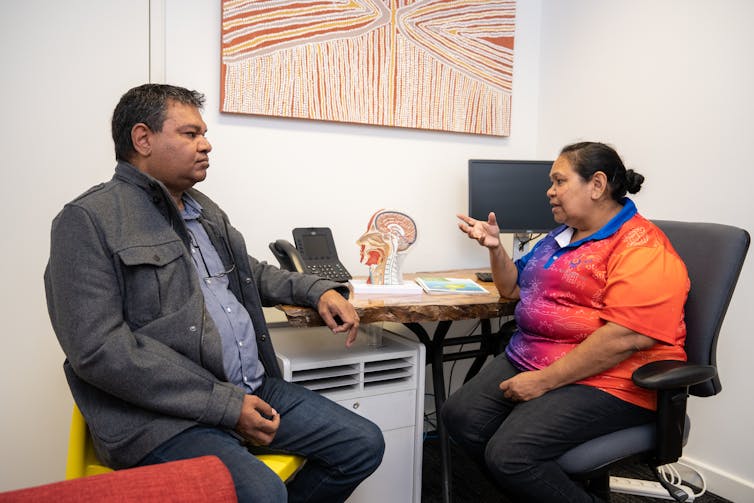 Aboriginal Brain Injury Coordinators provide education around brain injury and support patients during rehabilitation and recovery.
Edith Cowan University, Author provided
Aboriginal Brain Injury Coordinators provide education around brain injury and support patients during rehabilitation and recovery.
Edith Cowan University, Author provided
Healing Right Way will employ eight Aboriginal Brain Injury Coordinators to support Aboriginal people for the first six months following their injury. These are the first such positions in Australia.
Typically nurses, the coordinators meet the patient and their family in hospital immediately after injury. They provide education around brain injury and subsequent rehabilitation and recovery, as well as psychological support.
They also liaise with other services and care providers such as GPs, specialists, and Aboriginal Community Controlled Health Services.
Read more: Indigenous health leaders helped give us a plan to close the gap, and we must back it
Meanwhile, the project is providing training for hospital staff to enhance their skills and knowledge in delivering culturally secure care for Aboriginal people with brain injury.
There are success stories
Our research has revealed stories of “successfully” living with brain injury.
One man who suffered a severe stroke looked to family and community groups to support his recovery. He resumed painting, travelling, and socialising over time, despite being partially paralysed and having virtually no speech. This was enabled by a strong will and help from his sister who organised taxi vouchers, train trips and other supports.
These stories provide a rich basis from which to explore alternative possibilities in the rehabilitation process. Learning from Aboriginal brain injury survivors about how to re-engage with community and return to regular activities offers insights that can be shared with brain injury survivors in the future, and, importantly, with rehabilitation service providers.
Read more: The art of healing: five medicinal plants used by Aboriginal Australians
The issues raised for Aboriginal people with brain injury are mirrored in First Nations people with a range of other conditions.
While examples of individual clinicians attempting to provide culturally secure services were evident in our research, system-wide practices doing the same were rare.
To build a more culturally secure approach for Aboriginal patients recovering from brain injury, there needs to be acknowledgement of patient experiences alongside a system willing to implement change.
The involvement and leadership of Aboriginal researchers, health professionals and consumers is essential.
Authors: Beth Armstrong, Foundation Chair in Speech Pathology, Edith Cowan University


 Daily Bulletin


