

Some of our foods have nano particles in them – should we be worried?
- Written by: Emma Beckett, Lecturer (Food Science and Human Nutrition), School of Environmental and Life Sciences, University of Newcastle
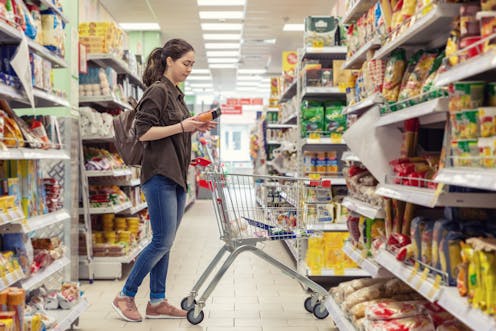
We choose to spend money on household items based on how they look, feel and taste, and how we think they might make our lives better.
Manufacturers apply nanotechnology – a field of technology that makes use of effects that happen at the nanoscale – to create the properties we want in such items. For example, whiteness in toothpaste, or preventing growth of bacteria in socks.
One nanometre is one billionth of a metre. Chemical and physical interactions at the nanoscale are way smaller than our eyes can see. Medicines, tiny sensors, fast computers and food science are all ways we can put nanotechnology to use.
Read more: Why nanotechnology is more than just a buzzword
But some people are concerned nanoparticles may present health risks. Recently France announced one nanoscale food additive will be banned from 2020 due to a lack of evidence about its safety.
Here’s what we know about nanotechnology in food.
What are nanoparticles?
Nanoparticles are extremely tiny particles. Their external dimensions are smaller than 100 nanometres, or 0.0001 of a millimetre. That’s pretty small!
Not all nanoparticles are the same. The can be made of all kinds of different things – metals like silver and gold, carbon or even clay – and can have different structures and chemistry. These properties ultimately determine how the nanoparticles behave, their functions and whether or not they are safe.
Nanoparticles occur naturally, and can also be manufactured. Naturally occurring nanoparticles can be found in ash, waterways, fine sand and dust, and even biological matter like viruses. When used in medicine, technology or science, nanoparticles are typically manufactured to better control their properties.
The benefits of nanoparticles come from their extremely small sizes. For example, materials can be made stronger, lighter or better electrical conductors. In medicine, nanoparticles can be manufactured to get into difficult-to-reach places in the body. This is useful in the treatment or diagnosis of diseases such as cancer and infections.
But sometimes nanoparticles which you did not intend to ingest get into the body, or small amounts are consumed in products. This leaves some people asking how we know they are safe.
Read more: A guide to the nanotechnology used in the average home
Nanoparticles occur naturally in foods
Firstly, nanoparticles in foods are not new. Nano-sized particles occur naturally in some foods: a good example is milk. Casein micelles in milk are nano-sized spheres made of proteins. By naturally coming together this way, the nutrients in the micelles are more available for us to absorb.
In addition to milk, it is also possible for some food ingredients to naturally assemble into nanoparticle sized units such as micelles. During digestion, our bodies use the bile that comes from our gall bladder to “nanofabricate” the fats we eat into micelles so we can absorb them.
Micelles also allow fats to be mixed more effectively into water – we create micelles when we wash the dishes using detergents.
Nanoparticles can be created during food processing – such as in homogenisation and emulsification, and milling and grinding. They are also shed from metallic cutlery and other cooking instruments over time.
Nanoparticles are in some additives
Common additives like titanium dioxide, a whitening agent, and silicon dioxide, an anticaking agent, can contain nanoparticles. This is because they are added as powders, and some of the powder particles will be nano-sized. These ingredients only make up a small percentage of foods and only a small fraction of them are actually nano-sized.
Titanium dioxide recently made headlines because a study showed it had an effect on bacteria in the guts of mice. This sounds scary, but the effects were seen when mice were given a big dose (about 50mg per kilogram of body weight each day). This is 50 to 25 times the estimated exposure in humans. It was also added to their drinking water, so there was no food around for the particles to bind with through digestion (as is the case when we eat products with nanoparticles in them).
Two reviews commissioned by Food Standards Australia New Zealand in 2015 found current evidence that nanoparticles of titanium dioxide and silicon dioxide are not absorbed better than micro-sized particles (particles a thousand times the size) and that the majority is excreted.
New uses are being explored
Researchers are looking at how nanoparticles might bring new benefits to food. For example, adding nutrients into foods could help us provide better nutrition from processed foods, slow the breakdown of nutrients and help nutrients be absorbed better.
Nano-sized salt and sugar could help make foods healthier. The smaller the particles, the quicker and more easily they can access your taste buds on your tongue, so the less we might need to eat to get that sweet or salty hit. Similarly, using nanoparticles can mean lower levels of additives by helping them mix more easily through products.
Nanoparticles might also be able to extend shelf life, improve safety of foods, and reducing the need for added fats. Testing for toxicity will be an important part of bringing these new technologies to market.
Read more: Nanotechnology could make our food tastier and healthier – but can we stomach it?
But all in all, we have been eating nanoparticles – naturally occurring and in additives – for a long time with no evidence of harm.
Authors: Emma Beckett, Lecturer (Food Science and Human Nutrition), School of Environmental and Life Sciences, University of Newcastle
Read more http://theconversation.com/some-of-our-foods-have-nano-particles-in-them-should-we-be-worried-117193


 Daily Bulletin


