

odds on for a Labor win, but don't bet on it
- Written by: Chris Aulich, Adjunct Professor at the University of Canberra, University of Canberra
Our “state of the states” series takes stock of the key issues, seats and policies affecting the vote in each of Australia’s states.
We’ll check in with our expert political analysts around the country every week of the campaign for updates on how it is playing out.
Victoria
Nick Economou, Senior Lecturer in the School of Political and Social Inquiry at Monash University
As polling day looms, Newspoll has finally provided a poll of voting intentions broken down by state.
The poll finds a two-party vote for Labor in Victoria of 54% – a 2.2% swing. If this is correct, and if the swing was uniform, Labor would only gain Corangamite (which needs a 0.03% swing to change). It would also retain Dunkley, which was made notionally Labor by the redistribution. This would leave Labor well short of its expectations of also picking up Chisholm (2.9%), La Trobe (3.2%), Deakin (6.4%) and maybe Flinders (7%).
The poll also indicates a fall in support for the Greens from the 13.1% it polled at the 2016 election down to 9%. Not only would the Greens fail to win a Senate seat if Labor persists with advising its supporters to preference the Derryn Hinch Justice Party, but Adam Bandt might face a battle to hold on to his seat of Melbourne.
Meanwhile, the poll’s finding of 36% primary support for the Liberal-Nationals might not be enough to secure three Senate seats. If this is the case, Clive Palmer’s United Australia Party would win a seat if LNP voters followed the how-to-vote card.
These data are at odds with anecdotal reports from those campaigning on the ground. Those reports suggest a different narrative, in which Labor sweeps through the aforementioned marginal Liberal seats, the Greens hold Melbourne and are competitive in Higgins and Kooyong, and independents win Indi and Mallee.
This looks like a case of science versus gut feeling, but it should be remembered that opinion polling indicated that the recent Victorian state election would also be a close affair. In fact, the result was a Labor landslide, and previously safe Liberal state seats like Hawthorn, Bass and Nepean were lost.
It is also worth remembering that a two party vote of 54% represents a significant outcome that mathematically ought to result in Labor winning 61% (that is, 23 out of a possible 38) of the seats in Victoria. That would represent a gain of five seats.
Queensland
Maxine Newlands, Senior Lecturer in Political Science at James Cook University
The pivotal factors influencing Labor’s fate in Queensland are preference deals, pre-polling and Labor’s support for Adani.
Newspoll currently has Queensland on a 50-50 tie (it was 54.1-45.9 to the Coalition in 2016). This means marginal seats will be vital in deciding the nation’s balance of power. Of the 30 Queensland seats, there’s 11 with a swing of less than 4% – Bonner, Capricornia, Dawson, Dickson, Flynn, Forde, Griffith, Herbert, Leichhardt, Longman and Petrie. Herbert is the tightest with a 0.02% margin.
It took Labor 20 years to wrestle Herbert from the Liberal heartland of North Queensland, but any chance of the party benefiting from a sophomore surge seems slim. The Coalition’s preference deal with Clive Palmer’s United Australia Party (UAP), and incumbent Labor’s Cathy O’Toole’s public support for the Adani mine, have been tipping points of the 2019 campaign.
Polls have put the Coalition up on primary votes between 2% and 4% since the second week of the campaign. Add in the higher-than-2016 pre-polling numbers and big cash promises early in the race, and it’s likely that Herbert will turn blue after preferences.
Redistribution means more Herbert voters have moved into Dawson. Dawson’s margin of 3.4%, and a strong Labor showing, could swing it away from Nationals incumbent George Christensen in Labor’s favour. Keep an eye on independent candidate, Lachlan Queenan, who could be a surprise challenger.
In Dickson, Dutton’s final week of the campaign ended as badly as the first. Former Labor PM Paul Keating encouraged voters to:
drive a political stake through [Dutton’s] dark political heart.
The Dickson incumbent has been relatively quiet, making one media appearance in the marginal seat of Herbert. If Dutton loses, it will be more than a high profile scalp, it will signal a dramatic shift in the political landscape.
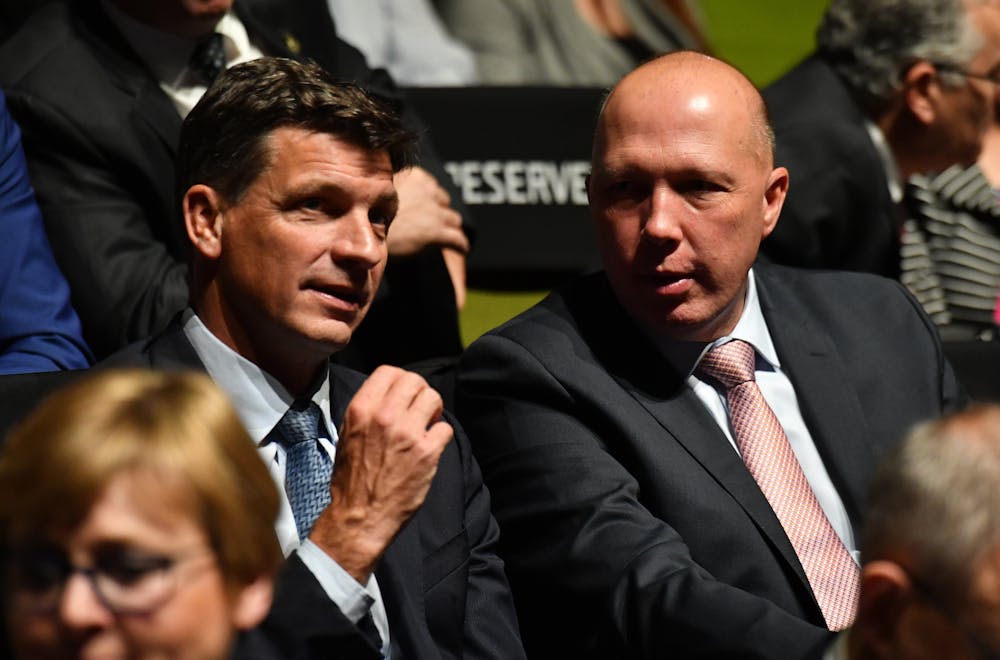 Peter Dutton has been keeping a low profile. He’s pictured here with Angus Taylor at the Liberal Party campaign launch in Melbourne on Sunday.
Mick Tsikas/AAP
Peter Dutton has been keeping a low profile. He’s pictured here with Angus Taylor at the Liberal Party campaign launch in Melbourne on Sunday.
Mick Tsikas/AAP
New South Wales
Chris Aulich, Adjunct Professor at the University of Canberra
Traditionally we rely on polls to gauge how the parties are faring, whether they are the big sample polls like Essential, Ipsos or Newspoll, or party-initiated polls and focus groups. These polls map voting intentions, and these may or may not be accurate, because people do change their minds when confronted by a real ballot paper. Polls also rely on small samples, which can be unreliable when extrapolated to the electorate at large or even the country as a whole.
There is growing interest in betting markets as an additional indicator of election results. These markets are likely to factor in polls, insider information and local knowledge. They also reflect willingness of punters to “put money where their mouth is”.
The betting market puts the chance of a Labor victory at about 77% nationally, giving them 82 seats to the Coalition’s 62. Of interest are the odds at electorate level. As of May 16, the following odds are being offered in crucial NSW seats by one of the larger betting firms:
If the punters prove correct, the Coalition would pick up two seats in NSW (one from Labor, and one from an independent), but lose two to independents and three to Labor (the seat of Farrer is too close to call).
Since the Coalition began the campaign with a notional 73 seats, needing 76 for government, a net loss of seats in NSW would land the Coalition with the very difficult task of making up those losses in other states and territories.
With Labor leading the national polls by 51-49% on a two-party preferred basis, the alignment of polls and the betting market predict a Labor win. But, don’t bet on it.
Read more: Compare the pair: key policy offerings from Labor and the Coalition in the 2019 federal election
Western Australia
Ian Cook, Senior Lecturer of Australian Politics at Murdoch University
Just when we were thinking Julie Bishop was going to spend the whole of the campaign providing low key support for “moderate” candidates in Western Australia, she moved front and centre of the election campaign this week.
First, to many people’s surprise, she joined Scott Morrison at the WA launch of the Liberal Party’s campaign last weekend. Then, during a business breakfast at Perth’s Crown Towers, Bill Shorten said that she was a talent he didn’t want to waste and that she’d probably be offered the job of Australia’s Ambassador to the US if he wins the election.
Shorten, like everybody else, is aware of Julie Bishop’s popularity in WA, and knew that publicly recognising this while he was in WA would be a good move for winning over voters here.
But it was also a reminder of Bishop’s struggle for recognition within the Liberal Party, which culminated in her getting little support (including no support from WA powerbroker Mathias Cormann) when she put her name forward for leader during Peter Dutton’s attempt to take over as PM from Malcolm Turnbull.
She made her feelings clear about what happened during the transition to a Morrison government in an interview with the Sunday Times a couple of weeks ago. She said she could have beaten Shorten, and that she was white-anted in her bid to replace Turnbull as PM.
But she continued to deny rumours that she had backed a difference candidate from the Conservative Christian who was pre-selected to run in Curtin, and that she had lost to Cormann in a power struggle over the seat.
While we are on the subject of women and the election in WA, Pauline Hanson came over to help her party’s One Nation candidates. It didn’t go so well, though. Her visit to an early polling station began with her getting some stick from voters. This was followed by a confrontation with Anne Aly (Labor’s candidate for the very marginal seat of Cowan) in which Hanson complained about Aly talking to the media after she and Hanson had lunch… three years ago.
Perceptive readers might have noticed that Morrison and Shorten were in WA again this week. Hopefully, West Australians enjoyed the attention while it lasted. It will likely be a long time before the major parties are this interested in winning seats in the state.
South Australia
Rob Manwaring, Senior Lecturer in Politics and Public Policy at Flinders University
Has South Australia become less “interesting” in the campaign? According to the election pendulum, there is only really one significant marginal seat in the state – Boothby (Liberal-held on a nominal margin of 2.7%).
Current incumbent Nicolle Flint is seeing off a challenge from Labor’s Nadia Clancy. Yet, a poll published this week in The Advertiser points to the Liberals holding the seat with a two-party preferred vote of 53-47. What was particularly striking is that Flint has a strong primary vote of 47%, compared to Clancy’s 37%.
There could be two countervailing trends at play here. On the one hand, interesting data to emerge from the ABC’s Vote Compass identified Boothby as the most “left-leaning” seat currently held by the Liberals. The conservative-minded Flint might then seem an unlikely fit for the seat, and as a public supporter of Peter Dutton, may have expected electoral backlash. But Flint could be benefiting from the “sophomore surge”, where first term incumbents often get a boost at the subsequent election.
Interestingly, one betting agency has Flint on $1.15 to hold the seat, and Labor at $2.45. This “surge” effect would mirror the position of Labor’s Amanda Rishworth in the seat of Kingston, who has shifted what was a marginal seat into a safe Labor one.
Both the major party leaders have been in South Australia this week, and inevitably both went to Boothby. Morrison was keen to flag infrastructure as a key selling point, and benefit to the state. Shorten used his visit to highlight climate change, and opposition climate change spokesman Mark Butler argued that it was an issue of growing electoral importance, with voters frustrated by the Coalition’s inaction.
The overall result of the election could have interesting implications for SA’s overall representation at cabinet-level. In a podcast featuring the outgoing Labor MP for Adelaide Kate Ellis sparring with Liberal Christopher Pyne (seat of Sturt), Ellis made a shrewd insight. She argued that if the Morrison government wins, SA is only likely to have one cabinet member, whereas if Labor wins then there is likely to be four – led by “big hitter” Penny Wong. For South Australians on polling day, the real interest will be the eventual makeup of the Senate.
Tasmania
Lachlan Johnson, PhD Candidate in Politics and International Relations and Research Assistant at the Institute for the Study of Social Change at the University of Tasmania
Michael Lester, researcher and PhD student at the Institute for the Study of Social Change
Tasmania has 44 candidates standing for the Senate on Saturday. Of those, the Liberals and Labor are all but guaranteed two seats. Barring a major shock, the Greens’ Nick McKim should be returned. Interest lies in what happens with the sixth seat as, even with preference deals, Tasmanian voters can be unpredictable.
One reason for this is that more people vote below the line in Tasmania than in any other state or territory. In the five elections to 2013, on average just 83% of Tasmanians voted above the line compared to 93.4% for all of Australia. After the introduction of partial preferential voting for the 2016 election, the above-the-line vote in Tasmania fell to 71.88%.
Tasmania’s high below-the-line voting rate can be partly attributed to low numbers of candidates compared with other states, as well as voters’ experience with the electoral system used in Senate polls. Tasmania has used a largely similar quota-preferential system (Hare-Clark) in its legislative assembly elections since 1909, which explains voters’ greater familiarity with below-the-line Senate voting in federal elections.
What makes this election intriguing is the range of interesting possibilities for the sixth seat. An unusually high proportion of independent and third-party senators up for reelection, following 2016’s double dissolution, further adds to the importance of the Senate race in all states as the major parties fight to recapture ground from the 45th parliament’s historically large (and unstable) crossbench.
Colourful former Senator Jacqui Lambie is trying to reclaim her seat from former standing partner-turned Nationals Senator Steve Martin, who replaced her following the High Court decision on the citizenship imbroglio.
Maverick north-west fisherman Craig Garland, who got a strong vote in last year’s Braddon byelection on a campaign to protect state fisheries, is getting plenty of attention after teaming up with independent Andrew Wilkie to broaden his appeal in the state’s south.
Then there’s Labor Senator Lisa Singh. In 2016, Singh was dropped to the supposedly “unwinnable” sixth position in the Labor team, but ran a successful below the line campaign to beat her fifth position rival, union secretary John Short.
Based on past results, the most likely outcome is two Labor, two Liberal, one Green and Jacqui Lambie, according to election analyst Kevin Bonham.
But nothing is certain. As Bonham notes, the populist non-major-party vote is incredibly crowded in Tasmania, with Pauline Hanson’s One Nation and the big spending United Australia Party also prominent in the campaign.
Authors: Chris Aulich, Adjunct Professor at the University of Canberra, University of Canberra
Read more http://theconversation.com/state-of-the-states-odds-on-for-a-labor-win-but-dont-bet-on-it-117189


 Daily Bulletin


