

Racism alleged as Indigenous children taken from families
- Written by: Dominic O'Sullivan, Associate Professor of Political Science, Charles Sturt University
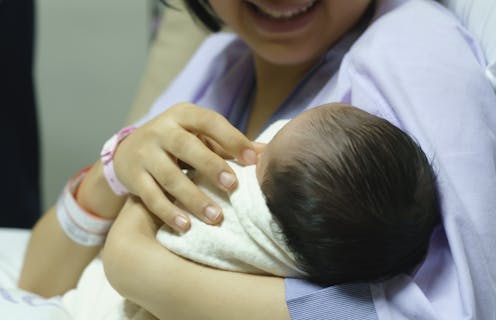
The New Zealand state tried to remove a newborn Māori baby from his family last week.
This is not unusual. Indeed, it is an increasingly frequent occurrence. Between 2015 and 2018, the number of Māori babies removed by the state increased by 33%. In 2018, the removal rate was 102 per 10,000 Māori births, compared to 24 per 10,000 births for the rest of the population.
Investigative journalism, intervention by the midwives’ professional association, Māori health advocates and the child’s iwi (tribe), Ngāti Kahungunu, brought this representative story to light.
Read more: Why children in institutional care may be worse off now than they were in the 19th century
The state knows best
The baby boy was, on the strength of limited evidence, a “high risk” child. His parents were allegedly afflicted by domestic violence, poor parenting skills and transient housing arrangements. These allegations had not been heard by a court, and it appears his wider family and midwives had already arranged supported accommodation for him and his mother. Plans seemed to be in place to mitigate whatever risks he may have faced.
Yet the state, which is already the subject of a royal commission of inquiry into the abuse of children in its care, was insistent. It could do better. Its child welfare agency, Oranga Tamariki – Ministry for Children, is under deep scrutiny for racist social work practices. But it insisted it knew what to do.
The police, hospital staff and Ngāti Kahungunu negotiated for the family’s own arrangements to prevail, at least until a substantive court hearing. The important moral and political principle is that the family, except when it is demonstrably and irreparably dysfunctional, is prior to the state.
Māori experience is not unique
Children in state care do not routinely fare better than others. As chief district court judge Jan-Marie Doogue commented in 2018, placing children in care signficantly increases their risk of a life of crime.
The well-being of vulnerable Māori children does then depend on the willingness and capacity of iwi like Ngāti Kahungunu to fulfil its promise to “intervene [against the state] at all costs”. The capacity to intervene with stable, sustainable and effective care arrangements is a matter of both child safety and cultural integrity.
The Māori experience is not unique. Indigenous children in Australia and Canada were routinely removed from their families under policies of genocidal intent until the mid-20th century. New Zealand pursued policies with more subtle assimilationist objectives. However, all three countries retain policies and practices that make it difficult for Indigenous people, iwi or first nations to intervene in support of families in difficulty.
As the New Zealand Children’s Commissioner Andrew Becroft notes:
The argument put to an Australian House of Representatives select committee by the Indigenous Australian lobby group Grandmothers Against Removals is representative. The group says that:
States have a responsibility to actively undo the harm they have perpetrated and continue to perpetrate.
With reference to the 2008 parliamentary apology to Australia’s Stolen Generations, Grandmothers Against Removals note that “sorry means you don’t do it again”.
State care needs reform internationally
In Australia, there is compelling evidence that the “care system is producing criminals”. Indeed, half the people in youth detention centres in Victoria have come from the child protection system.
Read more: The faulty child welfare system is the real issue behind our youth justice crisis
The Canadian Truth and Reconciliation Commission made recommendations to mitigate the risks of state care for Indigenous children. But for the First Nations Child and Family Caring Society of Canada child welfare remains “an agent of colonialism”. Outcomes for Indigenous children are rarely positive. In a jurisdiction where Indigenous children comprise 7.7% of children under 4, but represent 50% of those in state care, there is an urgent imperative for the state to support First Nations’ families and institutions to do the job of caring for children more effectively and respectfully than the state can.
Such is the depth of Indigenous concern internationally that the 1993 Draft Declaration on the Rights of Indigenous Peoples contained protections against “the removal of indigenous children from their families and communities under any pretext”.
States were opposed to the strength of this provision. The final declaration, which New Zealand, Australia and Canada voted against when it was adopted in 2007 but have since accepted as “aspirational”, made the less blunt but nevertheless clear statement (in article 7, section 2) that:
Indigenous peoples have the collective right to live in freedom, peace and security as distinct peoples and shall not be subjected to any act of genocide or any other act of violence, including forcibly removing children of the group to another group.
Indigenous rights and child welfare
The declaration thus provides an international moral authority to Indigenous arguments against legislation, such as in New South Wales, to accelerate the adoption of children in state care.
Read more: Why controversial child protection reforms in NSW could lead to another Stolen Generation
In 1997, the inquiry into the separation of Aboriginal and Torres Strait Islander children from their families recommended adoption as a last resort. The New South Wales legislation sets aside that principle and from widespread Indigenous perspectives establishes “a dangerous path to risking lives and tearing families apart”.
In 2019, the New Zealand government announced it was developing a declaration plan to help address “indigenous rights and interests”. The minister for Māori development, Nanaia Mahuta, has promoted this initiative at the United Nations.
New Zealand has a well-developed understanding of what is needed to address Māori rights and interests in child welfare, but, as the present case shows, the nation lacks the political will and institutional capacity to follow the values set out by Oranga Tamariki itself.
We respect the mana [status, power] of people. We listen, we don’t assume, and we create solutions with others.
We value whakapapa [ancestry and family relationships] - tamariki [children] are part of a whānau [family] and a community.
Child protection is complex. But there is widespread doubt that under its current leadership and legislative arrangements, Oranga Tamariki has the capacity to develop professional practices grounded in its own values.
Legislation to take effect on July 1 is intended to strengthen the obligation on Oranga Tamariki to develop relationships that involve iwi and other Māori organisations in decision-making and to recognise more respectfully, and according to established Māori values and practices, a child’s wider family, not just the parents, in care arrangements.
Developing a respectful organisational capacity, in the context of broader rights to culture and self-determination, is a pressing moral issue.
Authors: Dominic O'Sullivan, Associate Professor of Political Science, Charles Sturt University


 Daily Bulletin


