

Eighteen countries showing the way to carbon zero
- Written by: Pep Canadell, CSIRO Oceans and Atmosphere; Executive Director, Global Carbon Project, CSIRO
Eighteen countries from developed economies have had declining carbon dioxide emissions from fossil fuels for at least a decade. While every nation is unique, they share some common themes that can show Australia, and the world, a viable path to reducing emissions.
Global CO₂ emissions from fossil fuels continue to increase, with record high emissions in 2018 and further growth anticipated for 2019. This trend is linked to global economic growth, which is largely still powered by the burning of fossil fuels.
Read more: Australia is counting on cooking the books to meet its climate targets
Significant reductions in the energy and carbon intensities of the global economy have not been sufficient to trigger decreases in global emissions.
But 18 countries have been doing something different. A new analysis sheds light on how they have changed their emission trajectories. There is no “silver bullet”, and every country has unique characteristics, but three elements emerge from the group: a high penetration of renewable energy in the electricity sector, a decline in energy use, and a high number of energy and climate policies in place. Something is working for these countries.
Australia was not part of the study, as its CO₂ emissions from the burning of fossil fuels remained largely stable over the study period 2005-2015 while the country’s economy grew. However, emissions of all greenhouse gases across all sectors of the economy (including land use change) declined over most of the same period, a trend that reversed in 2014 since when emissions have increased.
Why did emissions decline?
The 18 countries shown below all peaked their fossil fuel emissions no later than 2005 and had significant declines thereafter to 2015, the period covered by our study.
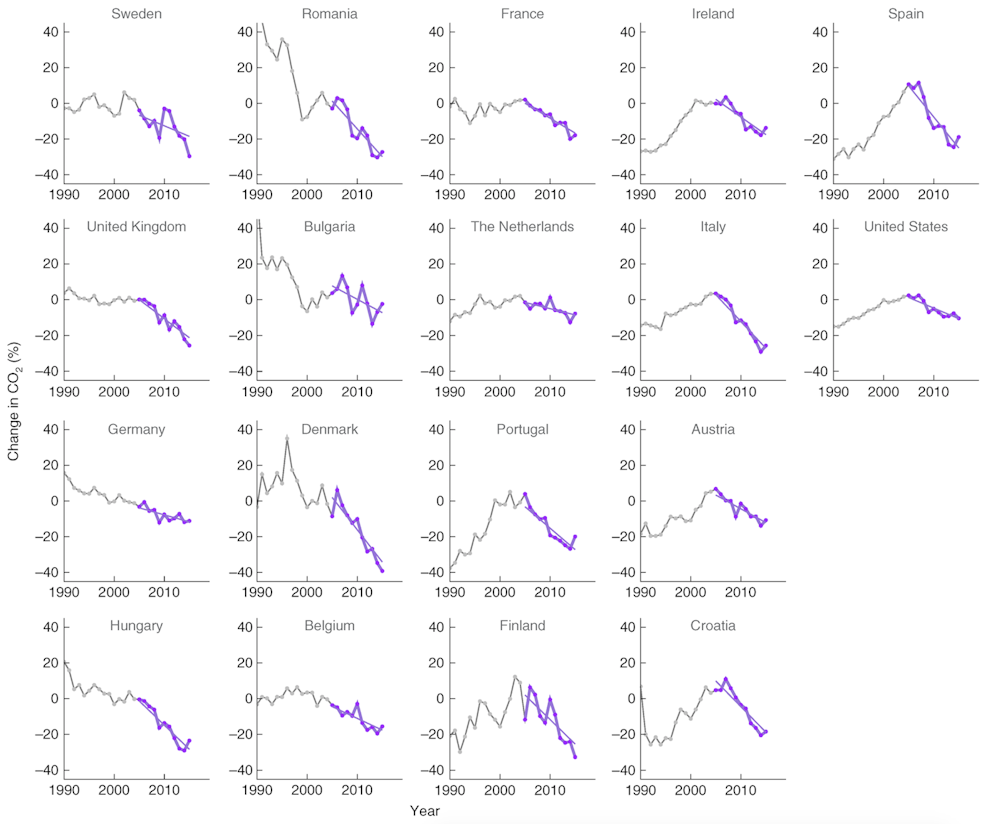 Changes in CO2 emissions from fossil fuel combustion for 18 countries with declining emissions during 2005-2015. Countries are ordered by how soon their emissions peaked and began to decline.
Le Quéré et al. Nature Climate Change (2019) based on data from the International Energy Agency @IEA/OECD
Changes in CO2 emissions from fossil fuel combustion for 18 countries with declining emissions during 2005-2015. Countries are ordered by how soon their emissions peaked and began to decline.
Le Quéré et al. Nature Climate Change (2019) based on data from the International Energy Agency @IEA/OECD
Uniformly, the largest contribution to emissions reductions – about 47% – was due to decreases in the fossil share of energy production, while reductions in overall energy use contributed 36%.
However, there are large differences in the relative importance of the factors that drove emissions reductions in the various countries. For instance, reduced energy use dominated emissions reductions in many countries of the European Union, whereas a more balanced spread of factors dominated in the United States, with the single largest contributor being the switch from coal to gas. Emissions reductions in Austria, Finland and Sweden were due to an increased share of non-fossil and renewable energy.
Interestingly, our analyses suggest that there is a correlation between the number of policies to promote the uptake of renewable energy and the decline in the 18 countries.
The declining emissions were not caused by the consumption of products produced elsewhere during the period examined. Earlier in the 2000s, this practice of outsourcing emissions to other countries (for example by moving manufacturing offshore) was a significant driver of emissions decline in many developed countries. But that effect has diminished.
The lasting consequences of the 2008 global financial crisis on the global economy however did have an impact, and partially explained the reduced energy use in many countries.
How significant are these emissions declines?
Emissions declined by 2.4% per year during 2005-15 across the 18 countries.
One could argue this decline is not particularly meaningful because global fossil fuel emissions continued to grow at 2.2% per year during the same period. However, this group of countries is responsible for 28% of the global CO₂ emissions from fossil fuels. That is a sizeable fraction, and if the decline continues and further intensifies it can have a significant impact.
The 18 peak-and-decline countries also played a part in the stalling of global emissions between 2014 and 2016 while the global economy continued to grow, a combination that showed, briefly and for the first time, what accelerated decarbonisation would look like. While China did not have 10 years of continuous declining emissions (and hence it was not part of the group of 18 countries), it was the biggest contributor during this stalling.
There is no guarantee that the declining trends will continue over the coming decades. In fact, our global 2018 carbon budget report showed that some of the more recent country trends are fragile and require further policy and actions to strengthen the decreases and support long-term robust decarbonisation trends.
Read more: Carbon emissions will reach 37 billion tonnes in 2018, a record high
If a journey of a thousand miles begins with a single step, it seems some countries have already begun walking that road. Now we all need to start running decisively.
Authors: Pep Canadell, CSIRO Oceans and Atmosphere; Executive Director, Global Carbon Project, CSIRO
Read more http://theconversation.com/eighteen-countries-showing-the-way-to-carbon-zero-112295


 Daily Bulletin


