

Super-recognisers accurately pick out a face in a crowd – but can this skill be taught?
- Written by: Alice Towler, Post-doctoral Research Fellow, UNSW
Yenny is 26 years old, lives in Melbourne, and has a very specific talent.
One day, she was driving her car when she recognised a man who had been several years below her at high school and whom she hadn’t seen for more than ten years. What makes this particularly impressive is that she recognised him from the briefest glimpse in her rear-view mirror while he was driving the car behind hers.
Yenny recounts many such amazing feats of recognition and is one of a very small proportion of the population known as “super-recognisers”. She was the top performer on a national test of face recognition abilities in Australia, coming first out of 20,000 participants.
Read more: Combining the facial recognition decisions of humans and computers can prevent costly mistakes
Could you learn to spot a face as well as Yenny? Well … maybe. Our new research shows that many training courses offered in this field of expertise are ineffective in improving people’s accuracy in face identification.
But other ways of learning how to identify faces may work; we’re just not yet sure exactly how.
In-demand expertise
Super-recognisers are used by police and security agencies to spot targets in crowded train stations, monitor surveillance footage, and track people of interest.
During the 2011 London riots, for example, super-recognisers from the Metropolitan Police identified more than 600 people from very poor-quality surveillance footage – a task that not even the best facial recognition software can perform reliably.
So can anyone become a super-recogniser? Can you make up for a lack of superpowers through training? In our paper we assessed the effectiveness of training courses given to practitioners who make facial identification decisions for a living.
We reviewed 11 training courses that comply with international training standards from Australia, UK, US and Finland.
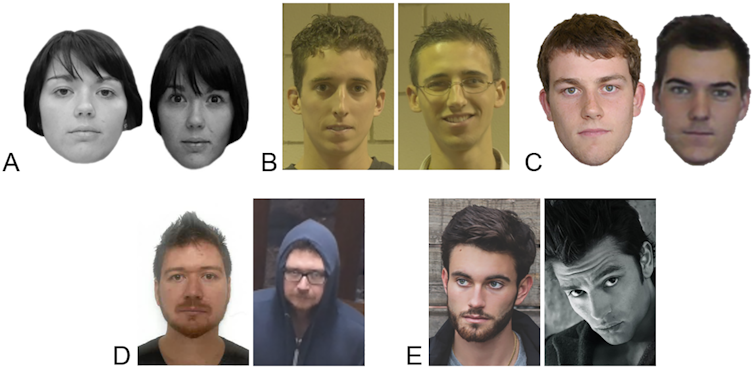 Sample test of face recognition: are the side-by-side images of the same, or different people? Answers can be found in the paper acknowledgements (click on journal link).
Towler and colleagues, PLOS ONE, CC BY
Sample test of face recognition: are the side-by-side images of the same, or different people? Answers can be found in the paper acknowledgements (click on journal link).
Towler and colleagues, PLOS ONE, CC BY
We found that training courses typically teach facial anatomy – focusing on the muscles, bones and shape of the face – and instruct trainees to inspect faces feature by feature. Novices and genuine trainees completed one of four training courses and we tracked their identification accuracy from before to after training.
Surprisingly, we found the training courses had almost no effect on people’s accuracy. This was especially surprising to the people who took the training – an astonishing 93% of trainees thought the training had improved their ability to identify faces.
Our research shows that even the world’s best available training – used to train police, border control agents, forensic scientists and other security personnel – does not compensate for talent in face recognition.
This is consistent with recent research suggesting that our face identification abilities are largely predetermined by genetics.
Forensic facial examiners
This may come as disappointing news to people who hope to become a super-recogniser. But all is not lost.
Scientists have recently discovered that some specialist groups of practitioners show very high levels of accuracy. Forensic facial examiners routinely compare images of faces to turn CCTV images into informative face identification evidence in criminal trials. Recent work shows that they too outperform novices in very challenging tests.
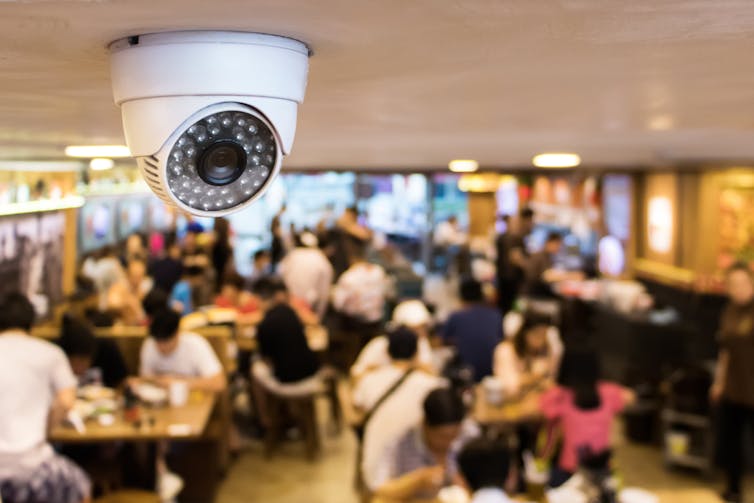 CCTV footage doesn’t always produce clear images, so identifying people can be difficult.
Shutterstock.com
CCTV footage doesn’t always produce clear images, so identifying people can be difficult.
Shutterstock.com
Forensic facial examiners present a paradox for scientists. They perform face identification tasks with a high degree of accuracy, and this ability appears to be acquired through professional experience and training.
Our study suggests there is no benefit of face identification training courses when tested immediately before and after.
In addition, previous work has suggested that merely performing face-matching tasks in daily work is not sufficient to improve accuracy. Some passport officers have been working for 20 years and perform no better than others who have been working for just a few months.
Read more: Passport staff miss one in seven fake ID checks
This paradox suggests there is something particular about the type of training and professional experience that forensic facial examiners receive that enables them to develop visual expertise in identifying faces, and which isn’t provided by standard training courses.
How do they do it?
In our current research we are working closely with government agencies to uncover the basis of forensic facial examiners’ expertise. For example, we now know that part of their expertise comes from using a very particular comparison strategy, where they break the face down into individual facial features and then slowly and systematically assess the similarity of each feature in turn.
Interestingly, the nature of this expertise appears to be qualitatively different to that of super-recognisers – Yenny recognised her old classmate using a quick, intuitive process as she glanced in the rear-view mirror.
 Super-recognisers can pick out a face they may have seen only once before.
Shutterstock.com
Super-recognisers can pick out a face they may have seen only once before.
Shutterstock.com
However, these snap judgements made by super-recognisers may not be suitable for the type of identification evidence that forensic facial examiners give in court, where a careful analysis of facial images is necessary to support identification decisions. Importantly, forensic facial examiners provide detailed reports of the observations used to support their decisions, which can then be cross-examined in court.
Trainable vs hardwired
Super-recognisers and forensic facial examiners use distinct routes to high performance in face identification.
Effective training appears to target the slower, deliberate and analytical visual processing that characterises forensic facial examiners.
The faster and more intuitive skill that enabled Yenny to recognise faces of relative strangers in her rear-view mirror is likely to be untrainable, and hard-wired.
This raises the question of how to balance these different sources of expertise. It may be that super-recognisers are best suited to surveillance-type roles, such as monitoring CCTV or searching for targets in large crowds.
Forensic facial examiners may be better suited to providing identification evidence to the court, which requires thorough explanations of how and why the expert came to their decision.
Alternatively, it may be possible to train super-recognisers in the expert skills characterising forensic facial examination, or to form teams that include both types of expert.
The aim of our work is to integrate these sources of human expertise with the latest face recognition software to improve the accuracy of face identification evidence. Such a system can make society safer, but also fairer, by reducing the likelihood of wrongful convictions.
Can you beat Yenny’s high score of 88% on the super-recogniser test? Find out here.
Authors: Alice Towler, Post-doctoral Research Fellow, UNSW


 Daily Bulletin


