

Populism's problems can be fixed by getting the public better-informed. And that's actually possible
- Written by: Ron Levy, Associate professor, Australian National University
Many commentators have been alarmed at the electoral wins of ultra conservative leaders around the world, as well as policy decisions such as Brexit made by a popular referendum. They see these as signs of a rising populism.
In its benign forms, populism can simply mean ordinary citizens’ desire to see their interests and preferences better reflected in policy making. It may also mean greater direct involvement in government by the people themselves.
But in its more dangerous manifestations, populism can mean a reckless, extreme distrust in governmental expertise. It can be under-informed, and divide communities between “us” and “them”. And – in its impatience to see change – it can tear down useful democratic values and institutions such as inclusivity and a neutral judiciary, which safeguard our rights in a democracy.
Read more: The pathologies of populism
There is at least one way we could harness the populist trend and turn it in a more useful direction: deliberative democracy.
As the name suggests, deliberative democracy aims to promote not only democratic majority rule, but also deliberation. This means well-informed, inclusive and reflective decision-making. While populism gives a greater role to ordinary citizens in the affairs of government, deliberative democracy models can improve this by ensuring citizen input is robustly inclusive, reflective and well-informed.
So far, deliberative democracy is the best answer we have to the challenge of populism.
Deliberative democracy at work
One form of deliberative democracy is to enlist ordinary citizens in deliberation, such as in the case of citizens’ juries. Here, randomly-picked groups of citizens are invited to attend a series of organised sessions, where they become well-informed on a specific policy matter before advising governments on the best way forward.
This model has been used hundreds of times around the world, including in the ACT (on matters such as housing) and South Australia (on nuclear waste).
Read more: City calls on jury of its citizens to deliberate on Melbourne's future
To many, such an approach seems fanciful. their cynicism is based on the assumption members of the public couldn’t possibly deliberate about public matters thoughtfully. But many studies show that creative approaches to democracy, such as citizens’ juries, can increase how well ordinary citizens deliberate about the matters put to them. Citizens’ juries can be informed, inclusive, thoughtful, fair and intellectually supple.
Citizens’ juries have a particular kind of democratic legitimacy. Since they are randomly-selected, and often demographically representative of the larger population, the public tends to see jury members as “just like me”, which creates more trust in the process.
But citizens’ juries have limitations. One is that the process has so far only included a handful of citizens at one time. And some critics will insist that only a vote in which all eligible voters can participate confers democratic legitimacy. This is where the referendum can be used as part of the deliberative democracy model.
Referendums can provide a neutral, democratically robust input into matters of public interest that politicians cannot resolve themselves. They can, for example, spur governments to act where a clear majority of the population has a considered view, but the government is divided and therefore powerless to act on that view.
Think of climate change mitigation, as well as other environmental matters such as coal seam gas mining and fracking.
But when a policy matter is put to a referendum or plebiscite – in which all eligible citizens could vote – it is a hard task to bring most of the people up to speed. It is far easier to inform people on a citizens’ jury, which might include just 50 people.
The conundrum is therefore that the citizens’ jury is deliberative but (according to some) democratically insufficient, while a referendum or plebiscite is more democratically robust but not always deliberative. But we can take useful steps toward making referendums or plebiscites more deliberative.
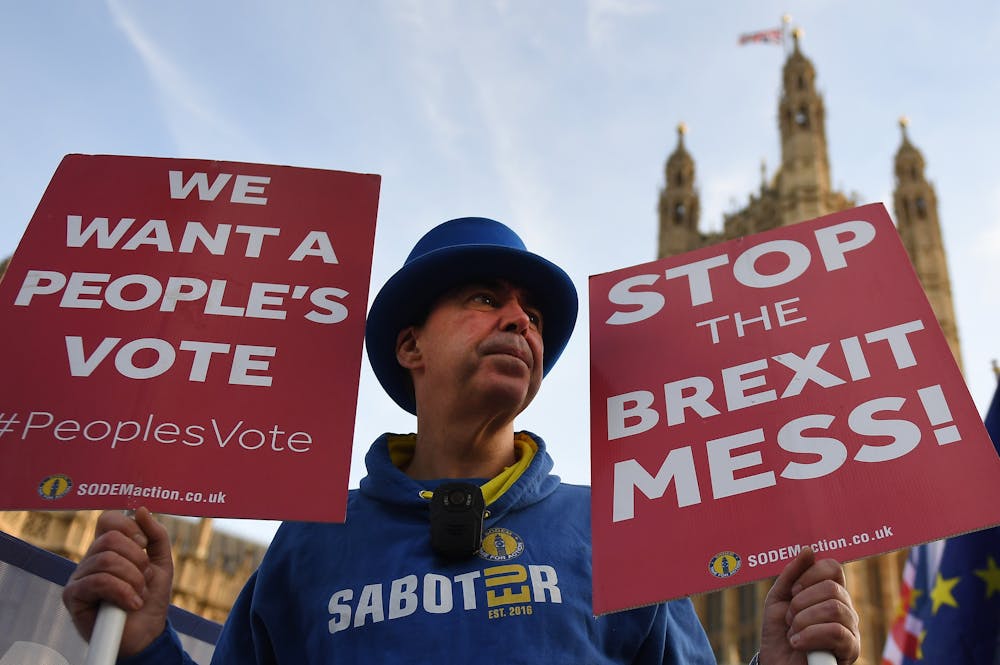 A few referendums are on the horizon, including another one on Brexit.
ANDY RAIN/EPA
A few referendums are on the horizon, including another one on Brexit.
ANDY RAIN/EPA
Around the world a number of academics, including the author, have proposed the “deliberative referendum”. Those who doubt referendums can be deliberative may prefer the term “informed referendum”.
The deliberative/informed referendum
Reforming a referendum or plebscite to make it more deliberative can be done through several methods – some already common. They include:
Voting online or at computer voting stations, which is already in use in many places. This can permit more interactive voting than a mere yes/no vote. In a new approach, before they could cast their votes, voters are asked to interact with a 15-minute tutorial informing them of the relevant issues. For instance, a vote on a local housing development plan would canvass environmental, economic and social arguments for and against greater urban density.
Multi-option voting would depart from the traditional yes/no vote, presenting voters with several options and avoiding the artificial reduction of complex matters into a binary choice. Preferential voting could still allow a single option to emerge with majority support.
Value-based voting could take place, meaning one set of ballot options put to voters would concern not just final choices, such as urban density levels adopted in a city plan, but also the values underlying them. Voters could rank values such as environmental sustainability and economic development. This would encourage voters to think more thoroughly about their final choices.
Citizens’ juries should be held in the lead up to a referendum. This has happened in many cases, such as in the recent Irish abortion referendum. A citizens’ jury could help to inform the broader public about the issues at stake. As a neutral body, the jury would write the questions on the ballot and the content of the information tutorials.
An optional measure would be a political misinformation law enacted to prevent politicians and others from uttering false statements likely to mislead voters. This method has been common, most of all, in Australia. Granted, around the world it has been subject to challenges under constitutional free speech and communication guarantees. But in Australia political misinformation laws were upheld by judges who cited the value of accurate information for voters.
Robust anti-misinformation laws would have been useful in the 2016 Brexit referendum campaign, which had a number of whoppers. For instance, campaigners greatly overstated the costs to the UK of both staying in and leaving the EU.
Referendums on Australia becoming a republic, and on Brexit (again), may be on the horizon. Other cases, such as the urban density example, are perennially unresolved matters in localities around Australia – in part because governments cannot decide whether to favour homeowners, developers, environmentalists or other groups. Even societies experiencing war often turn to referendums to try to jolt them out of their entrenched cycles of violence.
Referendums and plebiscites can be democratic circuit-breakers in a system of government that is in theory dedicated to serving the public, but that in many cases falls short.
Read more: Australia’s public servants: dedicated, highly trained ... and elitist
Of course, there is still a risk the circuit-break may end up merely giving greater voice to a coarse populism, which knows it wants to tear down elitism and expertise, but not what to replace them with. However, work on deliberative referendum design suggests we needn’t be quite so fearful of populism. At least sometimes, and to some degree, populism can be remade so the public can have a more deliberative input into government decision-making.
Authors: Ron Levy, Associate professor, Australian National University


 Daily Bulletin


