

Here's the seafood Australians eat (and what we should be eating)
- Written by: Anna Farmery, Research Fellow, University of Wollongong
Many Australians are concerned with the sustainability of their seafood. While definitions of sustainability vary, according to government assessments, over 85% of seafood caught in Australia is sustainable.
However, just because a fish is sustainably caught, it doesn’t make it the most nutritious and healty option – and vice versa. For the first time, research has investigated the seafood Australians eat in terms of what’s best for us and the planet.
Read more: How to reduce slavery in seafood supply chains
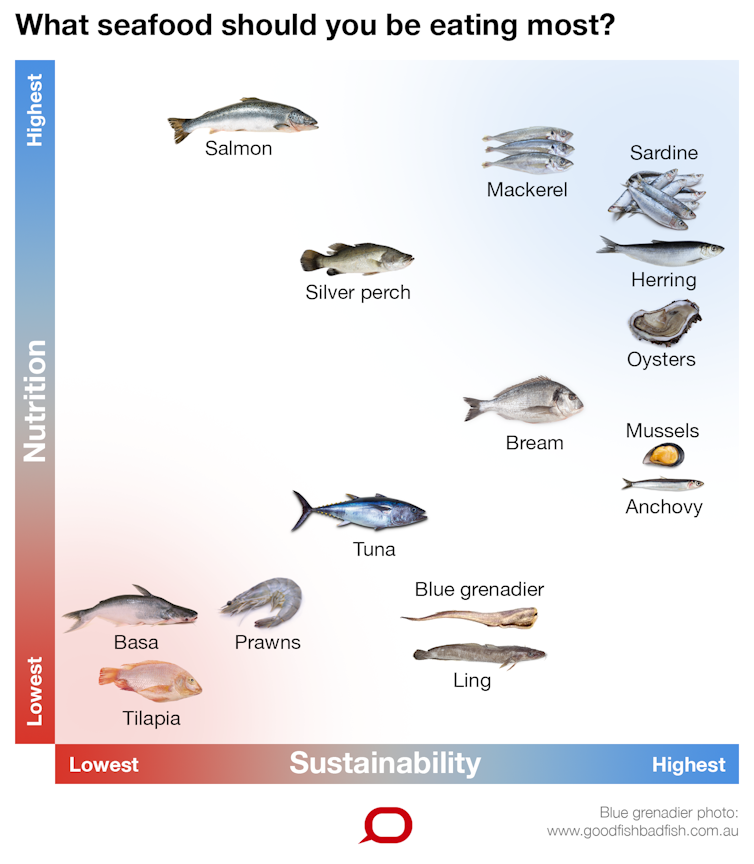
Our study, published today in the journal Frontiers in Nutrition, found that Australians consume a lot of large oceanic fish, like shark and tuna, as well as farmed salmon and prawns, but there are other, healthier options available like mackerel, sardines and blue grenadier.
 Shutterstock, unless otherwise noted
What Australians eat
The word seafood is used to describe thousands of different species, both marine and freshwater, and from the wild or farmed. Because of these differences, the environmental footprint of “seafood” can vary greatly, as can their nutritional profile.
Our research used data from the Australian Health Survey to investigate the nutritional quality and sustainability of seafood consumption in Australia.
We measured nutrition by the estimated contribution of 100g of a given seafood to the average requirement of protein, omega 3, calcium, iodine, selenium and zinc. Sustainability was assessed on the basis of stock status, resource use, habitat and ecosystem impacts, and health and disease management.
The majority of respondents (83%) did not consume any seafood on the day of the survey, and we found that there were large discrepancies in consumption patterns between different sociodemographic groups.
Of those who did consume seafood, the proportion was lowest among adults who were unemployed, had the least education and those who were most socio-economically disadvantaged.
Crustaceans and low-omega 3 fish, such as basa and tilapia, which were identified as some of the least nutritious and least sustainable types of seafood, constituted a substantial amount of total seafood intake for the lowest socio-economic consumers.
In contrast, consumers in the highest socio-demographic group consumed mainly high trophic level fish, such as tuna and shark, and farmed fish with high omega-3 content, such as salmon and trout, which were considered the more nutritious types of seafood with a moderate sustainability. Less than 1% of adults reported eating sardines and mackerel which were considered some of the most nutritious and sustainable varieties.
What is sustainability?
Sustainability in seafood is complex and difficult to quantify. Greenhouse gas emissions are not currently covered by the major assessment groups, despite the contribution of the fishing industry to global emissions and the variation between different seafood types.
For example, growing demand for crustaceans like prawns or shrimp, is resulting in higher emissions from the global fishing fleet, as these fisheries are fuel intensive. In contrast, small pelagic fisheries, such as sardines, have very low emissions – although they are a lot less popular.
Farmed seafoods also vary considerably in their environmental footprint. In the past, large farmed species of fish have been fed with much smaller wild fish. This practice is in decline, with small feed fish replaced by crops and animal by-products.
However, it’s not clear this substitution is environmentally friendly. At the same time, the nutritional value of farmed fish has decreased.
Making better choices
Detailed nutrition information is not readily available at the point of purchase for fresh seafood. It can be tricky making an informed decision on the spot.
However, Food Standards Australia and New Zealand have created nutrient profiles for a range of food, including seafood. The National Heart Foundation of Australia provides information on the amount of marine-sourced omega-3s in fish and seafood commonly available, with species such as Atlantic salmon and sardines listed as highest sources, while prawns and crabs are much lower.
To check the sustainability of your seafood choice, you can consult the AMCS guide or look for certifications such as the Marine Stewardship Council (MSC) for wild capture fisheries or the Aquaculture Stewardship Council (ASC) or Best Aquaculture Practices (BAP) logos. WWF have also developed a canned tuna guide (changeyourtuna.org.au).
Eating new seafood species can be tricky if you are not familiar with them. There are many resources available to help you pick and prepare seafood, such as FRDC fish files, Sydney Fish Market recipes and an SBS section on sustainable seafood recipes.
In WA, the Western Australian Fishing Industry Council have produced guides on local seafood, including information on underultised species, cooking and storage. South Australians can now pick up local fish from the new Community Supported Fishery each week, or have it delivered.
Read more:
The sustainable vegetables that thrive on a diet of fish poo
All food production has an impact, but making an informed choice can be beneficial for health and the environment. So, get adventurous with your seafood selections by experimenting with choices that are both nutritious and meet your sustainability criteria. As you become more familiar with different species and ways to prepare them, you won’t have to juggle different guides at the fish counter and decide it’s all too hard.
Shutterstock, unless otherwise noted
What Australians eat
The word seafood is used to describe thousands of different species, both marine and freshwater, and from the wild or farmed. Because of these differences, the environmental footprint of “seafood” can vary greatly, as can their nutritional profile.
Our research used data from the Australian Health Survey to investigate the nutritional quality and sustainability of seafood consumption in Australia.
We measured nutrition by the estimated contribution of 100g of a given seafood to the average requirement of protein, omega 3, calcium, iodine, selenium and zinc. Sustainability was assessed on the basis of stock status, resource use, habitat and ecosystem impacts, and health and disease management.
The majority of respondents (83%) did not consume any seafood on the day of the survey, and we found that there were large discrepancies in consumption patterns between different sociodemographic groups.
Of those who did consume seafood, the proportion was lowest among adults who were unemployed, had the least education and those who were most socio-economically disadvantaged.
Crustaceans and low-omega 3 fish, such as basa and tilapia, which were identified as some of the least nutritious and least sustainable types of seafood, constituted a substantial amount of total seafood intake for the lowest socio-economic consumers.
In contrast, consumers in the highest socio-demographic group consumed mainly high trophic level fish, such as tuna and shark, and farmed fish with high omega-3 content, such as salmon and trout, which were considered the more nutritious types of seafood with a moderate sustainability. Less than 1% of adults reported eating sardines and mackerel which were considered some of the most nutritious and sustainable varieties.
What is sustainability?
Sustainability in seafood is complex and difficult to quantify. Greenhouse gas emissions are not currently covered by the major assessment groups, despite the contribution of the fishing industry to global emissions and the variation between different seafood types.
For example, growing demand for crustaceans like prawns or shrimp, is resulting in higher emissions from the global fishing fleet, as these fisheries are fuel intensive. In contrast, small pelagic fisheries, such as sardines, have very low emissions – although they are a lot less popular.
Farmed seafoods also vary considerably in their environmental footprint. In the past, large farmed species of fish have been fed with much smaller wild fish. This practice is in decline, with small feed fish replaced by crops and animal by-products.
However, it’s not clear this substitution is environmentally friendly. At the same time, the nutritional value of farmed fish has decreased.
Making better choices
Detailed nutrition information is not readily available at the point of purchase for fresh seafood. It can be tricky making an informed decision on the spot.
However, Food Standards Australia and New Zealand have created nutrient profiles for a range of food, including seafood. The National Heart Foundation of Australia provides information on the amount of marine-sourced omega-3s in fish and seafood commonly available, with species such as Atlantic salmon and sardines listed as highest sources, while prawns and crabs are much lower.
To check the sustainability of your seafood choice, you can consult the AMCS guide or look for certifications such as the Marine Stewardship Council (MSC) for wild capture fisheries or the Aquaculture Stewardship Council (ASC) or Best Aquaculture Practices (BAP) logos. WWF have also developed a canned tuna guide (changeyourtuna.org.au).
Eating new seafood species can be tricky if you are not familiar with them. There are many resources available to help you pick and prepare seafood, such as FRDC fish files, Sydney Fish Market recipes and an SBS section on sustainable seafood recipes.
In WA, the Western Australian Fishing Industry Council have produced guides on local seafood, including information on underultised species, cooking and storage. South Australians can now pick up local fish from the new Community Supported Fishery each week, or have it delivered.
Read more:
The sustainable vegetables that thrive on a diet of fish poo
All food production has an impact, but making an informed choice can be beneficial for health and the environment. So, get adventurous with your seafood selections by experimenting with choices that are both nutritious and meet your sustainability criteria. As you become more familiar with different species and ways to prepare them, you won’t have to juggle different guides at the fish counter and decide it’s all too hard.
Authors: Anna Farmery, Research Fellow, University of Wollongong
Read more http://theconversation.com/heres-the-seafood-australians-eat-and-what-we-should-be-eating-108046
&media=https://dailybulletin.com.au/https://images.theconversation.com/files/248665/original/file-20181204-126665-1hbbqw7.png?ixlib=rb-1.1.0&q=45&auto=format&w=754&fit=clip&description=Here's%20the%20seafood%20Australians%20eat%20(and%20what%20we%20should%20be%20eating) "Pin It")

 Daily Bulletin


