

NZ is home to species found nowhere else but biodiversity losses match global crisis
- Written by: Robert McLachlan, Professor in Applied Mathematics, Massey University
The recently released 2018 Living Planet report is among the most comprehensive global analyses of biodiversity yet. It is based on published data on 4,000 out of the 70,000 known species of mammals, birds, fish, reptiles and amphibians.
Rather than listing species that have gone extinct, the report summarises more subtle information about the vulnerability of global biodiversity. The bottom line is that across the globe, the population sizes of the species considered have declined by an average of 60% in 40 years.
New Zealand is a relatively large and geographically isolated archipelago with a biota that includes many species found nowhere else in the world. One might think that it is buffered from some of the effects of biological erosion, especially since people only arrived less than 800 years ago. But as we show, the impact on wildlife has been catastrophic.
Read more: Tipping point: huge wildlife loss threatens the life support of our small planet
Describing biological diversity
The diversity of life may seem incomprehensible. Carolus Linnaeus began his systematic work to describe earth’s biological diversity in the 18th century with about 12,000 plants and animals. Since then, 1.3 million species of multi-cellular creatures have been described, but the size of the remaining taxonomic gap remains unclear.
Recently, sophisticated models estimated the scale of life, suggesting that multi-cellular life ranges between about five million and nine million species. Microbial life might include millions, billions or even trillions of species.
Species do not exist in isolation. They are part of communities of large and microscopic organisms that themselves drive diversification. Charles Darwin observed in his usual understated way:
It is interesting to contemplate an entangled bank, clothed with many plants of many kinds, with birds singing on the bushes, with various insects flitting about, and with worms crawling through the damp earth, and to reflect that these elaborately constructed forms, so different from each other, and dependent on each other in so complex a manner, have all been produced by laws acting around us.
Global decline of wild places
The main threat to biodiversity remains overexploitation of resources, leading to loss of habitat. Human overconsumption can only get worse in coming decades, and this will likely escalate the impact of invasive species, increase the rate of disease transmission, worsen water and air pollution and add to climate change.
Read more: Capitalism is killing the world's wildlife populations, not 'humanity'
This is the Anthropocene, the era of human domination of many global-scale processes. By the early 1990s, just 33 million of the earth’s 130 million square kilometres of ice-free land remained in wilderness. By 2016, it was down to 30 million. Most of this is either desert, taiga or tundra. In other words, humans and their cities, roads and farms occupy 77% of the available land on earth.
By 2050, wild lands are projected to contract to 13 million square kilometres, leaving ever less space for wild animals and plants. In terms of resources consumed, there is huge inequity. Preliminary estimates of the biomass of all life on earth reveal that humans, their pets and their farm animals outweigh wild land mammals by 50 to one. Poultry outweigh all wild birds 2.5 to one.
New Zealand: at the bottom of the cliff
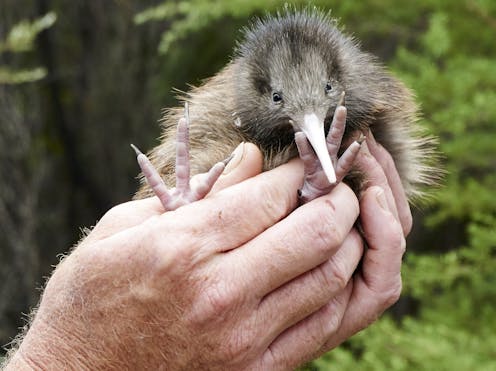
In New Zealand, a lot of attention is paid to iconic, rare species, such as kiwi and kākāpo. However, in 2017, the Parliamentary Commissioner for the Environment reported that the proportion of forest land occupied by birds found only in New Zealand had declined in the North Island from 16% to 5% between 1974 and 2002. In the South Island, it declined from 23% to 16%.
These figures are consistent with other studies on animal populations. For example, kiwi, which currently number 70,000, may have declined by two thirds in 20 years. Thus there is a risk that continued biodiversity decline overall will see more and more species requiring last-ditch efforts to save them, with healthy populations confined to heavily protected and often fenced sanctuaries.
New Zealand is unusual in that introduced, invasive predators are a major threat and are widely seen as the predominant threat to native animals. However, land use change in New Zealand has been rapid, extensive and catastrophic for biodiversity and ecosystem resilience. The New Zealand situation is at best the global story writ small.
As the last substantial land area to be settled by humans, the land experienced an alarming rate of habitat loss. Indeed, deforestation was considered a necessity and the “homestead system” in Auckland saw tenants turned off the land if they failed to clear sufficient native bush.
Native bush in New Zealand has been reduced by about three quarters from its former 82% extent across the landscape. What remains is heavily modified and not representative of former diversity. For example, in the Manawatū-Whanganui region, ancient lowland kahikatea forest has been reduced to less than 5% of its former extent, and between 1996 and 2012, 89,000 hectares of indigenous forest and scrub was converted to exotic forest and exotic pasture. When a habitat is removed, the organisms that live in it go, too.
The way forward
The Living Planet report charts a detailed, aspirational roadmap to reverse the decline in biodiversity. It takes heart from the 2015 Paris Agreement and Sustainable Development Goals. It looks ahead to a greatly strengthened Convention on Biological Diversity for 2020.
Unfortunately, biodiversity threats are, if anything, even more pervasive and difficult to address than fossil fuel emissions. In climate change, it is broadly agreed that rising seas, acidifying oceans and destabilised weather patterns are bad. There is no such universal understanding of the importance of biodiversity.
To address this, the report details the importance of biodiversity to human health, food production and economic activity – the “ecosystem services” that nature provides to humans. The intrinsic value of nature to itself is hardly mentioned. This is not a new debate. The 1992 UN Convention on Biological Diversity is founded on “the intrinsic value of biological diversity”, while the Rio Earth Summit of the same year stated that “human beings are at the centre of concerns for sustainable development.”
The issue should not be confined to ecologists, philosophers, and diplomats. It needs to be addressed or we may find that future generations value nature even less than present ones do. In 2002, Randy Olsen popularised the concept of the shifting baseline, which means that people progressively adjust to a new normal and don’t realise what has been lost:
People go diving today in California kelp beds that are devoid of the large black sea bass, broomtailed groupers and sheephead that used to fill them. And they surface with big smiles on their faces because it is still a visually stunning experience to dive in a kelp bed. But all the veterans can think is, “You should have seen it in the old days”.
Authors: Robert McLachlan, Professor in Applied Mathematics, Massey University


 Daily Bulletin


