

G20 summit bring a truce in US-China trade relations – but it's likely to be temporary
- Written by: Tony Walker, Adjunct Professor, School of Communications, La Trobe University
The United States and China have arrived at a temporary truce in a trade conflict that was threatening to further destabilise world equity markets, entrench a global slowdown and cause more damage to a rules-based international order.
Agreement by US President Donald Trump and his Chinese counterpart, Xi Jinping, to allow further negotiations before threatened tariff increases on Chinese imports come into effect is a welcome development.
However, this is a temporary respite, a short-term fix, not a long-term solution to myriad trade and other tensions that have put the US and China at odds with each other.
For their own purposes and in their own interests, Trump and Xi could come away from the Argentine capital with a deal that papers over differences that extend from China’s activities in the South China Sea to its mercantilist trade policies.
Read more: Much at stake as Donald Trump and Xi Jinping meet at G20
As far as we know, China’s ruthless assertion of its sovereignty over disputed waters in the South China Sea was not a material subject for discussion in Buenos Aires except, possibly, in passing.
China’s rise and America’s relative decline ensure these global economic superpowers will continue to bump up against each other.
So, what was achieved and what are the prospects for an accord reached on the sidelines of the G20?
In their efforts to lower trade tensions and prevent a further erosion of global confidence, Trump and Xi agreed to a 90-day extension on the imposition of additional US tariffs on some US$200 billion of Chinese imports.
Trump had threatened to increase tariffs from 10% to 25% on an initial batch of Chinese imports from January 1. He had also flagged his intention to impose levies on another US$267 billion worth of imports if progress was not made in resolving broad-based trade differences.
A joint statement laid out a timeline for continuing negotiations. It reads:
Both parties agree that they will endeavour to have this transaction completed within the next 90 days. If, at the end of this period of time, the parties are unable to reach an agreement, the 10 percent tariffs will be raised to 25 percent.
In return for these temporary concessions, China agreed to:
… purchase a not yet agreed upon, but very substantial, amount of agricultural, energy, industrial, and other product from the United States to reduce the trade imbalance between the two countries. China has agreed to start purchasing agricultural product immediately.
China also agreed to crack down on sales of Fentanyl by making it a controlled substance. The US is battling an opioid crisis in which Fentanyl is a lethal component.
In retaliation for US trade actions, China had imposed duties on US$110 billion of imports. A principal component of this is soybeans, effectively killing one of America’s more lucrative export markets.
Trump has been under huge pressure from his Mid-Western rural heartland over a collapse in the Chinese market for American agricultural products.
The two sides also agreed to address structural problems in the trading relationship. These extend to five areas – forced technology transfer, intellectual property protection, non-tariff barriers, cyber intrusions and cyber theft.
These are highly complex issues and unlikely to be resolved in the short term, if at all.
In the wash-up of the Xi-Trump discussions it appears China has got more out of the deal than the US – at least for now. It has secured a stay of execution for the implementation of tariff increases and forestalled, for the time being, tariffs on an additional bloc of Chinese exports.
In return, it has agreed to buy unspecified quantities of US products and to talk about differences.
Trump’s willingness to compromise after months of bombast reflects pressures from a shellshocked grain-producing constituency and alarm on Wall Street at prospects of a full-blown trade war.
From Beijing’s perspective, China has demonstrated that its growing economic heft has enabled it to avoid the appearance of yielding to US pressure.
If not a “win-win” for China – as Chinese officials are fond of saying – it is certainly not a “lose-lose”.
In a statement at odds with months of fire-breathing rhetoric over China’s allegedly perfidious trade practices, Trump hailed his understanding with Xi. He said:
This was an amazing and productive meeting with unlimited possibilities for both the US and China.
For their part, Chinese officials were more circumspect.
Foreign Minister Wang Yi said the talks were conducted in a “friendly and candid atmosphere”. The presidents:
agreed that the two sides can and must get bilateral relations right… China is willing to increase imports in accordance with the needs of its domestic market and the people’s needs.
Impetus for a face-saving deal in Buenos Aires has been prompted by growing concerns about the global economy. The signs of a slowdown are clear. Trade volumes had begun to moderate in the third quarter, heightening worries of a global retrenchment.
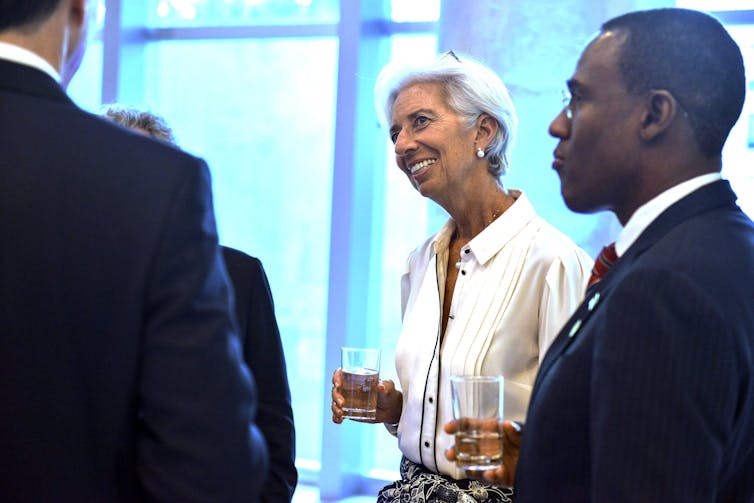 International Monetary Fund managing director Christine Lagarde at the G20 summit.
AAP/EPA/G20 handout
International Monetary Fund managing director Christine Lagarde at the G20 summit.
AAP/EPA/G20 handout
On the sidelines of the G20, the International Monetary Fund’s managing director, Christine Lagarde, noted:
Pressures on emerging markets have been rising and trade tensions have begun to have a negative impact, increasing downside risks.
In its October Outlook statement, the IMF warned about threats to global growth due to trade disturbances.
In their final communique, G20 leaders danced around contentious issues on trade to accommodate American objections to having the word “protectionism” inserted in the document.
In the end, participants settled on the need for reform of the World Trade Organisation to describe a world trading system that is falling short of its objectives. Washington has been agitating for a review of the WTO to strengthen its dispute resolution and appeal procedures.
The US has also objected to a continuing description of China as a developing country, with concessions that enable it to take advantage of less developed country status in its access to global markets.
Read more: As tensions ratchet up between China and the US, Australia risks being caught in the crossfire
On climate change, Washington separated itself from the other G20 members. All, except the US, reaffirmed their commitment to the Paris Agreement. The US announced in 2017 it was pulling out of Paris.
Foreign policy specialists will be sceptical about a de-escalation of trade hostilities given the range of issues bedevilling the US-China relationship.
Reflecting a hardening of US attitudes towards China, and in contrast to the optimism that had prevailed for much of the past two decades, Ely Ratner in Foreign Affairs notes:
Even if tariffs are put on hold, the United States will continue to restructure the US-China economic relationship through investment restrictions, export controls, and sustained law enforcement actions against Chinese industrial and cyber-espionage.
At the same time, there are no serious prospects for Washington and Beijing to resolve other important areas of dispute, including the South China Sea, human rights and the larger contest over the norms, rules and institutions that govern relations in Asia.
A stiffening view in the US towards China is shared more or less across the board. In those circumstances, a temporary ceasefire in Buenos Aires is unlikely to be sustained.
Authors: Tony Walker, Adjunct Professor, School of Communications, La Trobe University


 Daily Bulletin


