

Five projects that are harnessing big data for good
- Written by: Arezou Soltani Panah, Postdoc Research Fellow (Social Data Scientist), Swinburne University of Technology
Data science has boomed over the past decade, following advances in mathematics, computing capability, and data storage. Australia’s Industry 4.0 taskforce is busy exploring ways to improve the Australian economy with tools such as artificial intelligence, machine learning and big data analytics.
But while data science offers the potential to solve complex problems and drive innovation, it has often come under fire for unethical use of data or unintended negative consequences – particularly in commercial cases where people become data points in annual company reports.
We argue that the data science boom shouldn’t be limited to business insights and profit margins. When used ethically, big data can help solve some of society’s most difficult social and environmental problems.
Industry 4.0 should be underwritten by values that ensure these technologies are trained towards the social good (known as Society 4.0). That means using data ethically, involving citizens in the process, and building social values into the design.
Here are a five data science projects that are putting these principles into practice.
Read more: The future of data science looks spectacular
1. Finding humanitarian hot spots
Social and environmental problems are rarely easy to solve. Take the hardship and distress in rural areas due to the long-term struggle with drought. Australia’s size and the sheer number of people and communities involved make it difficult to pair those in need with support and resources.
Our team joined forces with the Australian Red Cross to figure out where the humanitarian hot spots are in Victoria. We used social media data to map everyday humanitarian activity to specific locations and found that the hot spots of volunteering and charity activity are located in and around Melbourne CBD and the eastern suburbs. These kinds of insights can help local aid organisations channel volunteering activity in times of acute need.
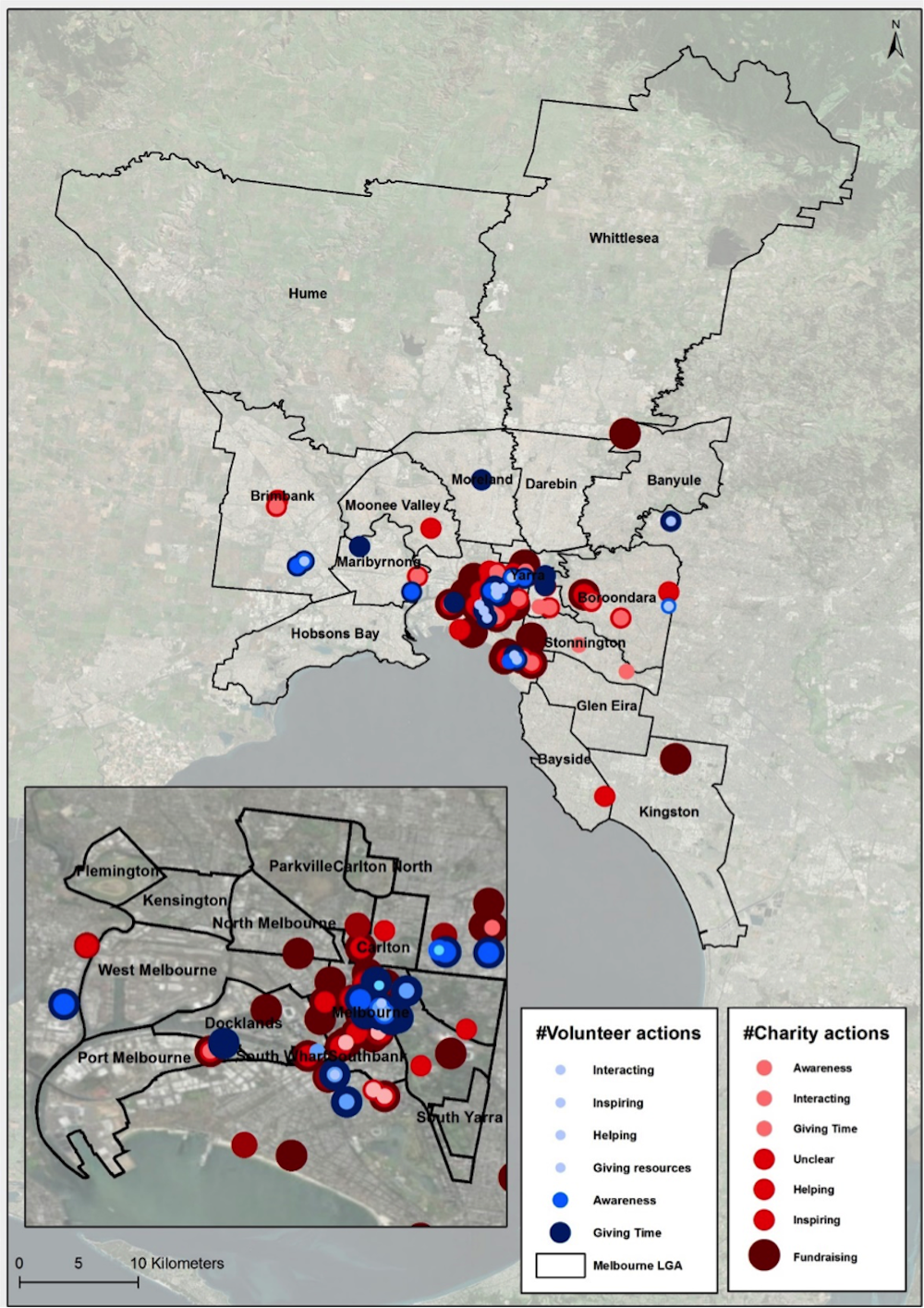 Distribution of humanitarian actions across inner Melbourne and local government areas. Blue dots and red dots represent scraped Instagram posts around the hashtags #volunteer and #charity.
2. Improving fire safety in homes
Accessing data – the right data, in the right form – is a constant challenge for data science. We know that house fires are a serious threat, and that fire and smoke alarms save lives. Targeting houses without fire alarms can help mitigate that risk. But there is no single reliable source of information to draw on.
In the United States, Enigma Labs built open data tools to model and map risk at the level of individual neighbourhoods. To do this effectively, their model combines national census data with a geocoder tool (TIGER), as well as analytics based on local fire incident data, to provide a risk score.
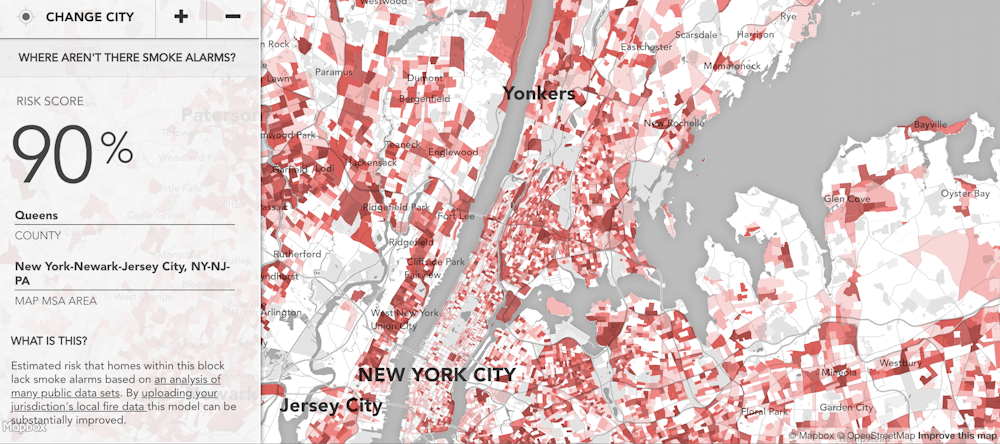 Fire fatality risk scores calculated at the level of Census block groups.
Enigma Labs
Fire fatality risk scores calculated at the level of Census block groups.
Enigma Labs
3. Mapping police violence
Ordinary citizens can be involved in generating social data. There are many crowdsourced, open mapping projects, but often the value of data science lies in the work of joining the dots.
The Mapping Police Violence project in the US monitors, make sense of, and visualises police violence. It draws on three crowdsourced databases, but also fills in the gaps using a mix of social media, obituaries, criminal records databases, police reports and other sources of information. By drawing all this information together, the project quantifies the scale of the problem and makes it visible.
 Distribution of humanitarian actions across inner Melbourne and local government areas. Blue dots and red dots represent scraped Instagram posts around the hashtags #volunteer and #charity.
Mapping Police Violence
Distribution of humanitarian actions across inner Melbourne and local government areas. Blue dots and red dots represent scraped Instagram posts around the hashtags #volunteer and #charity.
Mapping Police Violence
Read more: Data responsibility: a new social good for the information age
4. Optimising waste management
The Internet of Things is made up of a host of connected devices that collect data. When embedded in the ordinary objects all around us, and combined with cloud-based analysis and computing, these objects become smart – and can help solve problems or inefficiencies in the built environment.
If you live in Melbourne, you might have noticed BigBelly bins around the CBD. These smart bins have solar-powered trash compactors that regularly compress the garbage inside throughout the day. This eliminates waste overflow and reduces unnecessary carbon emissions, with an 80% reduction in waste collection.
Real-time data analysis and reporting is provided by a cloud-based data management portal, known as CLEAN. The tool identifies trends in waste overflow, which helps with bin placement and planning of collection services.
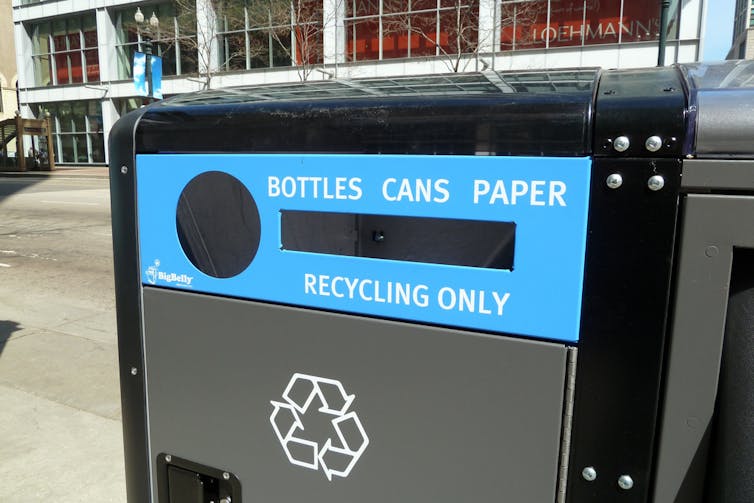 BigBelly bins are being used in Melbourne’s CBD.
Kevin Zolkiewicz/Flickr, CC BY-NC
BigBelly bins are being used in Melbourne’s CBD.
Kevin Zolkiewicz/Flickr, CC BY-NC
5. Identifying hotbeds of street harassment
A group of four women – and many volunteer supporters – in Egypt developed HarassMap to engage with, and inform, the community in an effort to reduce sexual harassment. The platform they built uses anonymised, crowdsourced data to map harassment incidents that occur in the street in order to alert its users of potentially unsafe areas.
The challenge for the group was to provide a means for generating data for a problem that was itself widely dismissed. Mapping and informing are essential data science techniques for addressing social problems.
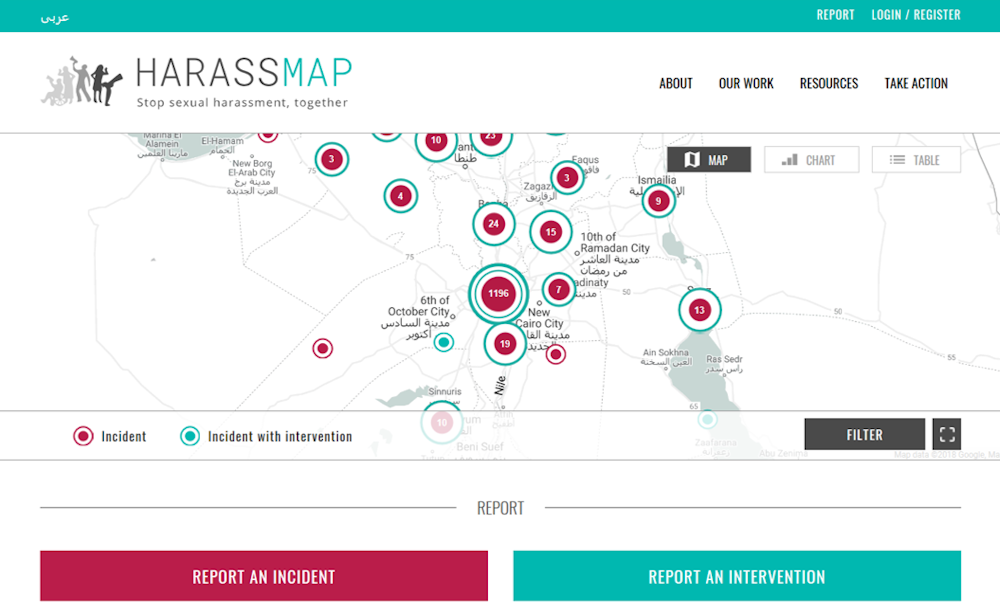 Mapping of sexual harassment reported in Egypt.
HarassMap
Mapping of sexual harassment reported in Egypt.
HarassMap
Read more: Cambridge Analytica's closure is a pyrrhic victory for data privacy
Building a better society
Turning the efforts of data science to social good isn’t easy. Those with the expertise have to be attuned to the social impact of data analytics. Meanwhile, access to data, or linking data across sources, is a major challenge – particularly as data privacy becomes an increasing concern.
While the mathematics and algorithms that drive data science appear objective, human factors often combine to embed biases, which can result in inaccurate modelling. Digital and data literacy, along with a lack of transparency in methodology, combine to raise mistrust in big data and analytics.
Nonetheless, when put to work for social good, data science can provide new sources of evidence to assist government and funding bodies with policy, budgeting and future planning. This can ultimately result in a better connected and more caring society.
Authors: Arezou Soltani Panah, Postdoc Research Fellow (Social Data Scientist), Swinburne University of Technology
Read more http://theconversation.com/five-projects-that-are-harnessing-big-data-for-good-104844


 Daily Bulletin


