

Four fundamental principles for upholding freedom of speech on campus
- Written by: Adrienne Stone, Redmond Barry Distinguished Professor, Kathleen Fitzpatrick Australian Laureate Fellow, Director, Centre for Comparative Constitutional Studies, University of Melbourne
It goes without saying – or at least it ought to – that freedom of speech should be a core value of universities. As a scholar of freedom of speech and a university academic, it has been gratifying to see so many Vice Chancellors (and a former Chief Justice of the High Court) take it so seriously.
This attention to freedom of speech is a response to recent controversies about on campus. Bettina Arndt’s campus tour met with rowdy and obstructive demonstrations. Students have accused each other of bullying and censorship. And last year, La Trobe University academic Roz Ward was briefly suspended for misconduct for her controversial views on Australia’s flag in a Facebook post.
Read more: The great irony in punishing universities for 'failing' to uphold freedom of speech
Temperatures are running high enough that universities have occasionally been forced to cancel controversial speakers for fear of the disruption caused by protesters. These controversies are not new. But it’s high time for universities to think very carefully about freedom of speech and they should prevent speakers from speaking in only very rare cases.
The special context of the university
One thing to consider is there is no context in which freedom of speech constitutes an absolute right to say anything at all. All serious thinkers about freedom of speech and all legal systems - even the US, which has the strongest protection of free speech in the world - recognise some limits on freedom of speech. The difficult question is where those limits properly lie.
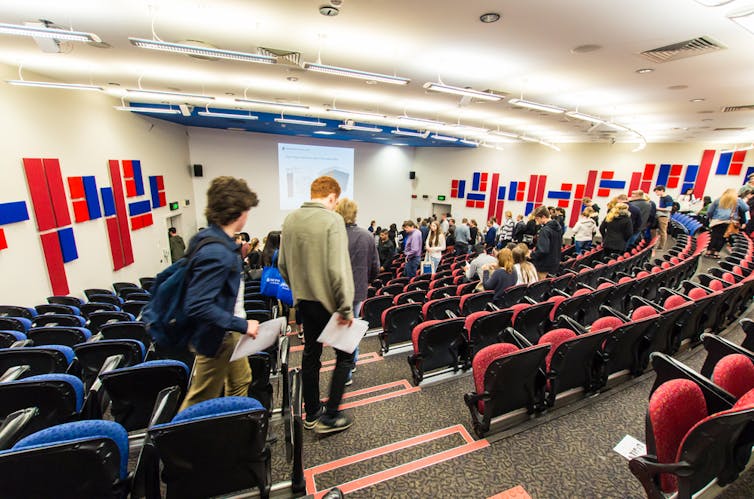 Universities should support the pursuit of knowledge, even if that means airing unorthodox ideas.
from www.shutterstock.com
Universities should support the pursuit of knowledge, even if that means airing unorthodox ideas.
from www.shutterstock.com
It’s also important to remember universities have a special responsibility for the attainment of knowledge and for the education of students. These goals require high levels of intellectual freedom, including freedom of speech. Freedom of speech enables researchers and students to discover new things, communicate and test their ideas, and foster and develop critical thinking skills.
But freedom of speech in universities is a means to that end, and not an end in itself.
The four fundamental principles
Because of this responsibility, universities should be guided by four fundamental free speech principles.
1. Unorthodox ideas should be welcomed and offensive ideas must be tolerated
The proper advancement of knowledge and learning requires a high degree of freedom of speech. It’s very important orthodoxies can be challenged and ideas subject to debate and criticism. It’s through freedom of speech, for example, that women and minorities challenged established ideas about their inferiority.
A university community is necessarily one in which people disagree and will often do so in deep and unchangeable ways. Those disagreements mean sometimes public debate on campus will be highly offensive and upsetting. Even so, offensive ideas must be tolerated.
Read more: Who really benefits from freedom of speech?
Our willingness to extend the right to people we disagree with is at the heart of freedom of speech. After all, popular or mainstream ideas generally need no protection. There is no question, for example, that Bettina Arndt should be permitted to speak on university campuses, as should those who oppose her.
2. Protest is crucial to the proper exercise of free speech rights on campus and should be permitted and facilitated
The protection of protest is just as important as protecting the expression of unorthodox and unpopular ideas. Protest - whether by environmentalists or anti-abortion activists – is an important means for the expression of unorthodox and unpopular ideas, as well as for a response to them. We should expect protest to be part of university life and universities should both permit and facilitate them.
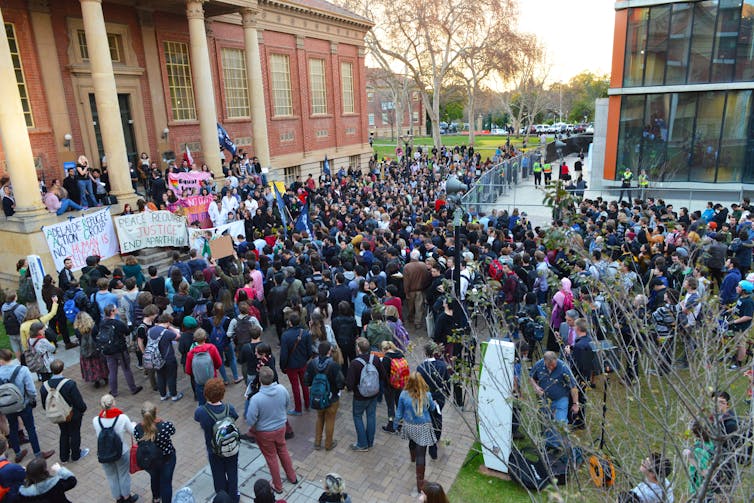 Universities should permit and facilitate protest, like this one at the University of Adelaide in 2014.
Brenton Edwards
Universities should permit and facilitate protest, like this one at the University of Adelaide in 2014.
Brenton Edwards
Obviously, universities will be in the middle of fierce disputes between opposing elements of the community and working out a balance of interests will be difficult. If there are loud and chaotic protests that require significant security, it will also be expensive.
But it’s not fair to place the cost of security entirely on those provoking the protest (giving protesters an effective heckler’s veto). Nor is it fair to place it on those protesting (given the importance of protest as a mechanism for free speech).
If governments are serious about protecting freedom of speech on campus they should fund universities in a way that makes it possible for them to balance free speech and protest on their campuses. A free speech fund for each university seems like a small price to pay for something so fundamental.
3. The university must protect the pursuit of knowledge
Because universities have a responsibility to promote the attainment of knowledge and education, they also need to protect those activities from people who blatantly disregard evidence, research and scholarly standards of inquiry.
Universities should not be required to give a platform to those who peddle nonsense – especially dangerous nonsense. Universities are quite within their rights to deny anti-vaxxers, holocaust deniers, flat earthers and others from the use of their facilities.
The line between the unorthodox and nonsense can, of course, be blurry and universities should be very careful about how they exercise this power. They might choose instead to permit such speakers but to ensure a platform for their critics that’s at least as prominent.
Free speech scholar and Columbia University President Lee Bollinger provided a good example of this kind of action when he permitted the appearance of then President of Iran, Mahmoud Ahmadinejad, on Columbia’s campus but personally introduced him with a series of sharp challenges. Universities should support freedom of speech, including unpopular ideas, but not without challenging them.
4. The university’s intellectual climate must be inclusive
Universities can’t be sure they have the best researchers and students unless everyone has an equal opportunity to attend and participate in university life. For this reason, universities need to take seriously the concerns of students and staff who are affected by the exercise of the free speech rights of others.
Read more: University changes to academic contracts are threatening freedom of speech
Students who claim controversial ideas threaten their safety have been widely condemned. Hurt feelings themselves provide no good reason to take action against speech or speakers. But these students are often arguing that ideas perpetuated by these speakers are a barrier to their equality and can lead to discrimination or violence.
At least in public forums on campus, a university should very rarely prevent speakers from spreading their message. But students concerned about their equality and safety on campus should not be ignored or ridiculed.
Universities need to engage with their students about their concerns, take steps to protect their physical safety and well-being, and ensure these students can respond on their own behalf. In serious cases, where students are subject to unfair and abusive commentary, the university ought to use its own powers of speech to defend them publicly.
Authors: Adrienne Stone, Redmond Barry Distinguished Professor, Kathleen Fitzpatrick Australian Laureate Fellow, Director, Centre for Comparative Constitutional Studies, University of Melbourne


 Daily Bulletin


