

You can't 'erase' bad memories, but you can learn ways to cope with them
- Written by: Carol Newall, Senior Lecturer in Early Childhood, Macquarie University
The film Eternal Sunshine of the Spotless Mind pitched an interesting premise: what if we could erase unwanted memories that lead to sadness, despair, depression, or anxiety? Might this someday be possible, and do we know enough about how distressing memories are formed, stored, and retrieved to make such a therapy possible?
Cognitive behaviour therapy (CBT) is a common treatment for anxiety disorders. The basic idea of CBT is to change the fear-eliciting thoughts that underlie a client’s anxiety.
Read more: Explainer: what is cognitive behaviour therapy?
Imagine the instance where a person has a dog phobia. They are likely to believe that “all dogs are dangerous”. During CBT, the client is gradually exposed to friendly dogs to cognitively reframe their thoughts or memories into something more realistic – such as the belief “most dogs are friendly”.
CBT is one of the most scientifically supported treatments for anxiety disorders. But unfortunately, a recent US study indicates that in around 50% of patients, old fear memories resurface four years after CBT or drug treatment. Put another way, the old fear memories seem impermeable to erasure through gold-standard therapy or drug treatment.
 Eternal Sunshine of the Spotless Mind was an interesting thought experiment into whether it’s better for your well-being to erase painful memories.
Focus Features/Anonymous Content/ This Is That Productions/IMDb
Eternal Sunshine of the Spotless Mind was an interesting thought experiment into whether it’s better for your well-being to erase painful memories.
Focus Features/Anonymous Content/ This Is That Productions/IMDb
Why distressing memories are difficult to ‘erase’
Fear memories are stored in an old part of the brain called the amygdala. The amygdala developed early in our evolutionary history because having a healthy dose of fear keeps us safe from dangerous situations that might reduce our chances of survival.
Permanent storage of dangerous information is adaptive. While we might learn some things are safe sometimes (encountering a lion in a zoo) we also need to be aware they not safe in many other circumstances (meeting a lion in the wild).
This permanent storage of a fear memory explains why relapse occurs. During therapy, a new memory – say, “most dogs are friendly” – is formed. But this new safe memory is bound to a specific context (friendly dog in the therapy room). In that context, the rational part of the brain, the prefrontal cortex, puts a brake on the amygdala and tells it not to retrieve the old fear memory.
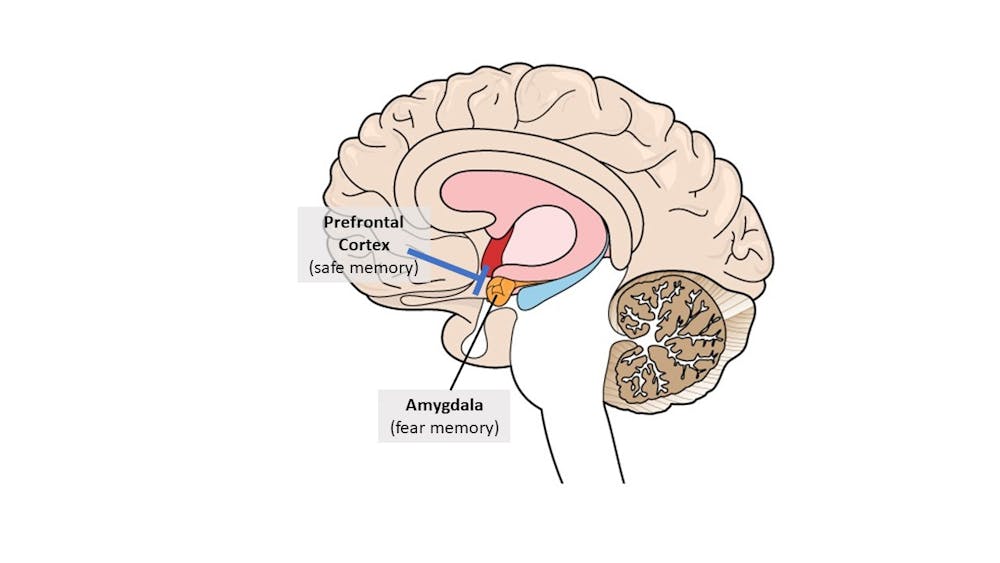 The prefrontal cortext can put a brake (blue line) on the amygdala, if it doesn’t want it to retrieve the old memory.
from shutterstock.com
The prefrontal cortext can put a brake (blue line) on the amygdala, if it doesn’t want it to retrieve the old memory.
from shutterstock.com
But what happens when a patient encounters a new context, such as a dog in a park? By default, the brain retrieves the fear memory that “all dogs are dangerous” in any context, except the one where the new safe memory occurred. That is, old fear memories can be renewed with any change in context.
This default has helped humans survive in dangerous environments throughout our evolutionary history. However, for anxious clients whose fear is unrealistic and excessive, this default to distressing memories is likely one important basis for the high rates of anxiety relapse.
So is it erasure ever possible?
There are a few instances that suggest “erasure” is sometimes possible. For example, relapse is not seen early in life with non-human animals. This may be because the brake signals from the prefrontal cortex to the amygdala mature late in development. As there are no brakes, perhaps erasure of fear memories occurs instead.
By extension, this suggests early intervention for anxiety disorder is important as children may be more resilient to relapse. However, the jury is still out on whether erasure of fear memories occurs at all in children and, if so, at what age.
 It’s important to expose yourself to your fear in as many different contexts as possible.
Marcus Benedix/Unsplash
It’s important to expose yourself to your fear in as many different contexts as possible.
Marcus Benedix/Unsplash
So, given the high rate of relapse, is there a point to pursuing treatment at all? Absolutely! Having some respite from anxiety allows for significant moments of sunshine and improves quality of life, even if it is not eternal. In these moments, the typically anxious person might attend parties and make new friends or handle a stressful job interview successfully – things they would not have done because of excessive fear.
Read more: Memories of trauma are unique because of how brains and bodies respond to threat
One way to reduce the chances of relapse is to confront irrational fear at every opportunity and create new safe memories in many different contexts. Anticipating contextual factors that are trigger points for relapse, such as changing jobs or relationship break-ups, can also be adaptive. Strategies can then be used to manage the re-emergence of distressing thoughts and memories.
While erasure of negative memories may be the goal of the characters in Eternal Sunshine, the film also emphasises the importance of these memories. When processed rationally, stressful memories motivate us to make better decisions and become resilient. Being able look back on unpleasant memories without excessive distress allows us to move forward with greater wisdom and this is the ultimate goal for all therapeutic frameworks.
Authors: Carol Newall, Senior Lecturer in Early Childhood, Macquarie University


 Daily Bulletin


