

a place to discover Australia's many stories
- Written by: Sarah Barns, Engaged Research Fellow, Institute for Culture and Society, Western Sydney University
This piece is republished with permission from Who We Are, the 61st edition of Griffith Review. It is a little longer and more in-depth than most published on The Conversation.
There are jackhammers everywhere. A new Parramatta is emerging out of the rubble, seeking to make real its tag line: “Australia’s next great city”. Thickets of new residential and commercial towers are rising – testament to the city’s ferocious ambition – overshadowing what remains of the squat, 1970s office blocks built during Parramatta’s previous development boom.
There are many today who loudly proclaim Parramatta’s centrality to the story of Sydney. Mike Baird, when premier of NSW in 2015, called Parramatta nothing less than “the infrastructure capital of the world”, its fortunes tied closely to those of the state and the nation. The west is booming, as the New South Wales government releases huge tracts of land in the north-west and south-west of Sydney for development, and developers are cashing in on Parramatta’s rise.
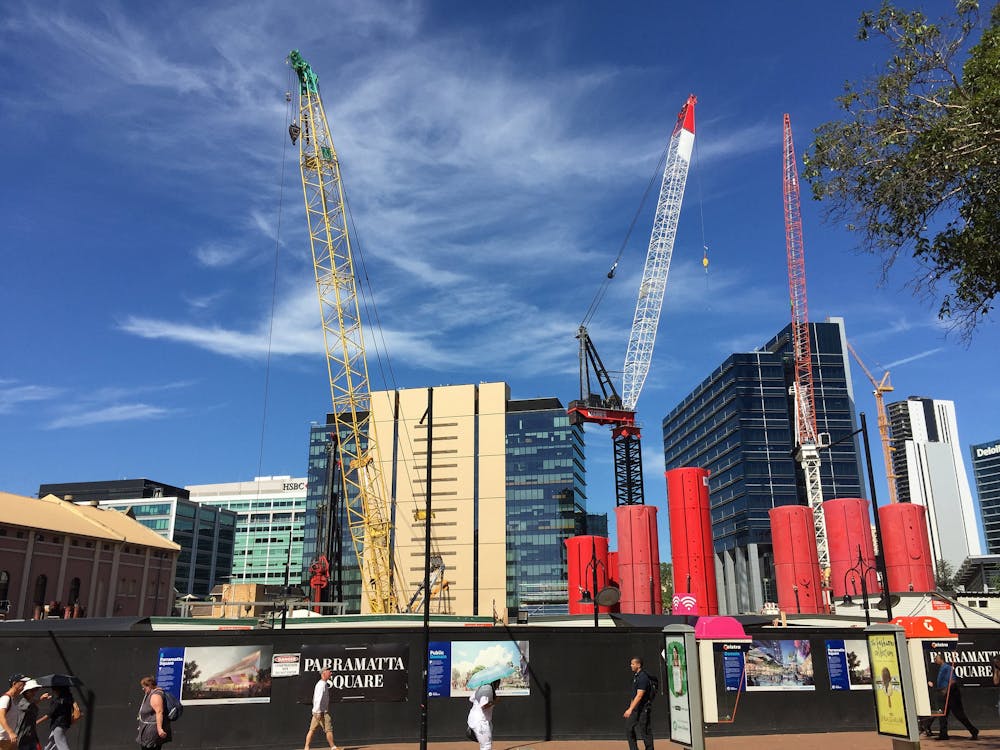 It’s been claimed Parramatta is the infrastructure capital of the world.
redwolfoz/Flickr, CC BY
It’s been claimed Parramatta is the infrastructure capital of the world.
redwolfoz/Flickr, CC BY
National Australia Bank is setting up its new headquarters at the A$2 billion development that is Parramatta Square. A new light rail network is on the way. Western Sydney University has completed its A$220.5 million high-rise campus. A new A$1 billion health precinct at Westmead is coming.
So, Parramatta is a city on the make. And the numbers tell us why. The NSW government’s population projections show Greater Sydney growing by more than 1.5 million people over the next two decades. The City of Parramatta’s population is forecast to grow by over 75,000 over the next decade alone.
Presented as objective fact, too often it’s forgotten that such numbers are primarily expressions not of a certain future but of a recent past, projected forward in time. Today’s population projections are comprised, to no small extent, by yesterday’s migration policies. They are not an inevitable future, but an intentional one, a story about where we want to go.
Read more: Migration helps balance our ageing population – we don't need a moratorium
Western Sydney attracts a high proportion of Australia’s migrants. Parramatta, in particular, is a city being radically reshaped to meet the volume of demand projected off the back of this recent, record-breaking intake. Between the 2001 and 2016 census dates, the city welcomed almost 20,000 more Indian-born residents and 16,000 Chinese-born arrivals.
Over the same period, the number of Parramatta’s Australian-born grew by just 6,000. Today, the proportion of Parramatta’s population that identifies as Australian by ancestry is just 13%, compared to 23% for Australia as a whole.
Clearly, Parramatta’s A$10 billion transformation is preparing the city for a future that will be culturally distinct from its past. Australia’s next great city is emerging as a beacon of our nation’s hopeful, cosmopolitan future, built on growth, multiplied. But what kind of city will it be?
What makes a city
A city, after all, is more than the sum of its speculative real estate invest- ments and projected demand. Cities, as Leonie Sandercock reflected in her essay Practicing Utopia, are “neither organisms nor machines. They are flesh and stone intertwined. They are ‘built thought’.”
Surely, to be great a city must capture our imaginations. It must offer, all at once, a place to get lost in and a place in which to belong. In great cities we seek both refuge in the crowd and a sense of connection with something bigger than our selfies.
The greatest cities of the world also immerse us in experiential encounters with the archaeology of other eras. They are storied landscapes. Walking through these cities, we quite naturally absorb the daily integration of archaic infrastructures – horse troughs, cobblestones, ceramic piping – with the computationally connected services of our emergent present.
 The road we walk along can capture our imagination of the stories it holds.
Donnie Rosie/Unsplash
The road we walk along can capture our imagination of the stories it holds.
Donnie Rosie/Unsplash
It is through the remnant traces of past eras that we can imagine a sense of physical connection with those who came before us. We hear a lot about the challenges that population growth brings to Australian cities. Mostly, we are conditioned to thinking of these challenges as infrastructural, or monetary.
But as our new, denser urban forms are rapidly realised, with forests of cranes and thickets of high-rise apartments replacing the sleepy suburbs that once represented the Australian dream, we’re also going to need to rebuild, as it were, the narratives of place and of belonging that define our cities.
As Robert Hughes once said, delivering a National Trust lecture in 1998 on Australia’s forgotten histories:
An urban culture that predicates itself chiefly on an obsession with development is not worth having. A city needs deep memory, without which it becomes merely a stage set.
It is the accumulation of stories and experiences inscribed in built form that gives a place its distinct identity. Such stories are not only for the culturally sensitive: they drive real-estate investment too. When a city is rebuilt from scratch, we risk losing these stories and connections.
Australian cities have never been particularly good at celebrating the stories of people and place that have shaped them over time. Is this still true? More and more, our planners, designers, architects and developers seek to use the resources of the past to cultivate a contemporary sense of place. Decades of urban sprawl and featureless, automobile-dependent suburban landscapes have led to a renewed push for the creation of “liveable” urban identities that celebrate place and community.
The art of city building is now the art of place-making. In this context, local heritage becomes an asset; an important contributor to both economic and cultural vitality. You can see this in the prices paid for the converted warehouse buildings and sugar mills dotted across the suburban landscape.
So, if it’s going to be Australia’s next great city, the radical rebuilding of Parramatta is also an opportunity to ask questions about how we make use of the past as a resource for building the future.
Parramatta – a gathering place
So often celebrated within historical accounts as the “cradle of the colony”, Parramatta’s history has been synonymous with the story of Australia’s beginnings as a nation.
This, after all, is where Australia’s identity as an agricultural nation was first forged. Having followed Arthur Phillip down the river in search of arable land, it is where early convicts successfully proved not only the economic viability of the fledgling colony, but their worthiness as free citizens. It is likewise in Parramatta that the British government first tested its limits of moral and administrative governance in its new colony through the building of not only the first Government House, but also of prisons, factories, asylums and “native institutions”.
This heroic story about Parramatta’s colonial foundations continues to be told through sites like Experiment Farm, the Parramatta Female Factory and the many other colonial administration buildings that remain. You walk into the Parramatta Heritage Centre and you will learn much about this story. And yet, cleaving to the notion of European founding, somehow standing in for the beginning of time, has in turn obscured other narratives.
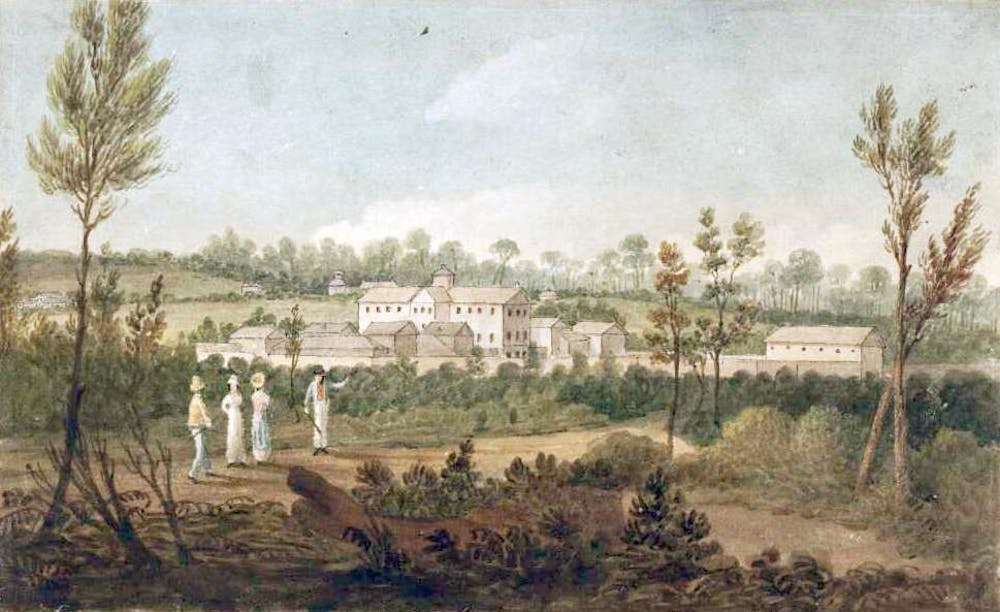 The Parramatta Female Factory continues to tell Parramatta’s colonial story.
Wikimedia Commons
The Parramatta Female Factory continues to tell Parramatta’s colonial story.
Wikimedia Commons
Parramatta’s founding is a big story, particularly when it helps forge the identity of Australia as a largely Europeanised nation. But the cradle story has also contributed to a certain blindness about the experiences of people in Parramatta since the days of Phillip and his men. It excludes millennia of Aboriginal occupation, their custodianship of the environment and continuing urban presence, as well as the great diversity of people who have arrived here from nations across the globe.
Rich as it is, Parramatta’s story requires considerable rethinking and public conversation in order to bring it into a stronger relation with the present. As Australia’s next great city appears in view, this dialogue is beginning to happen, and new evidence is being found within the rubble. A cultural plan for the new CBD released by the City of Parramatta in 2017 acknowledges that Parramatta “always was, always will be, a gathering place”.
Read more: Transforming the Parramatta Female Factory institutional precinct into a site of conscience
An archaeological analysis recently undertaken by Comber Consultants as part of the redevelopment of Parramatta Square has tentatively found the area may have been used as a gathering place for at least some 5,000 years. Such discoveries prompt a reassessment of the nature and experience of early interactions between settlers and Aboriginal peoples.
This gathering place likewise witnessed the “Battle of Parramatta” in 1797, when a hundred Aboriginal warriors led by Pemulwuy arrived in formation down George Street. They were fighting against the many injustices inflicted upon them by the new arrivals. Pemulwuy would be shot, his warriors dispersed.
A rich history
The City of Parramatta commissioned us in 2017 to offer an account of Parramatta’s many “waves of migration”, a project inspired by this revived notion of Parramatta as a gathering place. We found that not all the convicts who first settled here were European. Africans and Indians were among the first convicts.
The different nationalities caught up in the convict system reflected a number of diverse political struggles being fought at the time of European arrival in Sydney. Political activists from around the world included the Scottish “martyrs” of 1794 and 1795, Irish rebels of 1798 and 1803, trade unionists and insurrectionists from Canada, military prisoners from India and rebellious slaves from the West Indies.
In the early years of Parramatta’s settlement there are records of the presence of various Maori, Afro-Americans, Indian, Chinese, Maltese and others. There is a long association in Parramatta with Maori connecting to the colony through trade, shipping, whaling and missionary activity.
Read more: Rediscovered: the Aboriginal names for ten Melbourne suburbs
Parramatta was also central, we found, to the story of Australia’s embrace of immigration after the second world war. The formation of a federal department for immigration after the war, and massive growth of European migration from the late 1940s through the 1960s, would alter the fabric of Australian life in decisive ways.
Parramatta, where experiments in European food production were first tried and tested, is also where our early experiments in migrant support took place. It was here that many new arrivals from war-torn Europe first settled. An American naval base hospital, established in Granville Park in 1942, was used after 1945 as one of the first hostels for migrants. Other migrant hostels were located in nearby Ermington, Dundas and Villawood to accommodate displaced persons and recent migrants.
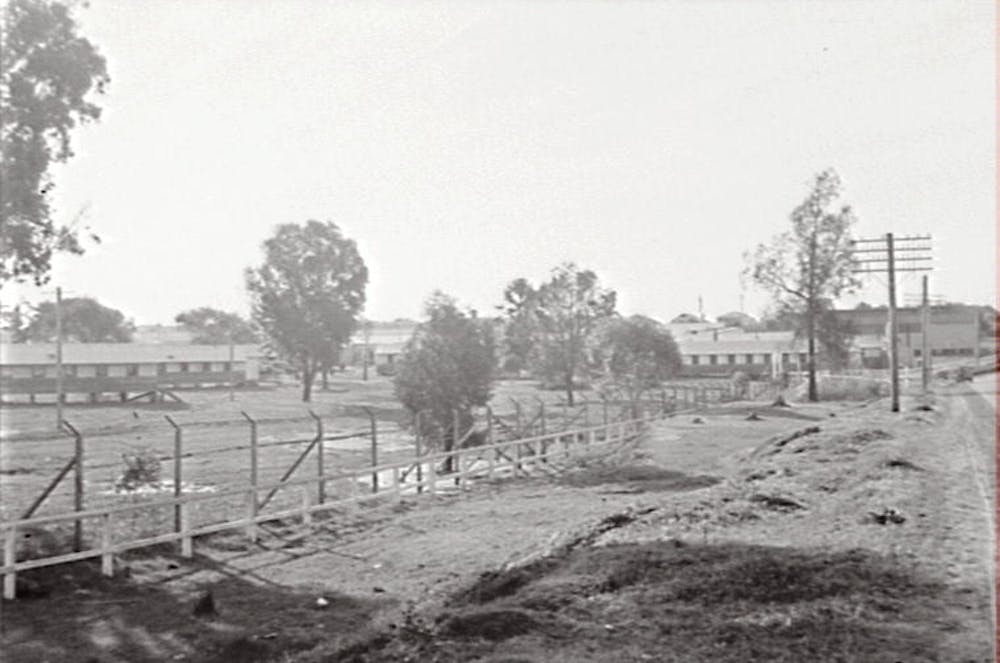 The US naval base hospital in Granville Park was used to house migrants after 1945.
Holroyd City Library/Flickr, CC BY
The US naval base hospital in Granville Park was used to house migrants after 1945.
Holroyd City Library/Flickr, CC BY
We saw that over the 20th century processes of “chain migration” would shape Parramatta fundamentally. Chain migration – the term used to describe how migrants follow others from their town to a new host destination – was most strongly practised by Lebanese and Greek communities.
We learned of the significance of two women from the Lebanese village of Kfarsghab, Rosie Broheen and Zahra Youssef Assad Rizk, who were among the first to have settled in Parramatta, after arriving in Australia in the late 1890s. Since their arrival, families from the Kfarsghab village continued to migrate to Parramatta, a process that intensified as part of the post-war wave of migration to Sydney. Chain migration was actively supported by Australian migration policy at this time, which placed strong emphasis on family reunion.
Read more: Australia's post-war migration was a success, let's admit it
By 2008, an estimated 10,000 people in Parramatta could trace their ancestry to the village of Kfarsghab. Indeed, the importance of Parramatta to this community was commemorated when the main street of the village in Lebanon was renamed Parramatta Road. Another Lebanese village of importance to Parramatta is the Maronite village of Hadchit in northern Lebanon. There are now about 500 Hadchiti households in areas such as Westmead and Harris Park.
We found great gaps in knowledge about the continued presence of Aboriginal people after the initial years of contact (gaps that are beginning to be filled). One woman we spoke to said she was sick of hearing about “her culture” being thousands of years old while not being listened to in the present.
And so, while we did gather together diverse stories of migration and movement in and around Parramatta – sometimes free movements, some under adverse circumstances – what was ever-present was the invisibility of lives not previously deemed of any real importance to the evolving story of Parramatta and its role in accommodating different ideas about Australia’s place in the world.
Keeping place
In commissioning our research, the City of Parramatta Council has sought to fill some of the gaps in its historical knowledge of migration impacts on the city. It plans to acknowledge and celebrate these many experiences – of both gathering and dispersal – through interpretive artworks within new developments like Parramatta Square. There are hopes for a “Keeping Place” that acknowledges stories of Indigenous lives, including their dispossession.
Through ongoing practices of interpretation, documentation and story-telling, as well as continuing dialogue about the most appropriate future uses of significant historical sites such as Parramatta Park and the Parramatta Female Factory, we hope Australia’s next great city can also be a place where new cultural imaginaries of place can be celebrated. Looking beyond the exaggerated localism of much local history and the “foundational narrative” of colonial beginnings, Parramatta is a place where many different versions of becoming Australian can be cultivated and explored.
Authors: Sarah Barns, Engaged Research Fellow, Institute for Culture and Society, Western Sydney University
Read more http://theconversation.com/reimagining-parramatta-a-place-to-discover-australias-many-stories-100652


 Daily Bulletin


