

New Zealand's zero carbon bill: much ado about methane
- Written by: Robert McLachlan, Professor in Applied Mathematics, Massey University
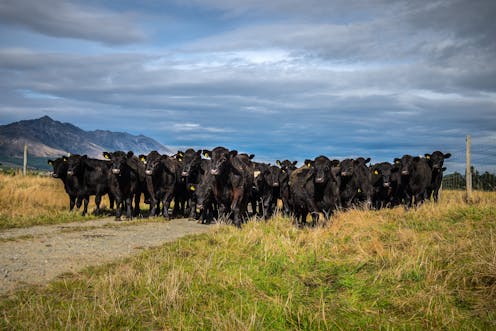
New Zealand could become the first country in the world to put a price on greenhouse gas emissions from agriculture.
Leading up to the 2017 election, the now Prime Minister Jacinda Ardern famously described climate change as “my generation’s nuclear-free moment”. The promised zero carbon bill is now underway, but in an unusual move, many provisions been thrown open to the public in a consultation exercise led by Minister for Climate Change James Shaw.
More than 4,000 submissions have already been made, with a week still to go, and the crunch point is whether or not agriculture should be part of the country’s transition to a low-emission economy.
Read more: New Zealand's productivity commission charts course to low-emission future
Zero carbon options
Many of the 16 questions in the consultation document concern the proposed climate change commission and how far its powers should extend. But the most contentious question refers to the definition of what “zero carbon” actually means.
The government has set a net zero carbon target for 2050, but in the consultation it is asking people to pick one of three options:
net zero carbon dioxide - reducing net carbon dioxide emissions to zero by 2050
net zero long-lived gases and stabilised short-lived gases - carbon dioxide and nitrous oxide to net zero by 2050, while stabilising methane
net zero emissions - net zero emissions across all greenhouse gases by 2050
The three main gases of concern are carbon dioxide (long-lived, and mostly produced by burning fossil fuels), nitrous oxide (also long-lived, and mostly produced by synthetic fertilisers and animal manures) and methane (short-lived, and mostly produced by burping cows and sheep). New Zealand’s emissions of these gases in 2016 were 34 million tonnes (Mt), 9Mt, and 34Mt of carbon dioxide equivalent (CO₂e), respectively.
All three options refer to “net” emissions, which means that emissions can be offset by land use changes, primarily carbon stored in trees. In option 1, only carbon dioxide is offset. In option 2, carbon dioxide and nitrous oxide are offset and methane is stabilised. In option 3, all greenhouses gases are offset.
Gathering support
Opposition leader Simon Bridges has declared his support for the establishment of a climate change commission. DairyNZ, an industry body, has appointed 15 dairy farmers as “climate change ambassadors” and has been running a nationwide series of workshops on the role of agricultural emissions.
Earlier this month, Ardern and the Farming Leaders Group (representing most large farming bodies) published a joint statement that the farming sector and the government are committed to working together to achieve net zero emissions from agri-food production by 2050. Not long after, the Climate Leaders Coalition, representing 60 large corporations, announced their support for strong action to reduce emissions and for the zero carbon bill.
However, the devil is in the detail. While option 2 involves stabilising methane emissions, for example, it does not specify at what level or how this would be determined. Former Green Party co-leader Jeanette Fitzsimons has argued that methane emissions need to be cut hard and fast, whereas farming groups would prefer to stabilise emissions at their present levels.
Read more: Why methane should be treated differently compared to long-lived greenhouse gases
This would be a much less ambitious 2050 target than option 3, potentially leaving the full 34Mt of present methane emissions untouched. Under current international rules, this would amount to an overall reduction in emissions of about 50% on New Zealand’s 1990 levels and would likely be judged insufficient in terms of the Paris climate agreement. This may not be what people thought they were voting for in 2017.
Why we can’t ignore methane
To keep warming below 2℃ above pre-industrial global temperatures, CO₂ emissions will need to fall below zero (that is, into net removals) by the 2050s to 2070s, along with deep reductions of all other greenhouse gases. To stay close to 1.5℃, the more ambitious of the twin Paris goals, CO₂ emissions would need to reach net zero by the 2040s. If net removals cannot be achieved, global CO₂ emissions will need to reach zero sooner.
Therefore, global pressure to reduce agricultural emissions, especially from ruminants, is likely to increase. A recent study found that agriculture is responsible for 26% of human-caused greenhouse emissions, and that meat and dairy provide 18% of calories and 37% of protein, while producing 60% of agriculture’s greenhouse gases.
A new report by Massey University’s Ralph Sims for the UN Global Environment Facility concludes that currently, the global food supply system is not sustainable, and that present policies will not cut agricultural emissions sufficiently to limit global warming to 1.5℃ above pre-industrial levels.
Finding a way forward
Reducing agricultural emissions without reducing stock numbers significantly is difficult. Many options are being explored, from breeding low-emission animals and selecting low-emission feeds to housing animals off-pasture and methane inhibitors and vaccines.
But any of these will face a cost and it is unclear who should pay. Non-agricultural industries, including the fossil fuel sector, are already in New Zealand’s Emissions Trading Scheme (ETS) and would like agriculture to pay for emissions created on the farm. Agricultural industries argue that they should not pay until cost-effective mitigation options are available and their international competitors face a similar cost.
The government has come up with a compromise. Its coalition agreement states that if agriculture were to be included in the ETS, only 5% would enter into the scheme, initially. The amount of money involved here is small - NZ$40 million a year - in an industry with annual export earnings of NZ$20 billion. It would add about 0.17% to the price of whole milk powder and 0.5% to the wholesale price of beef.
However, it would set an important precedent. New Zealand would become the first country in the world to put a price agricultural emissions. Many people hope that the zero carbon bill will represent a turning point. It may even inspire other countries to follow suit.
Authors: Robert McLachlan, Professor in Applied Mathematics, Massey University
Read more http://theconversation.com/new-zealands-zero-carbon-bill-much-ado-about-methane-99842


 Daily Bulletin


