

Why the ABC, and the public that trusts it, must stand firm against threats to its editorial independence
- Written by: Denis Muller, Senior Research Fellow in the Centre for Advancing Journalism, University of Melbourne
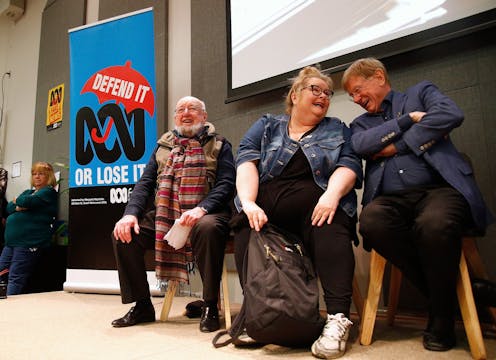
The people who are turning up at Save the ABC rallies around the country are defending a cultural institution they value because they trust it.
In particular, they trust its news service. Public opinion polls going back to the 1950s consistently show it is by far the most trusted in the country.
So at this time it is pertinent to look at what creates a trustworthy news service. The cornerstone is editorial independence. As opinion polls have shown time and again, where people suspect a newspaper, radio, TV or online news service of pushing some commercial or political interest, their level of trust falls.
Editorial independence does not mean giving journalists licence to broadcast or publish whatever they want or to avoid accountability for their mistakes.
It means encouraging journalists to tackle important stories regardless of what people in power might think, then backing them to make judgments based on news values and the public interest, not on irrelevant considerations such as commercial, financial or political pressure.
Read more: Constant attacks on the ABC will come back to haunt the Coalition government
Editorial independence is hard won and under constant pressure from outside the newsroom.
In commercial media, this pressure comes from big advertisers or company bosses with financial or political interests to push.
In public-sector broadcasting, the pressure comes from the federal government, which provides the funding and has powerful means of subjecting the broadcaster to intense political pressure.
A robust editorial leadership is essential to resisting this heat. It’s a daily battle. If the senior editorial management wilts, the weakness is swiftly transmitted down the hierarchy.
Middle-level editors and the staff journalists who work to them start looking over their shoulders, tempted to take easy options and avoid possible heat. The easiest option is self-censorship, dodging sensitive stories, leaving out material or watering it down.
This is where the ABC is at a crossroads. It has as its managing director and editor-in-chief Michelle Guthrie, a person with no journalistic background and who until recently showed scant signs of understanding the impact on the ABC’s editorial independence of the Turnbull government’s relentless bullying.
Then last month she gave a speech at the Melbourne Press Club in which she said Australians regard the ABC as a great national institution and deeply resent it being used as “a punching bag by narrow political, commercial or ideological interests”.
It was a start, and now the cause has been taken up by ABC staff themselves and by the wider public in the Save the ABC movement led by ABC Friends.
It is strongly reminiscent of events at The Age nearly 30 years ago, when I was an associate editor there. Then, a Save The Age campaign showed how effective a public outpouring of support for a news outlet can be when they set out to defend one they trust.
The campaign’s origins lay in concerns among senior journalists at the paper over what might happen to its editorial independence when receivers were appointed in 1990. This followed a disastrous attempt by “young” Warwick Fairfax to privatise the Fairfax company, which was the paper’s owner.
A group of senior journalists, including the late David Wilson and the distinguished business writer Stephen Bartholomeusz, formed The Age Independence Committee. It drew up a charter of editorial independence.
The key passages stated that:
the proprietors acknowledge that journalists, artists and photographers must record the affairs of the city, state, nation and the world fairly, fully and regardless of any commercial, political or personal interests, including those of any proprietors, shareholders or board members
full editorial control of the newspaper, within a negotiated, fixed budget, is vested in the editor
the editor alone decides the editorial content, and controls the hiring, firing and deployment of editorial staff.
The Save The Age campaign generated tremendous public support. Former prime ministers Malcolm Fraser and Gough Whitlam, who had barely been on speaking terms since the Dismissal 15 years earlier, joined together at the head of a public demonstration in Melbourne’s Treasury Gardens. One of the campaign slogans was “Maintain Your Age”, a pun on Whitlam’s post-Dismissal election slogan, “Maintain Your Rage”.
Read more: The politics behind the competitive neutrality inquiry into ABC and SBS
Eventually, the receivers signed the charter and so, after some wrangling, did the new owners led by the Canadian-born newspaper baron, Conrad Black. Black is gone but the charter remains.
Like The Age in 1990, the ABC today has strong public support.
Like The Age in 1990, senior journalistic staff, most notably the Melbourne “Mornings” radio presenter Jon Faine, and former presenter of 7.30 on ABC TV, Kerry O’Brien, have shown leadership, lending their profile and authority to the cause.
But unlike The Age, the ABC does not have publicly acknowledged bipartisan political support.
Whatever Malcolm Turnbull’s private views of the ABC, and whatever the stated policy of his government, the facts are that since 2014 the Abbott and Turnbull governments have cut $338 million from the ABC’s funding, and the federal council of the Liberal Party voted last month to sell it off.
It is quite possible that when it reports in September, the present inquiry into the ABC’s competitive neutrality will provide some impetus to this proposition or propose some other ways to clip the ABC’s wings.
It is significant in the context of editorial independence that the inquiry is taking a particular interest in the ABC news service. That is the part of the ABC most detested by politicians, and on which the present government has focused its most intense pressure.
If editorial independence weakens, public trust will weaken too. That would make the ABC an even more attractive political target for a hostile government.
Authors: Denis Muller, Senior Research Fellow in the Centre for Advancing Journalism, University of Melbourne


 Daily Bulletin


