

why we still have some way to go
- Written by: Dominic O'Sullivan, Associate Professor of Political Science, Charles Sturt University
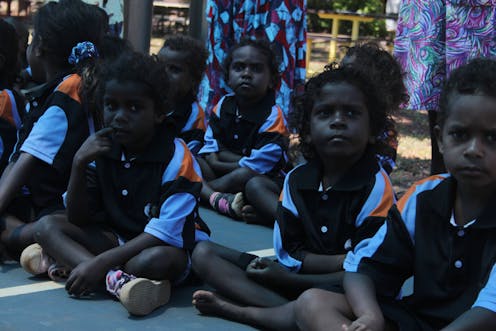
At a Senate Estimates hearing in May, LNP Senator Ian MacDonald said he found it difficult to find any but “very rare” cases of racism in Australia. Though, he did concede perhaps this view had developed “living in a bubble”. Bubbles are dangerous places from which to make public policy.
MacDonald may not have had personal experiences of racism, but 20% of Australians have experienced racism in the past 12 months due to the colour of their skin, ethnic origin or religion.
Racism means people experience citizenship differently. It means opportunities and capacities are not equally available to every citizen and egalitarian justice, the idea of a “fair go” for everyone, doesn’t work as it’s intended.
Racism divides societies and fractures the idea of common nationhood. It helps explain why some people don’t get a fair go at school, for example.
Racism and school policy
Schools operate outside MacDonald’s bubble. But they aren’t ideologically neutral.
Historically, education policy was explicit. Schools were not meant to work for Indigenous people. In the 1890s, inferior curriculums were officially circulated for Indigenous people.
By 1937, the idea of inherent Indigenous intellectual inferiority remained. A parliamentary committee heard and ignored arguments for better schooling:
I say that a full-blood can be educated just as well as a half-caste or non-Aboriginal…I say they must have qualified teachers…At present they are not qualified…
Indigenous people could be excluded from New South Wales public schools until 1972.
Separate schools for Indigenous peoples were established to meet the requirement for education set out by the Aboriginal Protection Acts. But education was usually for domestic service or labouring, and often marked by physical and sexual abuse.
Exclusion is the lived experience of some of the parents of Indigenous people who are in school now. As well as being a denial of equal human worth, the experience of racism at school directly predicts lower test scores.
Racism also occurs at other levels of the education system. For example, in 2017, an Australian Indigenous Doctors’ Association member survey found 60% of Indigenous doctors and medical students had experienced racism and/or bullying during training.
Education and culture are universal human rights. But when some people can bring their knowledge, experiences and worldviews to school and others can’t, it produces systemic discrimination. It means different people get different levels of access to education.
Who decides what knowledge counts
Canadian multicultural political theorist Will Kymlicka argues:
the state unavoidably promotes certain cultural identities and thereby disadvantages others. This may be true, but the state can also intentionally promote some cultural identities at the exclusion of others.
In 2008, Julia Gillard insisted bilingual schooling discontinue in the Northern Territory. It was an ideological position that undervalued the relationships between language, cultural identity and intellectual development. Nor did it consider that there are broader and more important contributors to school effectiveness such as teacher quality.
The question of who decides what knowledge counts for Indigenous people is also important. Can Indigenous people really be equal citizens if they can’t contribute to these decisions?
Again in 2008, a Northern Territory government submission to an inquiry into the Northern Territory Intervention made it clear even the citizen’s right to go to school was conditioned by systematic racism.
According to a government submission, policy measures to combat truancy were problematic because if they worked, the system would not be able to cope with the anticipated increase in school attendance. The failure of this policy was expected and accepted for Indigenous citizens.
Where are we now?
In Australia and elsewhere in 2018, policy rhetoric allows Indigenous peoples to pursue higher aspirations. It insists on fundamental human equality and aims to shift MacDonald’s observation from the naive to the prophetic. Eliminating racism from public policy means positive difference is a reasonable expectation of citizenship.
Everybody should enjoy the same political capacities to influence what happens at school, why and for whose benefit. The claim for influence, as a capacity of citizenship, inspires the contemporary call for a guaranteed Indigenous voice to parliament.
But diminishing racism and the policy failure that it causes requires Indigenous voice at all levels of public policy-making and implementation. Culture counts not just in classroom practices, but also in policy evaluation.
There are, for example, important arguments of equal citizenship for Indigenous policy makers to examine the apparent contradiction between low Indigenous achievement in NAPLAN and the only Closing the Gap target on track to be met – halving the gap in year 12 attainment by 2020. Policy failure can be reduced by replicating examples of success.
What does work?
In 2016, a National Health and Medical Research Council forum proposed establishing an Aboriginal community-controlled education sector. This would parallel the 143 existing community-controlled health organisations and contribute to a citizenship of influence.
The Indigenous Stronger Smarter Institute’s educational principles reflect an expectation that schools must work equally well for everybody; that education should occur on principles of equal citizenship. This includes acknowledging and embracing a positive sense of identity, Indigenous leadership in schools and school communities, and having high expectations for Indigenous staff and students.
The Australian Institute for Teaching and School Leadership provides examples of these principles working in practice to improve Indigenous achievement. But the institute’s listed instances of “what works” are not generally measures that have been trialled, evaluated and replicated across whole school systems.
All New Zealand schools are evaluated explicitly and publicly on Maori achievement and their efforts to improve it. Many have raised Maori achievement with reference to an Effective Teaching Profile developed by the Maori led Te Kotahitanga research and teacher professional development project. Its six presumptions are that:
teachers care for their students as culturally located human beings above all else
teachers care for the performance of their students
teachers are able to create a secure, well-managed learning environment
teachers are able to engage in effective teaching interactions with Māori students as Māori
teachers can use strategies that promote effective teaching interactions and relationships with their learners
teachers promote, monitor and reflect on outcomes that in turn lead to improvements in educational achievement for Māori students.
Te Kotahitanga and its successor professional development programmes are widely implemented and the Coalition Government Agreement between the Labour and New Zealand First parties commits to further investment in the project.
The contrast between Australia and New Zealand is ultimately one of expectations about what it means to be an Indigenous citizen entitled to a “fair go” as racism’s opposite.
Authors: Dominic O'Sullivan, Associate Professor of Political Science, Charles Sturt University
Read more http://theconversation.com/racism-citizenship-and-schooling-why-we-still-have-some-way-to-go-99373


 Daily Bulletin


