

Universities need to do more to support refugee students
- Written by: Sally Baker, Lecturer, School of Social Sciences, UNSW
In the past two decades Australian universities and schools have received growing numbers of students from refugee backgrounds. This is in line with increasing numbers of people accepted through Australia’s humanitarian program.
But there are concerns refugee students are denied access to equitable educational opportunities as a result of:
In addition, transition is seen as something that only happens in the first year of university. This adds challenges for students like refugees who often have complex and ongoing needs.
Read more: Student success: why first year at uni is a make-or-break experience
Our recent research looked at refugee students’ experiences of transitioning into and participating in higher education. It shows refugee students are hindered by institutional assumptions about their knowledge of higher education, inflexible systems, and limited supports offered to refugee students. Particularly with regard to recognising their developing English language and literacy.
The research
Our research was undertaken in partnership with Newcastle, Macquarie and Curtin Universities. We used a qualitative, longitudinal approach to explore refugee students’ transitions into university. We tracked groups of adult and young refugee students as they entered higher education from three different pathways:
seven students from TAFE (in Newcastle)
35 students from high schools (in Sydney)
45 students from Intensive English Centres (IEC) (in Perth).
We followed our participants’ journeys into, through and (prematurely) out of higher education. We documented their aspirations for higher education, reasons for studying (and dropping out), perceptions, and practices. We also conducted a national audit of available pathways into higher education for refugee students.
Institutional views of transition limit refugee students
Our findings challenge the idea transition is a linear process that’s similar for everyone. Instead, our results highlight that transition is strongly influenced by:
- a student’s age
- familial responsibilities
- clarity of future vision (professional/career aspiration)
- support networks
- understanding of what higher education entails (in terms of the time and space it takes to undertake higher education studies).
We also found inflexible structures of higher education and competing demands on their time and resources related to settlement often make transition difficult. This was even though participants expressed their desire to work hard.
Language challenges and supports
Our participants’ English proficiency often impacted negatively on their overall learning experience. Learning difficulties such as dyslexia can go undiagnosed due to the assumption academic issues are a result of English language difficulties.
Read more: How students from non-English-speaking backgrounds learn to read and write in different ways
Trauma is also unrecognised, as symptoms such as silence are assumed to be related to poor English ability. In particular, difficulties with spelling and grammar, along with discrimination towards poor pronunciation and difference in accent, especially for female students, were highlighted.
The availability, accessibility and use of face-to-face support are significant for developing good academic practices and language, and for creating social and cultural networks. But there is an evident mismatch between the type and quantity of support available and the types of support our participants needed. This is particularly true with regard to English language learning and developing social connections.
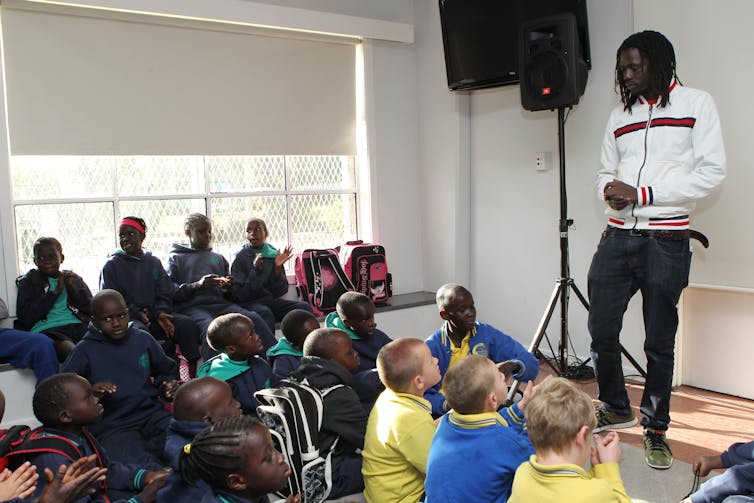 International hip hop star Emmanuel Jal visits Sudanese kids at the breakfast club of a Fitzroy community centre in Melbourne.
David Crosling/AAP
International hip hop star Emmanuel Jal visits Sudanese kids at the breakfast club of a Fitzroy community centre in Melbourne.
David Crosling/AAP
Our findings illustrate the importance of developing trusting relationships with mentors who can offer institutional support but are also seen as caring. Our participants told us they tended to go back to their former teachers and supporters for help, instead of seeking new relationships in their new contexts. For example, when starting undergraduate studies.
Time is a significant challenge
Time significantly impacted our participants in many forms:
- the imperative to “make up” for lost time (for adult participants)
- the lack of time to develop appropriate language and academic practices
- time-limited assessment procedures (which are harder for non-native English speakers)
- the labour of time needed for linguistic translation in study
- inflexible scheduling of academic programs and settlement obligations.
Read more: The importance of teaching more than English to refugee students
Recommendations
Schools, TAFEs and universities should work together to develop mentoring programs for high school/IEC/TAFE refugee students to make the transition into higher education easier
institutions should provide special orientation activities for refugee students. Possibly a “rolling orientation” to cater for students who have family commitments that may prevent attendance at stand-alone orientation activity
universities should employ an identified person, preferably with a refugee background, to offer consistent navigational and pastoral support to refugee students
suitably qualified and trained English language specialists should provide assistance with language development
provide targeted professional development for teaching staff to make clear the implicit assumptions and misrecognitions of refugee stereotyping. Also to illuminate the strengths, experiences and challenges refugee students bring with them into higher education.
Universities need to do more to support refugee students by addressing institutional assumptions about transition and language proficiency. They should also train and employ more front-line teachers and support staff.
Without developing a better understanding of the challenges refugee students face we run the risk of further disadvantaging them.
The authors wish to acknowledge the contributions of Associate Professor Seamus Fagan and Evonne Irwin from the University of Newcastle, Shelley Gower from Curtin University and Dr Sonal Singh from Macquarie University who were instrumental in conducting the research and the production of this article.
Authors: Sally Baker, Lecturer, School of Social Sciences, UNSW
Read more http://theconversation.com/universities-need-to-do-more-to-support-refugee-students-97185


 Daily Bulletin


