

Ancient stone tools found on Sulawesi, but who made them remains a mystery
- Written by: Adam Brumm, ARC Future Fellow, Griffith University
Another collection of stone tools dating back more than 50,000 years has been unearthed on the Indonesian island of Sulawesi. Details of the find, at a rock-shelter known as Leang Burung 2, are described in our paper out today in PLOS ONE.
But we uncovered no human fossils, so the identity of these tool-makers remains a mystery.
In 2016 we reported the discovery of similar findings dating to 200,000 years ago on Sulawesi, and we also have no idea who made them.
The earliest Sulawesi tools are so old that they could belong to one of several human species. Candidates include Homo erectus and Homo floresiensis, the dwarf-like “Hobbits” of Flores.
Read more: World's scientists turn to Asia and Australia to rewrite human history
Alternatively, they might have been Denisovans, distant cousins of Neanderthals who met early Aboriginal people in Southeast Asia, leaving a genetic legacy in their descendants.
They may even have been Homo sapiens that had ventured out of Africa long before the main exodus of our species.
Or they could be a totally unknown species.
Where did they go?
Not only do we not know who the first inhabitants of Sulawesi were, we have no idea what happened to them.
By 40,000 years ago people were creating rock art on Sulawesi. Given the sophistication of these artworks, their makers were surely Homo sapiens with modern minds like ours.
If the first islanders were a now-extinct group, did they linger long enough to encounter modern cultures?
Sulawesi also holds great promise for understanding the initial peopling of our land.
This large island on the route to Australia might have been the launch pad to these shores up to 65,000 years ago. It could even be where the First Australians met Denisovans.
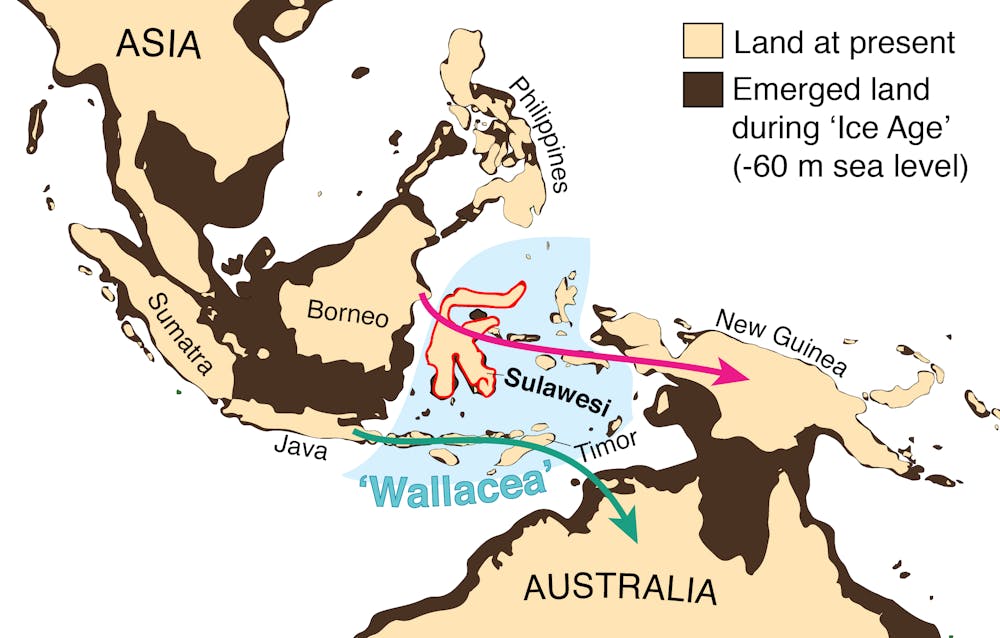 How our region looked during the Ice Age. Lower sea levels bridged the ocean barrier now separating Australia from New Guinea and joined up numerous islands in Southeast Asia to each other and to the adjacent mainland, with the exception of islands in Wallacea, which have always remained separate. The arrows show how the ancestors of Aboriginal people may have got to Australia up to 65,000 years ago.
Adam Brumm, Author provided
How our region looked during the Ice Age. Lower sea levels bridged the ocean barrier now separating Australia from New Guinea and joined up numerous islands in Southeast Asia to each other and to the adjacent mainland, with the exception of islands in Wallacea, which have always remained separate. The arrows show how the ancestors of Aboriginal people may have got to Australia up to 65,000 years ago.
Adam Brumm, Author provided
Resolving this mystery is not easy on a huge landmass like Sulawesi. Where do you begin to look? Which brings us to Leang Burung 2.
The original dig
Leang Burung 2 is a limestone rock-shelter in the island’s south. It was first excavated in 1975 by archaeologist Ian Glover.
 Sulawesi, showing the location of Leang Burung 2 rock-shelter.
ESRI (right map), Author provided
Sulawesi, showing the location of Leang Burung 2 rock-shelter.
ESRI (right map), Author provided
Glover dug to a depth of 3.6m, uncovering “Ice Age” artefacts dating back 30,000 years. He also found, at the bottom of his trench, a layer of yellow clay containing simpler stone tools and fossils of large mammals (megafauna) that were rare to absent in overlying (that is, younger) “Ice Age” levels.
But before Glover could explore these hallmarks of earlier habitation he had to shut down the dig – large rocks in the trench had made further progress untenable.
Decades later, the late Mike Morwood, of “Hobbit” fame, resolved to extend Glover’s trench to bedrock. He had a hunch that below the undated clay might be evidence that archaic humans existed on Sulawesi until relatively recent times. In fact, Mike thought the ancestors of the “Hobbits” might have come from this island to the north of Flores.
In 2007 Mike’s team (led by Makassan archaeologist Irfan Mahmud) deepened the trench to 4.5m, but the dig was once again halted by rocks.
A new dig and deeper
Later, at Mike’s invitation, and with colleagues from Indonesia’s National Research Centre for Archaeology (ARKENAS), I reopened the trenches in an effort to finally get to the bottom of things.
 Indonesian archaeologists at work in Leang Burung 2.
Adam Brumm, Author provided
Indonesian archaeologists at work in Leang Burung 2.
Adam Brumm, Author provided
Over three seasons (2011-13) we excavated to a depth of 6.2m – deeper than ever before. It was a trying dig, requiring the use of heavy-duty shoring to support the unstable walls and specialist drilling equipment to remove huge rocks that had hindered prior work at this site.
Instead of reaching bedrock, we hit groundwater. With water seeping in, our dig was done.
 Deep-trench excavation at Leang Burung 2 in 2012.
Adam Brumm, Author provided
Deep-trench excavation at Leang Burung 2 in 2012.
Adam Brumm, Author provided
Nevertheless, we can confirm that beneath an upper disturbed zone there is indeed evidence of an early human presence, having exposed a rich cultural horizon in a brown clay deep below Glover’s yellow clay.
Among the findings are large, rudimentary stone tools and megafauna fossils. We also turned up a fossil from an extinct elephant, the first known from the site.
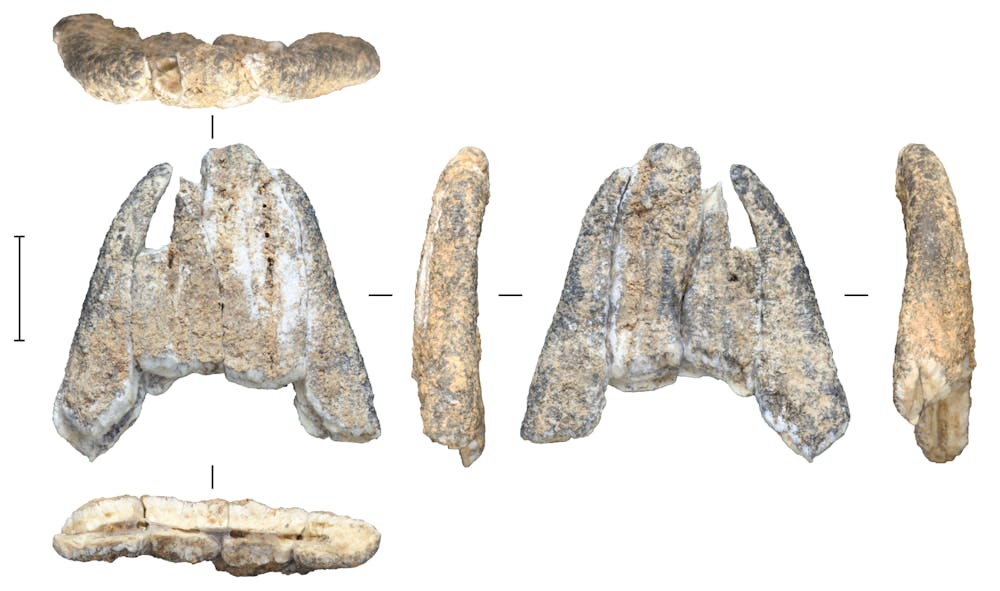 Fossil tooth fragment from an extinct elephant, excavated from Leang Burung 2.
M W Moore, Author provided
Fossil tooth fragment from an extinct elephant, excavated from Leang Burung 2.
M W Moore, Author provided
Dating the new find
We are fortunate to have dating methods that were unavailable in Glover’s day, but the age of the lowermost layers has still proved tricky to nail down.
Our best efforts suggest that the top of Glover’s clay is over 35,000 years old, while the brown clay is about 50,000 years old – and we still have not bottomed out.
The early inhabitants used tools like those made 200,000 years ago on Sulawesi, so the deepest artefacts may be connected to the island’s oldest tool-making culture.
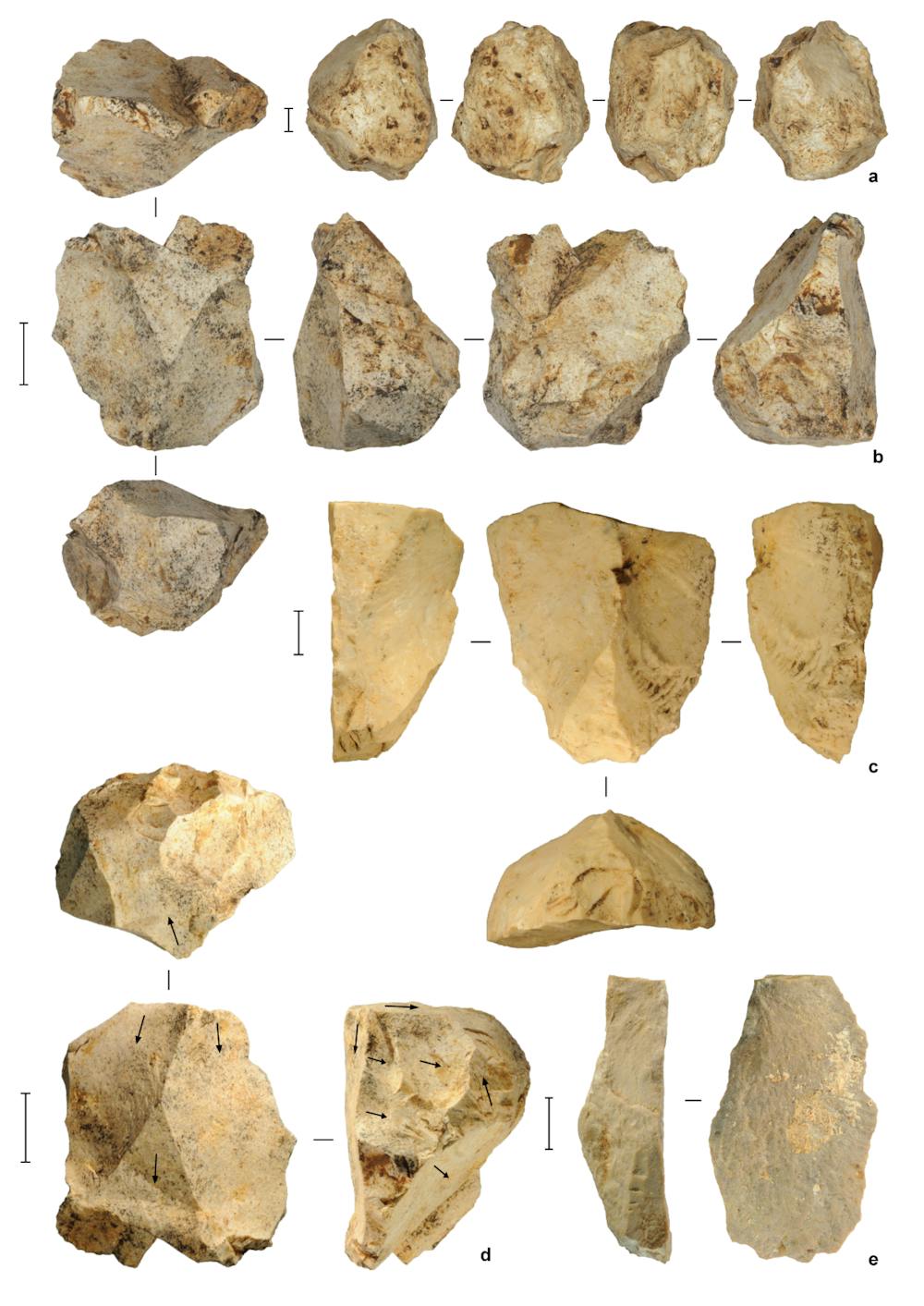 Stone artefacts from the deep deposits at Leang Burung 2, dated to at least 50,000 years ago.
M W Moore, Author provided
Stone artefacts from the deep deposits at Leang Burung 2, dated to at least 50,000 years ago.
M W Moore, Author provided
These cave dwellers could still have been around when the first rock art appears 40,000 years ago, but owing to dating uncertainties and the erosion of a large amount of sediment from Leang Burung 2, we can’t be sure.
Read more: Ice age art and 'jewellery' found in an Indonesian cave reveal an ancient symbolic culture
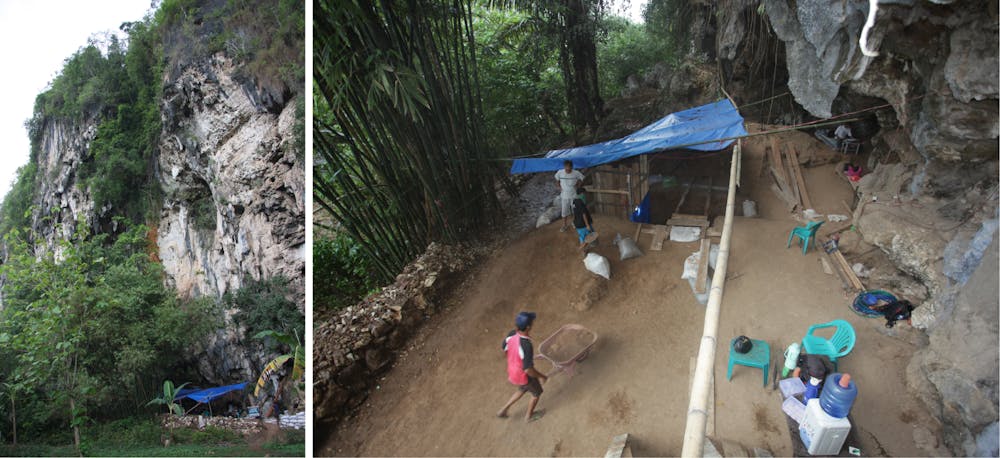 Leang Burung 2 rock-shelter.
Adam Brumm, Author provided
Leang Burung 2 rock-shelter.
Adam Brumm, Author provided
A new hope
Digging deeper at Leang Burung 2 is possible but it will require serious effort, including artificially lowering the water table. But while research at this shelter has been challenging, it has led us to another site with better prospects.
Our excavations at nearby Leang Bulu Bettue have unearthed rare “Ice Age” ornaments up to 30,000 years old, and we have now reached deeper and older levels.
Further work at this cave may yield vital clues about the original inhabitants of Sulawesi, including, we hope, the first fossil remains of these enigmatic people.
Authors: Adam Brumm, ARC Future Fellow, Griffith University


 Daily Bulletin


