

After the Rohingya crisis, Aung San Suu Kyi will come to the ASEAN summit with her reputation tarnished
- Written by: Nicholas Farrelly, Associate Dean, College of Asia and the Pacific, Australian National University
Two years ago, Aung San Suu Kyi led the National League for Democracy (NLD) into government in Myanmar amid a global outpouring of support and goodwill. When she arrives in Australia for this weekend’s ASEAN-Australia Special Summit, the welcome will be cooler, tempered by her government’s limited progress on a range of political and economic issues.
In particular, concerns will be raised over the Myanmar military’s appalling treatment of the Muslim Rohingya, and Suu Kyi’s refusal to denounce it.
For most of her 30-year political career, Suu Kyi was a revered and distant figure. As the world’s most famous political prisoner, she became, as one biographer explained, a “perfect hostage”: the exemplar of a democratic future held captive by a thuggish military regime.
Since her release from house arrest in 2010, Suu Kyi’s story has moved on quickly. In April 2012, her election to Myanmar’s legislature indicated the country was slowly emerging from long-term dictatorship. The peaceful transfer of power to her party in 2015, at the first openly contested democratic election in generations, offered hope that the worst of the country’s troubles were history.
Military power
The military-authored 2008 Myanmar Constitution places the armed forces at the centre of all security activities, regardless of legislative dominance. The military still controls the key security ministries, appointing the ministers of defence, home affairs and border affairs.
This means there is no civilian oversight of military activities. The NLD governs in coalition with the armed forces: a potentially unstable arrangement that requires constant attention from the NLD’s ageing high echelon.
In her critics’ eyes, Suu Kyi relies too much on the counsel of this small group of elitist figures. Her aloof manner has also made it difficult for her to build a functioning government, with many Myanmar people worried she does not understand their frustrations.
NLD supporters are adamant their leaders deserve some sympathy, especially when it comes to dealing with the armed forces. They seek to remind us that the party is trying to deliver on an ill-defined national transformation, but that it will take decades before the average Myanmar citizen’s quality of life comes close to that of their southeast Asian peers.
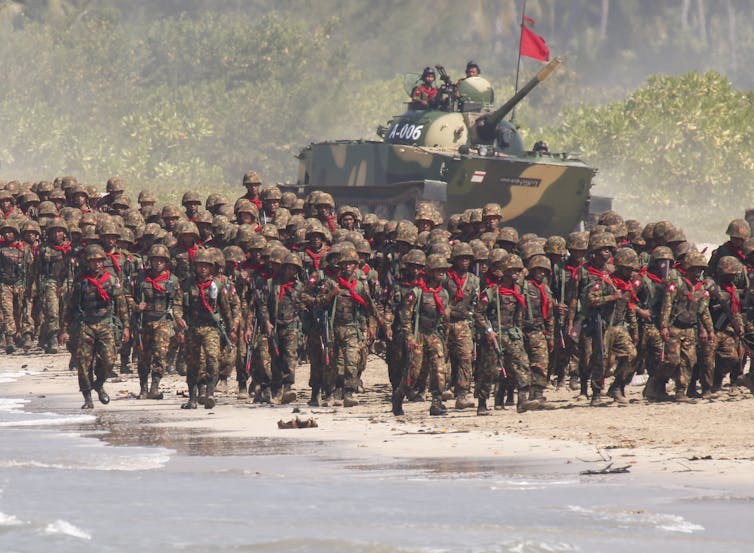 Troops and tanks at a joint military exercise in Myanmar.
Lynn Bo Bo/AAP
Troops and tanks at a joint military exercise in Myanmar.
Lynn Bo Bo/AAP
The Rohingya crisis
The most damaging development during the NLD government’s term has been the military’s brutal “counter-terror” campaign in northern Rakhine State, home to the Rohingya ethnic and religious minority.
The campaign caused the exodus of at least 671,000 people across the border to Bangladesh. Despite living in the country for generations, the Rohingya are not one of Myanmar’s recognised ethnic groups and therefore do not qualify for citizenship.
The population of exiled Rohingya in Bangladesh’s Cox’s Bazar District – driven out in successive pogroms – is now estimated by the UN as 884,000. The United Nations High Commissioner for Human Rights recently named Northern Rakhine State as one “of the most prolific slaughterhouses of humans in recent times”.
It is a grim situation, for which there is no quick fix. The Myanmar and Bangladesh governments have agreed on a structure for repatriation of some of the displaced people, but many of these people will likely never return to their homes in northern Rakhine State.
Read more: The Rohingya repatriation deal: what is at stake and what needs to be done
Evidence of what a senior UN spokesperson has called “ethnic cleansing” suggests that, from a Myanmar government standpoint, the operations against the Rohingya have been successful. The virulent anti-Rohingya feelings of Rakhine State’s Buddhist population are a further complication. It does not help that anti-Muslim sentiment is widespread across the country.
NLD supporters often seek to emphasise the military’s control of security ministries to diminish the elected government’s culpability. But this situation goes well beyond embarrassment of Suu Kyi. The 2017 Rohingya crisis may prove to be one of this century’s most egregious episodes of state-sanctioned murder, rape and pillage. It is no wonder they want to avoid sharing the blame.
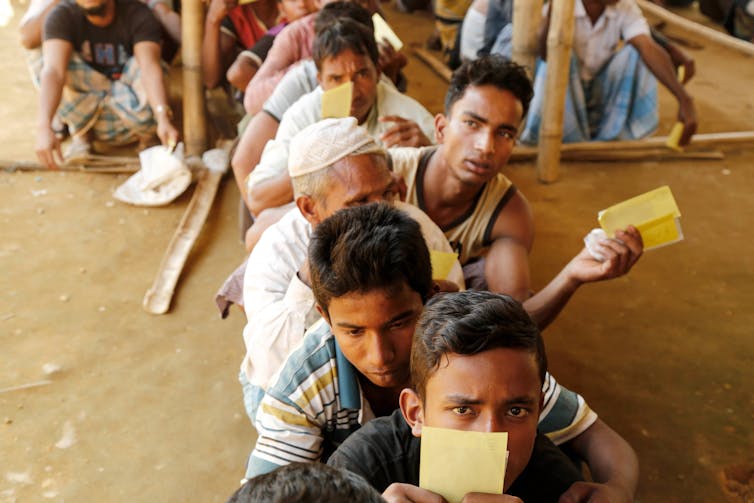 Newly arrived Rohingya refugees wait for relief goods at the newly extended camps in Bangladesh’s Cox’s Bazar District.
Abir Abdullah/AAP
Newly arrived Rohingya refugees wait for relief goods at the newly extended camps in Bangladesh’s Cox’s Bazar District.
Abir Abdullah/AAP
Political and economic consequences
In this disastrous context, the NLD has done itself no favours by failing to articulate a distinction between its position and that of the armed forces.
In practice, there appears to be no significant difference, and Suu Kyi’s reluctance to forthrightly engage with the topic may be a permanent black mark against her name. Instead of being remembered as the saviour of Myanmar democracy, her reputation will now be defined by complicity with 2017’s anti-Rohingya pogrom.
The great tragedy for Myanmar is that old friends are now turning away. Understandably, former NLD supporters from around the world have voiced their alarm, and calls for sanctions and boycotts are increasing. So is a growing chorus demanding justice for the victims of Myanmar’s crimes, including for the journalists who helped uncover the slaughter.
Read more: What is the best way to respond to the Rohingya crisis: boycott, sanctions or engagement?
Foreign investors, at least those from democratic societies, tend to dampen their enthusiasm whenever there is the talk of war crimes and ethnic cleansing. Chinese and Russian commercial interests will not miss a beat in filling any space that is available.
Australia’s role
On the eve of the ASEAN-Australia Special Summit, designed to build regional security and prosperity, Australia should certainly pay extra attention to Myanmar.
For a start, Suu Kyi should be given an opportunity to defend her record, so that any future Australian government response is appropriate. However, where her explanations are lacking, and where there is evidence her NLD government has been part of human rights violations, appropriate pressure should be applied.
Read more: The ASEAN-Australia Special Summit marks a step toward a deeper relationship
The Australian defence department will spend almost A$400,000 on English lessons and training for Myanmar’s military over 2017-18. This engagement should not preclude the imposition of targeted sanctions against military personnel suspected of criminal acts.
Myanmar’s democratically elected government has squandered almost all of the goodwill built up over decades of struggle against military rule. Suu Kyi’s coalition is now at the centre of this failure, and while that fact does not yet seem to matter for many senior people in Myanmar, Australia must look critically and objectively at this dramatic downward spiral.
Authors: Nicholas Farrelly, Associate Dean, College of Asia and the Pacific, Australian National University


 Daily Bulletin


