

Xenophon's SA-BEST slumps in a South Australian Newspoll, while Turnbull's better PM lead narrows
- Written by: Adrian Beaumont, Honorary Associate, School of Mathematics and Statistics, University of Melbourne
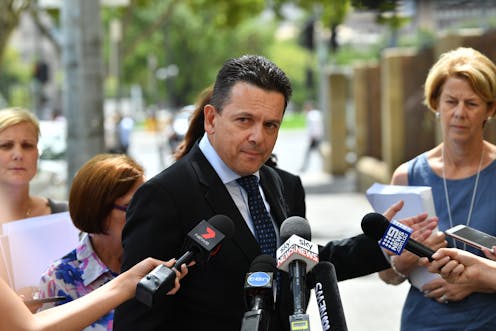
The South Australian election will be held on March 17. A Newspoll, conducted in the three days from February 27 to March 1 from a sample of 1,078, gave the Liberals 32% of the primary vote (up three since the October to December Newspoll), Labor 30% (up three), SA-BEST 21% (down 11), the Greens 7% (up one) and the Australian Conservatives 6%. No two-party figure was calculated.
About half of SA-BEST’s drop is because it is contesting 36 of the 47 lower house seats, and Newspoll did not offer SA-BEST as an option in the seats they are not contesting. In the seats SA-BEST is contesting, it averaged 27%.
On the three-way better premier question, 29% supported Nick Xenophon (down 17), 28% incumbent Jay Weatherill (up six) and 24% Opposition Leader Steven Marshall (up five). Weatherill led Marshall 38-31 head-to-head (37-32 previously).
Although SA-BEST and Xenophon’s support has slumped, neither of the two major party leaders is at all popular. Weatherill’s net approval is -21, down two points, and Marshall’s net approval is -26, down three points.
The Liberals led Labor 42-38 on best party for the South Australian economy, and led Labor 37-36 on best to maintain the energy supply and keep power prices lower. SA-BEST voters favoured the Liberals 37-33 on the economy and Labor 35-27 on energy.
Although SA-BEST is averaging 27% in seats it is contesting, the major parties are less vulnerable to losing seats to SA-BEST than it may appear from primary votes. Most Greens will preference Labor higher than SA-BEST, and most Conservatives will preference the Liberals higher.
Labor’s biggest problem in South Australia is that it has been in government since 2002. Old governments cannot blame problems on their predecessors, and there is an “It’s Time” factor.
14 to 16 year-old Labor governments in Queensland, New South Wales and Tasmania were smashed between 2011 and 2014, so Labor in South Australia is doing well to be competitive. Picking fights with the unpopular federal Coalition government probably explains Labor’s competitiveness.
Only once in the four elections since 2002 South Australian Labor won has the party received a majority of the two party vote (in 2006). At the 2014 election, despite losing the two party vote 53.0-47.0, Labor won 23 of the 47 seats, and formed government with an independent’s support.
Unlike other Australian electoral commissions, the South Australian commission is required to create electorally fair boundaries. The 2018 boundaries were drawn so that, based on the last election’s results, a party that won a majority of the two party vote should win a majority of the seats, ignoring independents.
The result of this requirement is that boundaries have been changed to favour the Liberals. According to the ABC’s Antony Green, the new boundaries notionally give the Liberals 27 seats out of 47, to Labor’s 20. Including independents, the Liberals have 24 seats, Labor has 19 and independents four. Ignoring independents, Labor needs a 3.1 point uniform swing to gain four seats from the Liberals and a majority.
The South Australian upper house has 22 members, with half up for election every four years. Statewide proportional representation is used to elect the upper house, with a similar system to the Senate. The South Australian parliament abolished group voting tickets last year.
The new system has optional preferential voting above the line; a single “1” vote above the line will expire within the chosen party, and will not be passed on as preferences to another party. Voters can direct preferences to other parties by marking “2”, “3”, and so on, above the line.
With 11 members to be elected, a quota is one-twelfth of the vote, or 8.3%. Overall, the upper house has eight Liberals, eight Labor, two Greens, two Conservatives, one Dignity and one Advance SA (formerly SA-BEST). At this election, the members up for election are four Liberals, four Labor, one Green, one Conservative and one Dignity.
Federal Newspoll: 53-47 to Labor
This week’s Newspoll, conducted March 1-4 from a sample of 1,660, gave federal Labor a 53-47 lead, unchanged on last fortnight. Primary votes were 38% Labor (up one), 37% Coalition (up one), 9% Greens (down one) and 7% One Nation (down one).
This is Malcolm Turnbull’s 28th successive Newspoll loss, just two short of Tony Abbott. If Newspoll sticks to its schedule, Turnbull will hit his 30th loss in April, but Parliament will not be sitting until the May budget.
Despite the argument about Bill Shorten and Labor’s stance on the Adani coal mine, Labor gained a point at the expense of the Greens on primary votes. However, the overall Labor/Greens primary is still stuck at 47%, where it has been since August.
Turnbull’s ratings appear to have suffered further from the Barnaby Joyce and Michaelia Cash controversies. 32% were satisfied with Turnbull (down two), and 57% were dissatified (up three), for a net approval of -25. Shorten’s net approval was down three points to -23. Turnbull’s lead as better PM narrowed from 40-33 to 37-35, his equal lowest better PM lead.
In the first Newspoll of the year, in early February, Turnbull was at a net -13 approval, Shorten at a net -18, and Turnbull led Shorten by an emphatic 45-31 as better PM. That Newspoll came after a controversy-free summer holiday period. Since then, Turnbull has lost 12 points of net approval, Shorten has lost five, and Turnbull’s better PM lead has narrowed from 14 points to two.
Essential 53-47 to Labor
In last week’s Essential, conducted February 22-25 from a sample of 1,028, Labor led by 53-47, a one-point gain for the Coalition. Primary votes were 35% Coalition (down one), 35% Labor (down two), 10% Greens (steady) and 8% One Nation (up two).
By 50-32, voters supported a ban on sex between ministers and their staff. Voters also supported a ban on politicians having extra-marital sex 44-36, and a ban on sex between managers and their staff in the workplace 48-35. However, voters were opposed to a ban on sex between workmates 55-22.
A total of 60% thought Barnaby Joyce should resign, with 26% saying he should remain in parliament, and 34% saying he should leave parliament. Only 19% thought he should remain deputy PM.
By 44-41, voters approved of the media reporting on politicians’ private affairs.
Only 23% thought Joyce’s sexual relationship with his staffer was a major concern. On the other hand, 60% thought alleged excessive use of travel entitlements a major concern, and 50% thought finding the staff member work in another Minister’s office a major concern.
Essential asked whether four Indigenous-related issues, the republic and changing Australia Day were a high priority. Just 11% thought changing the date of Australia Day was a high priority, and 21% becoming a republic. All the Indigenous-related issues scored higher.
By 48-32, voters would support abolishing private health insurance subsidies, and using this money to include dental care within Medicare.
Authors: Adrian Beaumont, Honorary Associate, School of Mathematics and Statistics, University of Melbourne


 Daily Bulletin


