

Crimes of solidarity: liberté, égalité and France’s crisis of fraternité
- Written by: Abi Taylor, PhD Researcher in Political Theory and Government, University of Sydney
This article is part of the Revolutions and Counter Revolutions series, curated by Democracy Futures as a joint global initiative between the Sydney Democracy Network and The Conversation. The project aims to stimulate fresh thinking about the many challenges facing democracies in the 21st century.
The French republican ideals of freedom and equality – indeed of all modern democracies – crystallised in the late 18th century. This was when revolutionary forces combined and fought to abolish two hallmarks of the Ancien Régime: absolutism (unrestricted government power) and privilege (aristocratic rights and status).
Freedom and equality are assumed to be reinforced, brought into harmony by the republic’s third principle – fraternity. Yet, while liberty relates to government, and equality to the law, fraternity is the domain of society. And as France today struggles with its changing social fabric, fraternity is in crisis.
To understand this, and importantly the growing dissidence of citizens who refuse a fraternalism that diminishes human solidarity, we need to spend a moment covering the workings of French republicanism.
The 1789 revolutionaries’ aim of destroying feudal privilege, and ultimately the monarchy, had its roots in republican “anti-particularism”. The concept endures in French democracy today to describe a political and social system opposed to any exclusive or special devotion to the interests of particular groups, whether based on ethnicity, religion or gender, to name but a few.
Anti-particularism is enacted through a variant of Enlightenment universalism that positions human nature as a “rational” universal that is capable of resisting cultural and historical differences. That is, reasoned deliberation would underpin France’s universal republican values: a secular public sphere, equality, freedom, and autonomy.
France’s republicanism laid further claim to universality by offering citizenship to all those willing to belong to the nation on the basis of their active participation as citizens. The “citizen” is defined solely through the notion of equal political rights and duties, and not, for example, through ethnic or territorial ties.
So, in France, the citizen is a purely political concept, and an abstract one, to comply with its demands of universalism. Abstract universalism establishes France as a political nation, through its body of equal citizens, whose aim is to integrate diverse populations.
In this way, abstract universalism functions to prevent particularism, or the division of the republic into individual and multiple identity groups. Their demands for recognition are seen as threatening republican unity and equality.
Are some people more equal than others?
A key challenge of equality, in establishing the public sphere as primarily one in which individual interests are subjugated to the common interest, is whether particular groups are able to recognise themselves, and are recognised, as belonging to a wider whole, as equitable contributors to common societal goals.
In post-revolutionary France, the obsession has always been with equality. Laïcité, its distinctive take on secularism, is an extended exercise in equality.
Laïcité implies in its varying dimensions: freedom of conscience for all, thereby ensuring the republic’s commitment to individual autonomy; state neutrality toward religious difference to allow for the cohabitation of all religions in the name of equality; and the fostering of civic bonds and allegiance to a particular historical community, the republic’s public culture.
This third dimension, which Cécile Laborde terms the “laic” civic bond, is what encourages feelings of republican fraternity.
Particularist nationalism rounds out, in a sense, France’s political culture and model of citizenship. But does a strong sense of national identity not inspire feelings of suspicion towards the politics of diversity?
The impossible and the ‘unassimilable’
Historically, and to this day, it is not arbitrary groups that have been denied access to the public sphere, or deemed “unassimilable” – that is, incapable of becoming a part of the res publica.
Women, Jews, gays and more recently Muslims have all been excluded, not as abstract citizens, but on the very basis of their difference.
In other words, the content of the abstraction continues to resurface. It’s a sign that not everyone’s particular identities – whether gendered, ethnic or religious and so on – can be so easily abstracted.
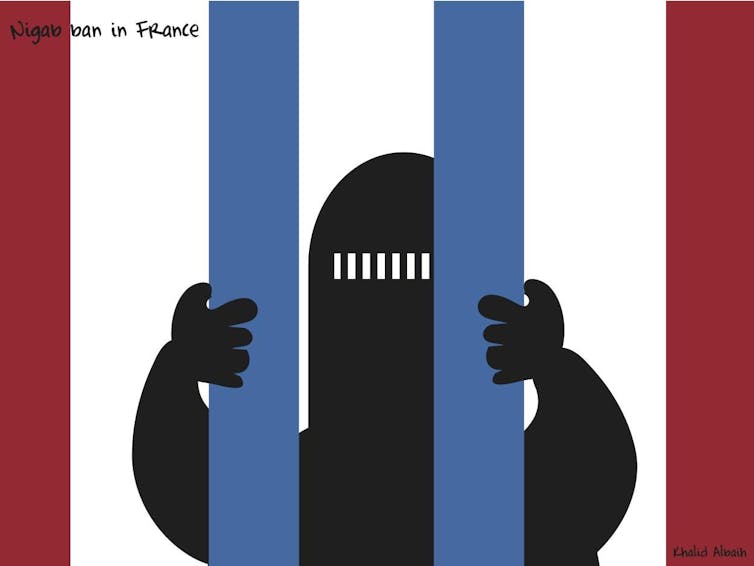 Not everyone’s particular identity can be so easily abstracted and assimilated by French republican ideology.
Khalid Albaih/flickr, CC BY
Not everyone’s particular identity can be so easily abstracted and assimilated by French republican ideology.
Khalid Albaih/flickr, CC BY
Yet, paradoxically, those excluded by French republican ideology and its politics are unable to petition the state for political recognition or inclusion on the basis of their difference.
Where recognition and rights have been achieved, excluded groups had to write themselves into the logic and reach of universalism. The women’s rights movement, for example, succeeded in erasing sexual difference from the list of categories that carried weight in French politics.
Likewise, the more recent success of the marriage equality movement wasn’t attributed to activists’ demands for “gay rights”. This would have been viewed as too particularistic or individualist – not republican enough.
Instead, equality was achieved by petitioning for mariage pour tous, “marriage for all”. The language of republicanism was used to point out that a universal – the right to marriage – was not truly universal if it excluded certain groups.
All manner of activists have succeeded in shattering the hypocrisy of formal equality by drawing attention to ways in which the French model creates “impossible subjects” who do not neatly fit into its republican categories.
Universalism holds within it a paradox: its need to be reconciled with the particularism of states, without which promises like liberté, égalité and fraternité could never be reality.
While these tensions and paradoxes are not isolated to the French case, France is often held up as the model (in Europe) for the political integration of culturally diverse populations. Yet its citizenship requirement that outsiders be “culturally fit” to fully integrate French values shows that certain ideas of a secular public sphere, or republican national identity, can result in speculation about the “unassimilable” nature of some populations.
What’s more, the French Republic has long sacralised human rights and the right to asylum in political and ideological presentations of itself.
In holding dear its image of a nation as simultaneously a strong supporter of societal and national sovereignty and a land of asylum, France is arguably the most glaring demonstration of the tension between the universal and the particular.
Solidarity delinquents
France actively pursues the criminalisation of its citizens for acts of solidarity and fraternity toward vulnerable refugees. At best this is puzzling. It is even more so when citizens refer to their civil disobedience as restaking a claim on the values upon which the republic was founded.
In their specific understanding of what it means to be French, fraternity and its modern equivalent, solidarity, are wedged between particularist politics of closure and ethical considerations of universal obligation. This has very real consequences for citizens and non-citizens alike.
On January 4, 2017, Cédric Herrou, a farmer from the Roya valley (a key crossing point for migrants into France from Italy), was placed on trial for helping some 200 asylum seekers to enter and pass through France. He had provided many of them with shelter, first in his home and later a disused railway building.
His initial penalty (a suspended fine of €3,000) was increased to a suspended four-month prison sentence after an appeal by the prosecution.
Cédric Herrou is a farmer who defies French authorities by helping African refugees.On October 17, 2016, Pierre-Alain Mannoni, a 45-year-old geography professor at Nice University, was arrested while driving three badly injured Eritrean girls to seek medical attention. Following his acquittal, the prosecutor appealed and continued to press for a six-month suspended prison term. The appeals court imposed a suspended sentence of two months in September 2017.
In 2015, Education Without Borders Network volunteer Denis Lambert was arrested for receiving direct “compensation”, in the form of domestic chores, while lodging a family of undocumented Armenians at his Perpignan home following their failed asylum claim.
French immigration law, the Code on the Entry and Sojourn of Foreigners and Right to Asylum (CESEDA) punishes persons found guilty of “assisting the entry, travel or undocumented stay” of irregular status foreigners. The offence carries a five-year prison sentence and €30,000 fine.
Since 2012, the law does exempt from prosecution anyone providing aid in the form of “legal advice, food, accommodation or medical care to ensure the foreigner with dignified and decent living conditions”, provided no benefit is received in return. On the other hand, transporting irregular foreigners and assisting their safe passage across or around border zones are punishable offences.
But the law operates on an ambiguity. Although intended to combat organised networks of illegal immigration (human trafficking and people smugglers), its wording lends itself to associating “disinterested” humanitarian assistance with the profit motives of human trafficking.
This has led to numerous arrests and prosecutions of French citizens who have received direct or indirect “benefits” or “compensation” for their humanitarian assistance of vulnerable people. The ongoing intimidation, prosecutions and convictions have sparked a collective movement of “solidarity delinquency”, or “crimes of solidarity”. The movement asserts:
If solidarity with foreigners is a crime, then we are all delinquents.
How did France come to this?
How is it that universalist France punishes citizens for helping vulnerable refugees? One explanation is found in the way that France’s republican ideals meet state rationalities.
The state invokes universalism and secularism to reserve the right not simply to determine who can become a member of French society, but more generally to maintain a stronghold on symbolising Frenchness. And so the state defends the republic’s indivisibility, unity and social and moral order – no more so than when the nation perceives itself plagued by insecurity.
Themes of insecurity, national identity and immigration have featured heavily in French election campaigns since 2002. Asylum and immigration have become increasingly regulated and politicised within a security framework. This is because there is electoral capital in making both so central to anxieties about national identity, safety and order, and the public purse.
For Didier Fassin, insecurity takes three forms:
public insecurity is used to legitimate stricter border policing and limits on immigration to secure the nation from external (terrorist) threats
identity insecurity, apparent in growing mistrust and hostility towards Islam, seeks to reinforce republican belonging and insists upon more secularism in the public sphere
social insecurity lies in the threat that unwelcome outsiders pose to the welfare and medical systems, as well as the nation’s capacity to provide citizens with jobs.
The “tough on crime”, securitarian approach to asylum, immigration and borders began in earnest under Interior Minister Charles Pasqua in 1993. It gained momentum under Nicolas Sarkozy as interior minister from 2002 and president from 2007.
Sarkozy’s “securitarian frenzy” and subsequent focus on immigration policy – which included prolonged detention, performance targets, deportations, high-tech police checks and surveillance – was intended to “fix” the issues of republican integration. It is perhaps better understood as the systemisation of a logic of suspicion toward all foreigners.
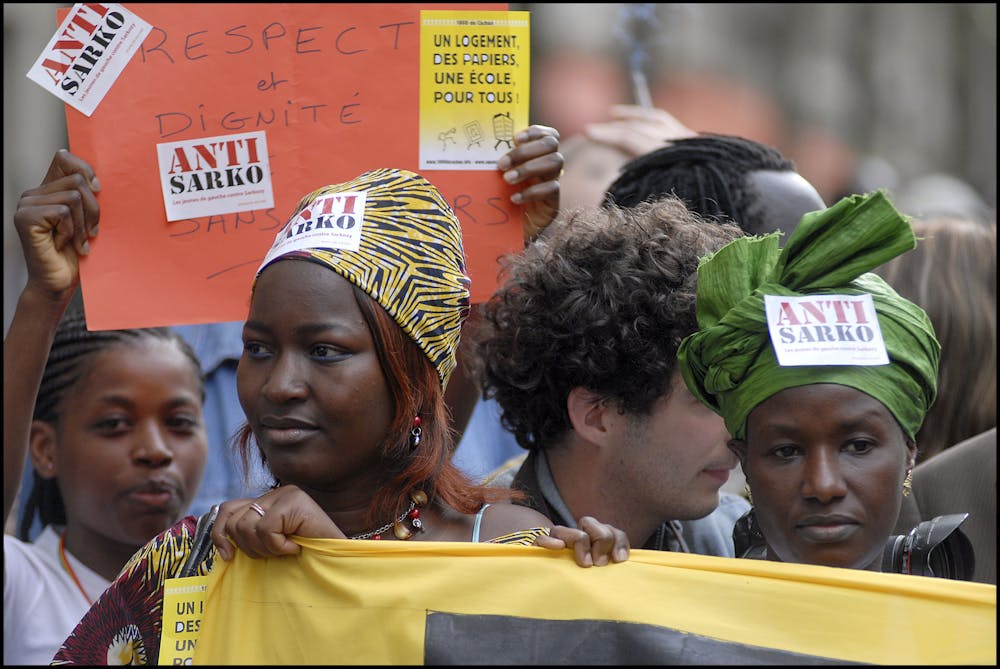 Protests did little to reverse the state’s ‘securitarian frenzy’ under the presidency of Nicholas Sarkozy.
Alain Bachellier/flickr, CC BY-NC-ND
Protests did little to reverse the state’s ‘securitarian frenzy’ under the presidency of Nicholas Sarkozy.
Alain Bachellier/flickr, CC BY-NC-ND
The significance of this reconfiguring of relations between citizens and foreigners is that the state’s desire to monopolise what it means to “be French” also brings about dissidence.
We see this in the collective movement of “solidarity delinquency” and in individual crimes of solidarity. Ethico-political acts of civil disobedience call attention to the inhospitable treatment of vulnerable refugees. Solidarity delinquents demand that, in extolling the virtues of fraternity, their public institutions act more hospitably toward refugees and asylum seekers. They also seek to overturn laws so that a minimum of their fellow humans’ fundamental interests can be met.
These acts are a democratic refusal of the blackmail of universals. They attempt to revive and recover a vanishing dimension of French values, namely solidarity and fraternity.
Authors: Abi Taylor, PhD Researcher in Political Theory and Government, University of Sydney


 Daily Bulletin


