

Deposit schemes reduce drink containers in the ocean by 40%
- Written by: Qamar Schuyler, Research Scientist, Oceans and Atmospheres, CSIRO
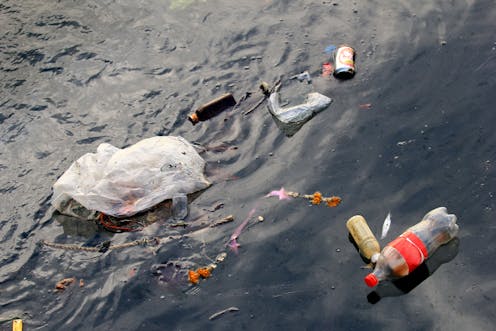
Plastic waste in the ocean is a global problem; some eight million metric tonnes of plastic ends up in the ocean every year.
Read more: Eight million tonnes of plastic are going into the ocean each year
One possible solution – paying a small amount for returned drink containers – has been consistently opposed by the beverage industry for many years. But for the first time our research, published in Marine Policy, has found that container deposits reduce the amount of beverage containers on the coasts of both the United States and Australia by 40%.
What’s more, the reduction is even more pronounced in areas of lower socio-economic status, where plastic waste is most common.
Plastic not so fantastic
There have been many suggestions for how to reduce marine debris. Some promote reducing plastic packaging, re-purposing plastic debris], or cleaning beaches. There has been a push to get rid of plastic straws, and even Queen Elizabeth II has banned single use plastics from Royal Estates! All of these contribute to the reduction of plastics, and are important options to consider.
Read more: Pristine paradise to rubbish dump: the same Pacific island, 23 years apart
Legislation and policy are another way to address the problems of plastic pollution. Recent legislation includes plastic bag bans and microbead bans. Economic incentives, such as container deposits, have attracted substantial attention in countries around the world.
Several Australian jusrisdictions, including South Australia, the Northern Territory, and New South Wales), already have container deposit laws, with Western Australia and Queensland set to start in 2019. In the United States, 10 states have implemented container deposit schemes.
But how effective is a cash for containers program? While there is evidence to suggest that container deposits increase return rates and decrease litter, until now there has been no study asking whether they also reduce the sources of debris entering the oceans.
In Australia, we analysed data from litter surveys by Keep South Australia Beautiful, and Keep Australia Beautiful. In the US, we accessed data from the Ocean Conservancy’s International Coastal Cleanup.
Read more: The future of plastics: reusing the bad and encouraging the good
We compared coastline surveys in states with a container deposit scheme to those without. In both Australia and the US, the proportion of beverage containers in states without a deposit scheme was about 1.6 times higher than their neighbours. Based on estimates of debris loading on US beaches that we conducted previously, if all coastal states in the United States implemented deposit schemes, there would be 6.6 million fewer containers on the shoreline each year.
Keep your lid on
But how do we know that this difference is caused by the deposit scheme? Maybe people in states with container deposit schemes simply drink fewer bottled beverages than people states without them, and so there are fewer containers in the litter stream?
To answer that question, we measured the ratio of lids to containers from the same surveys. Lids are manufactured in equal proportion to containers, and arrive to the consumer on the containers, but do not attract a deposit in either country.
If deposit schemes cause a decrease in containers in the environment, it is unlikely to cause a similar decrease in littered lids. So, if a cashback incentive is responsible for the significantly lower containers on the shorelines, we would expect to see a higher ratio of lids to containers in states with these programs, as compared to states without.
That’s exactly what we found.
We were also interested in whether other factors also influenced the amount of containers in the environment. We tested whether the socio-economic status of the area (as defined by data from the Australian census) was related to more containers in the environment. Generally, we found fewer containers in the environment in wealthier communities. However, the presence of a container deposit reduced the container load more in poorer communities.
This is possibly because a relatively small reward of 10 cents per bottle may make a bigger difference to less affluent people than to more wealthy consumers. This pattern is very positive, as it means that cashback programs have a stronger impact in areas of lower economic advantage, which are also the places with the biggest litter problems.
Read more: Sustainable shopping: take the 'litter' out of glitter
Ultimately, our best hope of addressing the plastic pollution problem will be through a range of approaches. These will include bottom-up grassroots governance, state and federal legislation, and both hard and soft law.
Along with these strategies, we must see a shift in the type of we products use and their design. Both consumers and manufacturers are responsibility for shifting from a make, use, dispose culture to a make, reuse, repurpose, and recycle culture, also known as a circular economy.
Authors: Qamar Schuyler, Research Scientist, Oceans and Atmospheres, CSIRO
Read more http://theconversation.com/deposit-schemes-reduce-drink-containers-in-the-ocean-by-40-91897


 Daily Bulletin


