

What is your real 'biological age', and what does this mean for your health?
- Written by: Carissa Bonner, Research Fellow, University of Sydney
Age-based risk calculators that work out your “real biological age” are increasingly popular. We hear about body age on health shows like How to Stay Young; gyms promote reductions in metabolic age and fitness age; games and apps claim to lower your brain age; and researchers have developed specific organ measures like heart age, lung age and bone age.
It seems most people have a “biological age” that is older than it should be. Four out of five people, for instance, have an older heart age than their current age. But what does this really mean?
All these age calculators compare your measurements for a range of health risk factors to an average or an ideal number to come up with your score. Having an older biological age on these calculators simply means you have at least one risk factor that is higher than the number set as “normal”.
But unless we know which specific risk factors are above normal, and how normal is defined, it’s hard to know whether you should really be worried, or what you should do about it.
Read more: Biological vs chronological age: how old are you really?
In the latest season of How to Stay Young, researchers assess volunteers’ performance on 23 different tests and combine this into an overall body age. Individual test results are explained to each person, but the volunteers have little reaction to these numbers until they are converted into a body age.
Richard, an obese and inactive 49-year-old man, is reduced to tears when he sees his score: a body age of 92, more than 40 years older than his actual age. By the end of the program, he has lowered his body age by 13 years, to 79. Each episode has a similar example.
The last episode of the BBC/ABC show How to Stay Young featured Richard’s story (from 4.45 minutes in).While a compelling story, it’s not entirely clear how these ages were calculated. Is it really plausible to reverse 13 years of ageing in just a few months?
What actually happened is Richard reduced specific risk factors to be closer to the level set as “normal” by the calculator. By standing up at work and starting cycling, he improved at least three risk factors: he increased physical activity and muscle strength, and lost 11kg to reduce his body mass index. This is not the same as reversing the ageing process at a biological level, known as “senescence”.
Another example is heart age calculators, which are common online and have been used by millions of people around the world. The principle is the same: if any risk factors are higher than what has been set for “normal”, then you will get an older heart age than your current age.
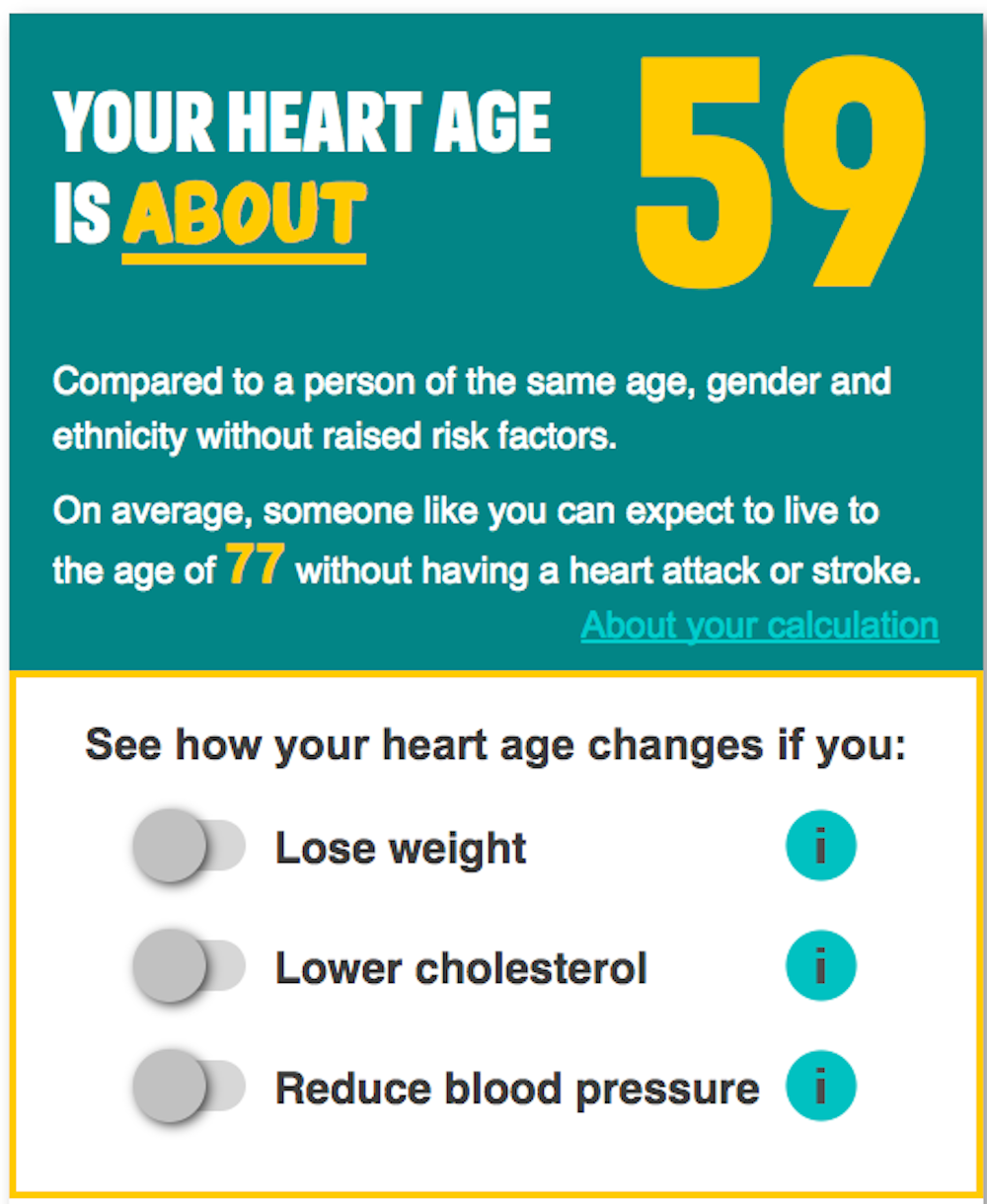 The NHS’s What’s your heart age? calculator (screenshot)
NHS Health Check
The NHS’s What’s your heart age? calculator (screenshot)
NHS Health Check
The problem is, the same person can get an older heart age on one calculator but a younger heart age on another calculator. This is because they all use different models with different risk factors and different rules. Some include blood pressure and cholesterol, while others use body mass index to estimate these clinical risk factors. Some won’t provide a number for younger heart age, and set a maximum for older heart age.
You will also get a different heart age based on different definitions of “normal” for the same risk factor – is normal the average, or the ideal?
To add to the confusion, there is no universal agreement on what is ideal, as controversy over recent US guidelines to lower the blood pressure medication threshold demonstrates.
If the ideal systolic blood pressure is set as 120mmHg, then what happens if you have 121mmHg? On a heart age calculator, this difference is enough to give you an older heart age result. Clinically, this is probably not an important difference given the variability in blood pressure readings.
Read more: Health Check: what do my blood pressure numbers mean?
Since one-quarter of online heart disease risk calculators don’t explain how the calculations are done, it can be very hard to know what the result means, or which one to believe.
So is there any point to age-based risk calculators? There is some research to suggest “biological age” formats like heart age have more emotional impact and may act as a wake-up call to motivate people like Richard to change their lifestyle and reduce their risk factors – which is a good thing.
But they can also mislead people by making them worry that their risk of disease is higher than it actually is. As such, they shouldn’t be used to make decisions about preventive medication, such as whether to take drugs to lower cholesterol levels or blood pressure.
If you get an older “biological age” on any of these calculators, don’t get too worried about the exact number – it’s not a direct measure of ageing or life expectancy. But it might mean you have a risk factor for chronic disease that could be reduced. Ask your doctor:
- Which specific risk factors are too high?
- How is “normal” defined for those risk factors?
- What is my absolute risk of disease (that is, my chance of having a heart attack or stroke in the next five years)?
- How much can lifestyle and medication options reduce my risk of disease?
- What are the risks and side effects of these options?
Read more: I've always wondered: does anyone my age have any chance of living for centuries?
Authors: Carissa Bonner, Research Fellow, University of Sydney


 Daily Bulletin


