

Australia has 2,000 missing persons and 500 unidentified human remains – a dedicated lab could find matches
- Written by: Jodie Ward, Adjunct Professional Associate, University of Canberra
It’s been 52 years since the Beaumont children disappeared from Glenelg beach, Adelaide on Australia Day 1966.
In this case, excavation of a new area of interest – based on new evidence pointing to possible shallow graves – is expected to commence this week.
Sadly however, the Beaumont children are just three of around 2,000 long-term missing people in Australia. And we also have more than 500 sets of human remains believed to be archived across the country, that have not yet been identified.
It’s time Australia committed to a laboratory solely dedicated to missing persons casework. Current capability in DNA forensics could allow us to match up remains with some of these missing persons cases, and potentially give families relief.
Read more: How science is helping the police search for bodies in water
Forever wondering
New research shows 38,000 Australians are reported missing each year, around half of which are young people. Fortunately, most of those missing people are located alive within days of the report being made. However a small percentage of those reported missing have never been located.
But without clear evidence of life or death, it’s very hard for families to know what’s happened to their loved ones.
The Beaumont children is one of Australia’s most enduring missing person cases. More recently, William Tyrrell’s disappearance has had police tirelessly searching since 2014.
Last week the Hayley Dodd missing persons case was finally put to rest after 18 years, with Francis John Wark found guilty of her murder. However, until Hayley’s remains are found and identified through DNA testing, her family won’t have the answers they still long for.
DNA analysis was key in identifying the remains of Daniel Morcombe and Matthew Leveson in Australia.
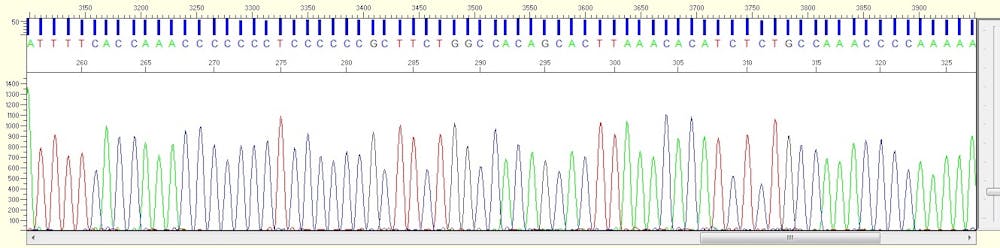 Sequencing technology allows scientists to identify the order of bases (called C, G, A and T) in DNA. Click to expand photo.
Jodie Ward, Author provided
Sequencing technology allows scientists to identify the order of bases (called C, G, A and T) in DNA. Click to expand photo.
Jodie Ward, Author provided
Sources of DNA
Technology for sequencing DNA useful for genetic identification is now cheaper, faster and better than ever before.
A bone, tooth, nail, tissue or hair sample can commonly be used to obtain a DNA profile for a person. For recovered bodies, what is available and suitable will depend on the condition of the remains when they are found.
DNA testing may be the only way of positively identifying people in cases where:
- only a single bone was located
- bones from the one person have been buried in multiple locations
- bones are very old and degraded, or
- when the police have no other evidence or leads.
Read more: From the crime scene to the courtroom: the journey of a DNA sample
Of those 500 boxes of bones stored in mortuaries across Australia, the selection of an optimal bone fragment is likely to yield a DNA result in most cases. For those unidentified persons given a “destitute burial”, hopefully a sample was taken and stored for DNA testing. For other, typically older cases of “John and Jane Does” – the names commonly given to unidentified people – some remains may need to be exhumed.
Once a sample from the remains has been tested, the DNA profile can be compared to a database of DNA profiles from missing persons. The missing person’s toothbrush or hairbrush, or ideally a medical sample such as a newborn screening card, could be used for this purpose. Often these samples are not available, so family members of the missing can be used for DNA matching because they share similar and predictable patterns in their DNA profiles.
Global precendent
Using DNA matching to examine how many of Australia’s 500 sets of unknown bones match with the 2,000 missing Australians would likely be successful for at least some cases.
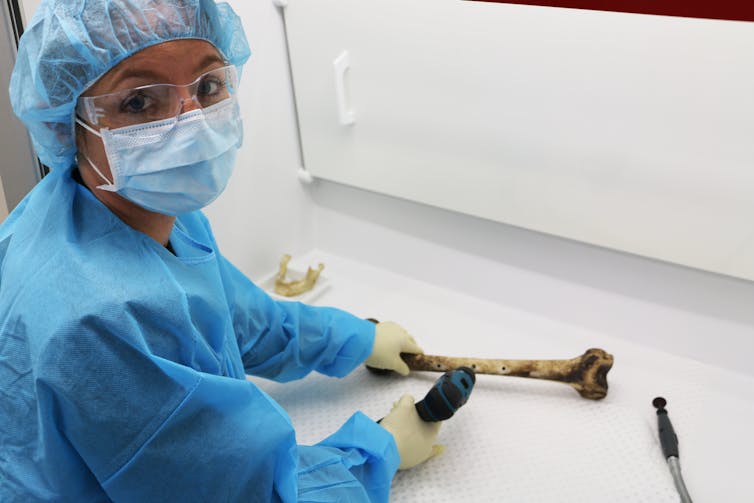 It can be challenging to extract useable DNA from old, degraded bones.
Jodie Ward, Author provided
It can be challenging to extract useable DNA from old, degraded bones.
Jodie Ward, Author provided
DNA technology is being recommended and used globally to identify large numbers of missing persons from war, genocide, terrorist attacks or mass disasters. The International Commission on Missing Persons DNA-led program has identified more than 20,000 missing persons.
Also, a new Australian DNA database capability soon to be rolled out will facilitate the sharing and comparing of DNA profiles from unknown remains, missing persons and their relatives across state borders.
Read more: For sniffing out crime and missing persons, science backs blood-detection dogs
Let’s solve some cases
We now need to focus on populating the new Australian database with DNA profiles from our stored bones and missing persons in order for identifications to be made. The establishment of a laboratory, solely dedicated to missing persons casework, would be the best way forward for such a large scale identification effort. The concentration of specialist expertise and technology under one roof would help bring families and loved ones closer to getting the answers they need.
This would be similar to the successful United States model, where the Missing Persons Unit at the University of North Texas Center for Human Identification processes the bulk of the missing persons casework across the country.
This approach also relies on suitable family members donating DNA reference samples for those missing persons that don’t have a DNA profile already in the DNA database.
 The three Beaumont siblings are still missing, 52 years after their disappearance from a beach in suburban Adelaide.
SA Police/AAP
The three Beaumont siblings are still missing, 52 years after their disappearance from a beach in suburban Adelaide.
SA Police/AAP
Forensic DNA phenotyping, which involves using DNA to predict the ancestry and physical appearance of an individual, should also be introduced as an intelligence tool for missing persons investigations. Applying this emerging technology to bones could help narrow down the list of possible missing persons, identify relatives that should be approached to donate a DNA reference sample, or add hair, eye and skin colour to facial reconstructions of skulls.
A national DNA identification program will be essential for identifying our unknown and missing citizens, and in the process solve some of Australia’s most baffling cold cases.
DNA is the only viable solution left for identifying most of these individuals. But the DNA will continue to degrade the longer we wait, so time is of the essence.
If remains are found at the suspected Beaumont children burial site, Australia’s bone experts will have to apply specialist DNA technologies in an attempt to recover a profile suitable for identification.
Authors: Jodie Ward, Adjunct Professional Associate, University of Canberra


 Daily Bulletin


