

To end share-bike dumping, focus on how to change people's behaviour
- Written by: Conor Wynn, PhD candidate at BehaviourWorks, Monash Sustainable Development Institute, Monash University
While most cities are keen to promote bike use, few foresaw the problems caused by dockless bike-sharing schemes such as oBike and Reddy Go. The advantage of dockless bikes is that users needn’t find dedicated stations to pick up and return the bikes. Instead, the user leaves the bike in a public place for the next rider to use. But the disadvantage turns out to be that these bikes are littering streets or being dumped in parks and rivers in cities in Australia and overseas.
These bikes can be tracked via in-built global positioning system (GPS) devices or Bluetooth on users’ smartphones. But, like foreign species introduced before them, the bikes seem to have gone feral in cities like Melbourne and Sydney.
Further reading: Bike-sharing fiascoes and how to avoid them – an expert’s guide
The question is what to do? Some city councils have agreed on tighter controls on the companies that supply them.
But that’s not enough. The new rules don’t tackle the source of the problem, which is people’s behaviour. If we deal with why people are behaving badly, then we’ll see fewer of these bikes stuck up trees or clogging rivers.
Understand the behaviour to fix it
If we’re going to intervene we need to understand this behaviour in the first place. This involves three sets of factors:
context, or the environment we’re in at the time
cognition, or how our brain works to process information (for example, bias)
behaviour, which is making choices about how to act.
We’ll mainly focus on behaviour here, with some reference to cognition.
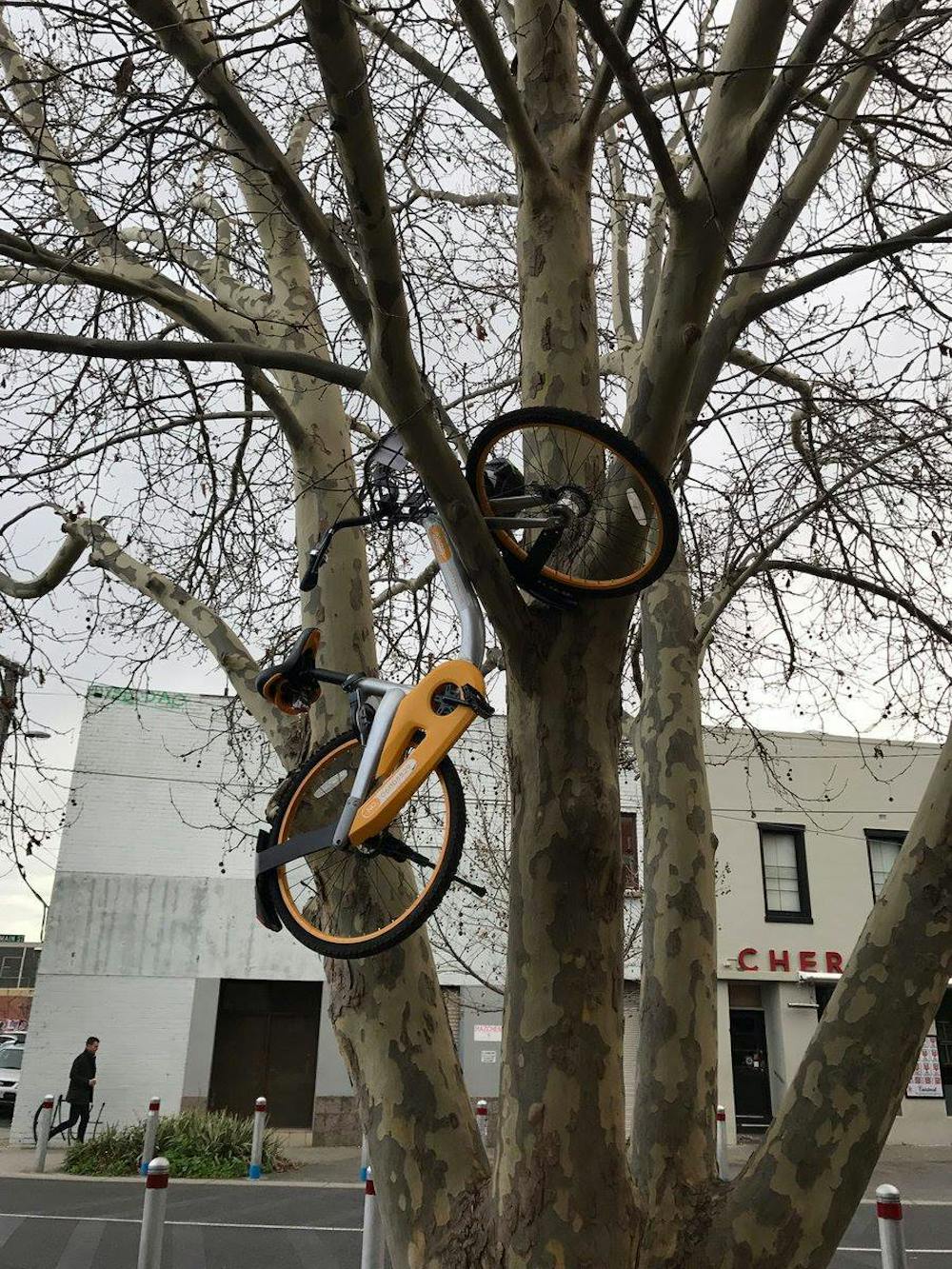 Once we understand how someone can think it’s OK to do this we can take steps to change such behaviour.
OBikes in unusual places/Facebook
Once we understand how someone can think it’s OK to do this we can take steps to change such behaviour.
OBikes in unusual places/Facebook
Ajzen’s theory of planned behaviour tells us there are three elements to be understood: norms, perceived behavioural control and attitudes.
Dockless bikes littering the city is symptomatic of what is called a social norm. Because everyone else seems to be dumping these bikes, the implied message is that it’s OK for us to do the same.
To make things worse, we are getting only faint signals from authoritative sources telling us what to do. Those are called injunctive norms.
In other words, everyone else seems to be doing it and there are only whispers telling us not to, so we should be right to ditch the bike at the end of a good night out.
Added to norms is how much choice we think we have over what to do with these bikes. This is called perceived behavioural control, which has two parts, control beliefs and perceived power.
First, control beliefs. How easy would it be for us to litter the street with a dockless bike? Pretty easy, right? So, there’s high control belief.
Second, perceived power. How confident are we that we’ll be able to get away with it? Perceived power is likely to be high as few users are being called to account for poor behaviour. So, we reckon we’ve got a fair bit of licence when it comes to mistreating dockless bikes.
And so to attitude. Again, this has two components, affective attitude and instrumental attitude. Affective attitude could be thought of as how the behaviour we’re thinking about makes us feel. And instrumental attitude is about the pay-off we get from behaving in a certain way.
It’s harder to guess how people might feel about bad behaviour, partly because some attitudes are not entirely conscious. But, as far as pay-off goes, it’s a lot easier to sling a bike in the gutter at the end of a journey than take care of it.
Further reading: Bike-sharing schemes might seem like a waste of space but the economics makes sense
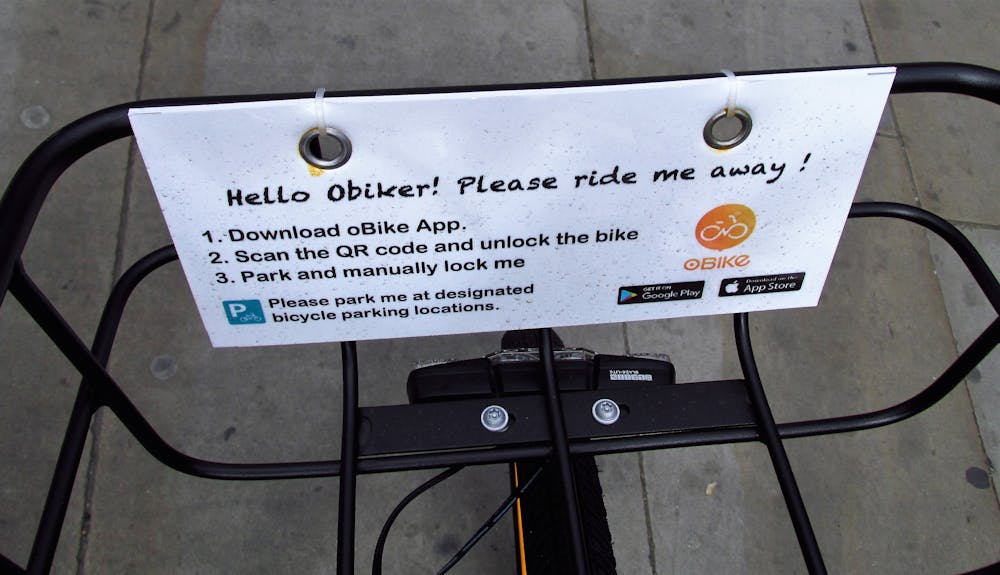 City councils are starting to insist on dockless bikes being left in designated parking areas, but how do you get users to comply?
David Holt/flickr, CC BY
City councils are starting to insist on dockless bikes being left in designated parking areas, but how do you get users to comply?
David Holt/flickr, CC BY
So what can we do to change this behaviour?
Having understood the behaviour, how might we change it? This is likely to involve a combination of measures. Here are three ideas for starters.
First, we could work on the perceived pay-off or instrumental attitude and link that to an unconscious cognitive bias known as loss aversion. If someone who ditched a bike in a river, for instance, suffered a financial penalty, that would change the perceived pay-off and so behaviour.
Getting the user to deposit some money as a bond – say $10 before the bike was used – could encourage users to treat the bikes with a bit more care. This would also tap into the loss aversion bias that most of suffer from. Kahneman says we’re much more motivated to avoid a loss of $10 than by a gain of $10. Having handed over our $10, we’ll want it back. And we’ll be motivated to provide proof that we’ve done the right thing.
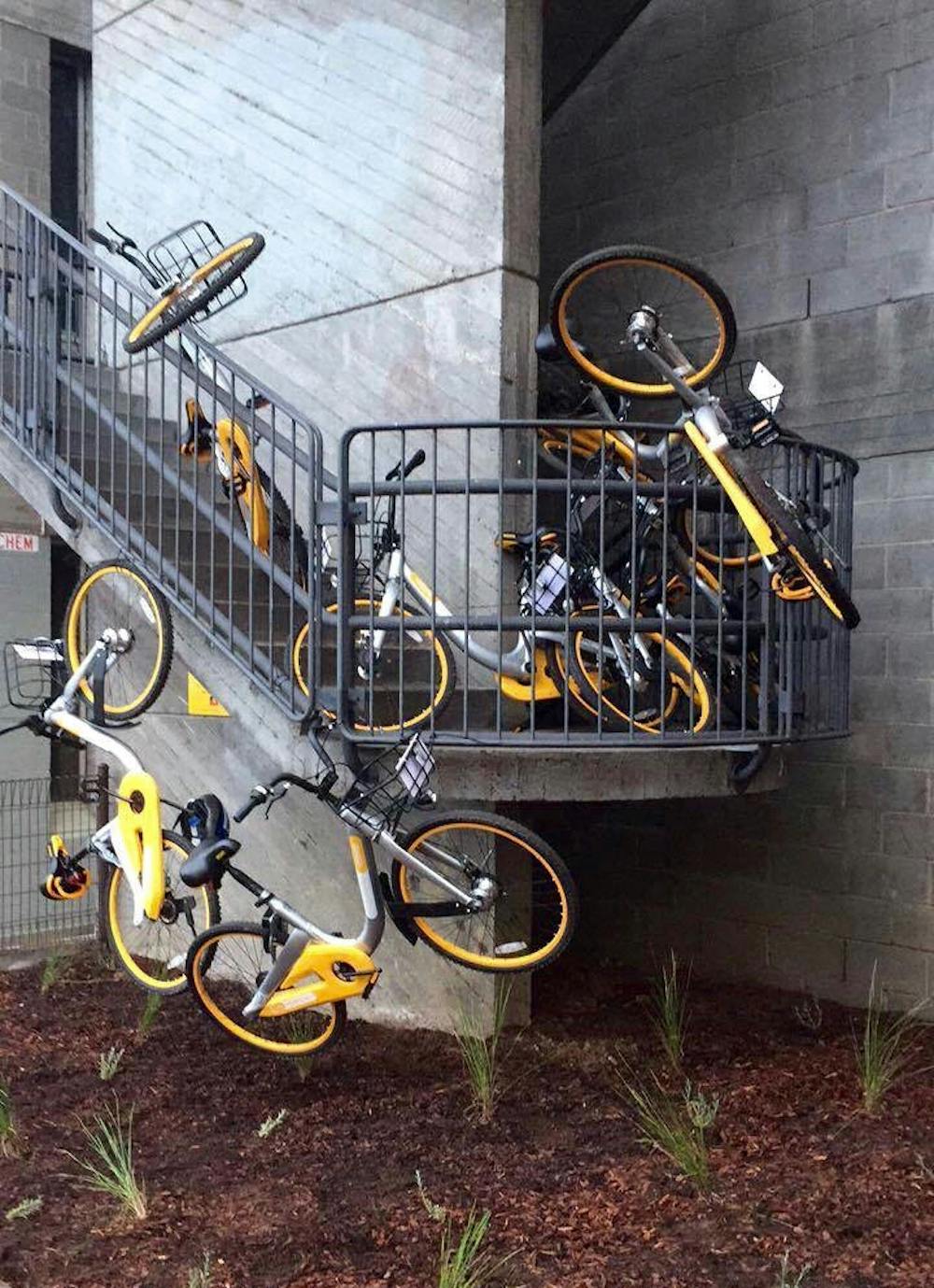 An education campaign to change what people do with the bikes needs to target social norms and effective deterrents.
OBikes in unusual places/Facebook
An education campaign to change what people do with the bikes needs to target social norms and effective deterrents.
OBikes in unusual places/Facebook
Second, we could work on social norms, or what we think others think is the right thing to do. Most of us have a strong desire to behave as we think others want us to. However, injunctive norms, or behaving as we think those in authority want us to behave, is likely to be not so attractive in Australia, sounding a bit too “nanny state”.
A communications campaign aimed at reminding users that most others don’t sling their bikes when they’re finished with them could work in the same way that water-saving campaigns worked during the Millennium Drought in many parts of Australia. Those campaigns helped convince many consumers that it’s not OK to waste water. One way this was achieved was by showing each household how their consumption compared to others.
A third suggested measure, also linked to loss aversion, would be to fine those who are found to have dumped their bike in the river or hung it from a tree, for instance. This is targeting perceived behaviour control – how confident we are that we’ll get away with it. But it might be best to leave that as one of the later options, as this could deter share-bike use by portraying it as financially risky.
While we might debate whether these are the right measures, no doubt more should be done to tackle the downsides of dockless bikes. So, let’s understand and deal with the source of the problem, bad behaviour.
Further reading: Here’s what bike-sharing programs need to succeed
Authors: Conor Wynn, PhD candidate at BehaviourWorks, Monash Sustainable Development Institute, Monash University
Read more http://theconversation.com/to-end-share-bike-dumping-focus-on-how-to-change-peoples-behaviour-90016


 Daily Bulletin


