

Before we colonise Mars, let's look to our problems on Earth
- Written by: Andrew Glikson, Earth and paleo-climate scientist, Australian National University
Everyone wants to go to Mars, or so it seems.
Elon Musk, NASA with Lockheed Martin, and now Boeing are all looking towards the red planet, with heady predictions of missions during the 2020s.
But at what cost? And could we even survive any long-term colonisation on Mars? Given the problems we face here on Earth it’s important to ask whether we should be better tasked with looking after the only planet we know (so far) that can harbour life.
Read more: Revealed today, Elon Musk’s new space vision took us from Earth to Mars, and back home again
The race to Mars
Boeing says it wants to be involved in the first mission to send humans to the red planet. The company’s chief executive Dennis Muilenburg told a US TV host in December 2017:
I firmly believe the first person that sets foot on Mars will get there on a Boeing rocket.
A key rival is Musk, the billionaire founder of SpaceX, which is already launching rockets. At the 68th Annual International Aeronautics Congress, in Adelaide in September 2017, Musk spoke of airline-like connections between Earth and Mars, with cargo missions to begin by 2022.
Lockheed Martin says it plans to send humans to Mars in the next decade.
Even the famous theoretical physicist Stephen Hawking has argued that it is “essential that we colonise space” although he doesn’t see it happening that soon:
I believe that we will eventually establish self-sustaining colonies on Mars and other bodies in the Solar system although probably not within the next 100 years.
Exploring other planets
Scientific exploration of Solar system planets constitutes one of the most exciting achievements the human race is realising.
But by contrast, the idea of colonising Mars or other planets or moons is misleading. It yields an impression in many people’s mind that an alternative exists to Earth, a unique (so far) haven of life in the Solar system, currently suffering from global warming, rising oceans, extreme weather events, mass extinction of species and growing risk of nuclear wars.
Microbial life may exist on Mars or may have existed in the past. According to NASA:
Among our discoveries about Mars, one stands out above all others: the possible presence of liquid water, either in its ancient past or preserved in the subsurface today. Water is key because almost everywhere we find water on Earth, we find life. If Mars once had liquid water, or still does today, it’s compelling to ask whether any microscopic life forms could have developed on its surface.
But doubts have been raised recently with regard to the distinction between water and sand flow on Mars.
No atmosphere for life
At present there is no evidence of a liveable atmosphere under which plants or other organisms would survive on Mars.
Its thin atmosphere is less than 1% of Earth’s, consisting of 96% carbon dioxide, 1.9% nitrogen, 1.9% argon and trace amounts of oxygen and carbon monoxide. It provides little protection from the Sun’s radiation, nor does it allow retention of heat at the surface.
Suggestions as to whether biological-like textures in a Martian meteorite (ALH84001) signify ancient fossils have not been confirmed.
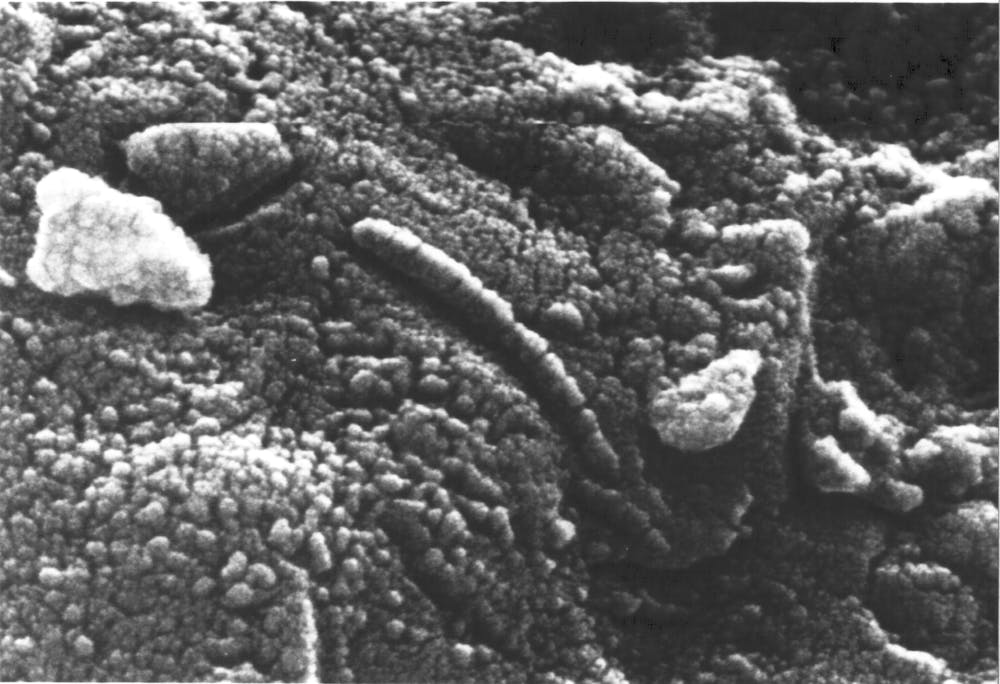 This high-resolution scanning electron microscope image shows an unusual tube-like structural form that is less than 1/100th the width of a human hair in size found in meteorite ALH84001, a meteorite believed to be of Martian origin.
NASA
This high-resolution scanning electron microscope image shows an unusual tube-like structural form that is less than 1/100th the width of a human hair in size found in meteorite ALH84001, a meteorite believed to be of Martian origin.
NASA
In July 2017 researchers reported that the surface of Mars may be more toxic to microorganisms than previously thought.
A Mars colony warning
There is no lack of warnings regarding the colonisation of Mars.
If a colony was established it would take continuous efforts and major expense to keep it supplied, including likely rescue missions. Furthermore, the long-term isolation of the colonists may take its toll.
When the Mars One project announced in 2013 that it was looking to recruit four people to send on a mission to colonise Mars, Chris Chambers, a professor of cognitive neuroscience at Cardiff University, warned of the psychological risks the colonists would face.
Yet dreams stay alive. According to NASA’s mission statement:
Even if Mars is devoid of past or present life, however, there’s still much excitement on the horizon. We ourselves might become “life on Mars”, should humans choose to travel there one day.
Earth calling Mars
Space colonisation dreams are not entirely devoid of economic interests. The international space industry is said to be worth in the order of some US$400 billion a year, and predicted to grow to nearly US$3 trillion over the next three decades.
Space travel and colonisation ideas are mostly promoted by engineers and entrepreneurs who stand to gain from these schemes, but far less so by biologists and medical scientists who understand the terrestrial origin and physiological limitations of the human body.
There can be little doubt that, given modern and future computer and space technologies, space stations could be constructed on Mars, where a few privileged humans may be able to live for periods of time.
Read more: The new space race: why we need a human mission to Mars
Should humans colonise a life-bearing planet, we should ask whether organisms would fare any better than species extinguished on Earth.
The ethical polarity between those dreaming of conquering space and those hoping to defend Earth from global heating and a nuclear calamity could not be greater.
The billions and trillions of dollars required to develop and maintain colonies in space could approach the estimated US$1.69 trillion military spending globally in 2016.
As a scientist who examines how a changing climate influences human evolution, I argue that funds on this scale would be better directed at the defence of the lives of more than 7 billion humans on Earth, as well as protection of animals and of nature more broadly.
Authors: Andrew Glikson, Earth and paleo-climate scientist, Australian National University
Read more http://theconversation.com/before-we-colonise-mars-lets-look-to-our-problems-on-earth-87770


 Daily Bulletin


