

That time when science came with me on a tropical holiday
- Written by: Darren Saunders, Associate professor, UNSW
Curiosity and awe dwell deep in the heart of most scientists. They are central to the motivation behind scientific thinking, and they have been my faithful and comfortable companions since childhood.
In 2004 my partner and I travelled to the Malaysian state of Sabah on the island of Borneo. At the time I was a postdoc, just a few years out of my PhD.
Sweating it out it in the oppressive tropical heat of Borneo was tough, but worth it for the amazing natural attractions. My time there had an intellectual impact too. It helped crystallise for me the innate nature of scientific thinking, and drew me even closer to one of my great scientific influences: David Attenborough.
It was a holiday when science came along for the ride.
Read more: We found evidence of early humans in the jungles of Borneo
Unfamiliar and mysterious
There’s something special about travel – it somehow reinforces that innate scientific drive to understand the world around us. What is it about being in unfamiliar and exotic environments that sharpens the senses, heightens the instinct to want to know how the world works? Maybe that’s why scientific thinking seems to come so naturally to children. So much of their daily existence is unfamiliar and mysterious.
Immersion in nature is associated with increased creativity and problem-solving abilities. And experiencing awe - feeling wonder and insignificance at something so vast it is difficult to comprehend - has been linked with enhanced critical and creative thinking. Awe has also been shown to make people more considerate and generous, endorse more ethical decisions, and report more prosocial values.
I’ve been lucky to experience many amazing natural wonders. The Great Barrier Reef, Hawaiian volcanoes, alpine glaciers, and ancient forests in New Zealand and North America, harbouring some of the largest and oldest living things on the planet.
Read more: Is it too cheap to visit the ‘priceless’ Great Barrier Reef?
Exotic Disneyland
One place stands out to me as a kind of biological Disneyland: the exotic jungles of Borneo. Home to iconic animals like the orangutan and proboscis monkey, weird and wonderful plants – like the carnivorous Nepenthes and the rotten meat-stinking Rafflesia – and a rich human history we are only just starting to understand.
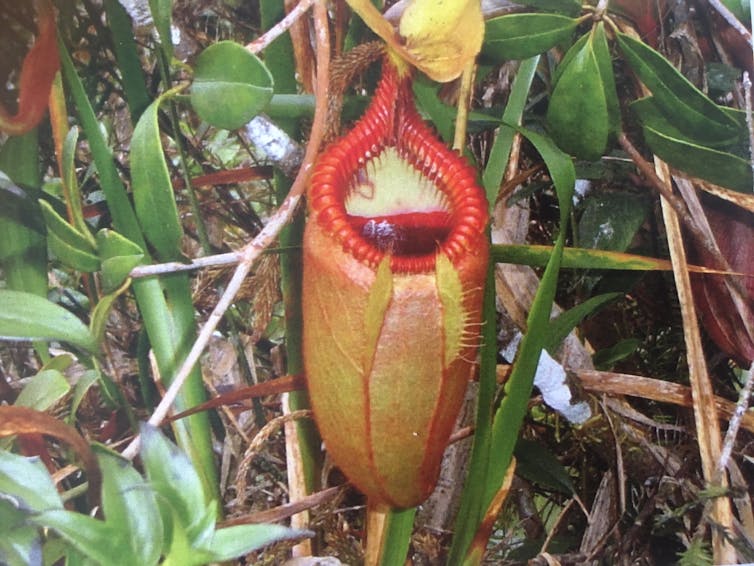 A Nepenthes - or Pitcher Plant - growing on the slopes of Mt Kinabalu. A diverse range of species of these carnivorous plants are found in the different climatic zones on Kinabalu.
Darren Saunders
A Nepenthes - or Pitcher Plant - growing on the slopes of Mt Kinabalu. A diverse range of species of these carnivorous plants are found in the different climatic zones on Kinabalu.
Darren Saunders
When it comes to experiencing amazement and wonder, it’s hard to beat the pure thrill of encountering an orangutan in the wild. A long, hot, dusty minibus ride through endless palm plantations, noisy speedboat ride and mad scramble up the slippery banks of a crocodile-infested river brought rich reward: an audience with a giant, solitary male. To sit in quiet mutual contemplation within arms reach of this huge but gentle “person of the forest” was something I will never forget.
Read more: How we discovered a new species of orangutan in northern Sumatra
Orangutans are only found in Borneo and Sumatra, where their lowland forest habitat is being rapidly destroyed, degraded and fragmented through illegal logging and burning. One of our closest living relatives was recently declared at “extremely high risk of extinction in the wild” by the International Union for Conservation of Nature. As a result, many young orangutans end up in orphanages like the Sepilok Rehabilitation Centre.
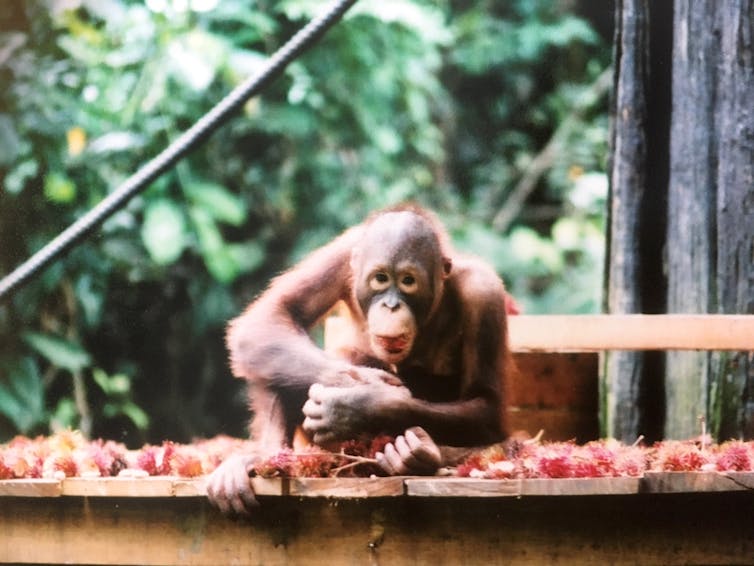 A young orangutan at Sepilok Rehabilitation Centre.
Darren Saunders
A young orangutan at Sepilok Rehabilitation Centre.
Darren Saunders
Curiosity and unfenced danger
Apart from being a great place for humans to see orangutans up close, rehabilitation centres are also helping us understand how curiosity contributes to problem solving. A recent study showed that normally solitary, cautious orangutans become more inquisitive if they spend more time with humans as youngsters. And this curiosity increased their cognitive abilities, measured by their ability to open tricky boxes or use tools to access fruit or honey.
The threat to habitat in Borneo is laid bare in the forests along the Kinabatang River, an important corridor for many endangered species. In many places, the forest is reduced to a narrow strip stretching no more than a few hundred metres from the water, hemmed in tightly by palm oil plantations. But even there, it’s possible to see remarkable wildlife up close - sometimes too close.
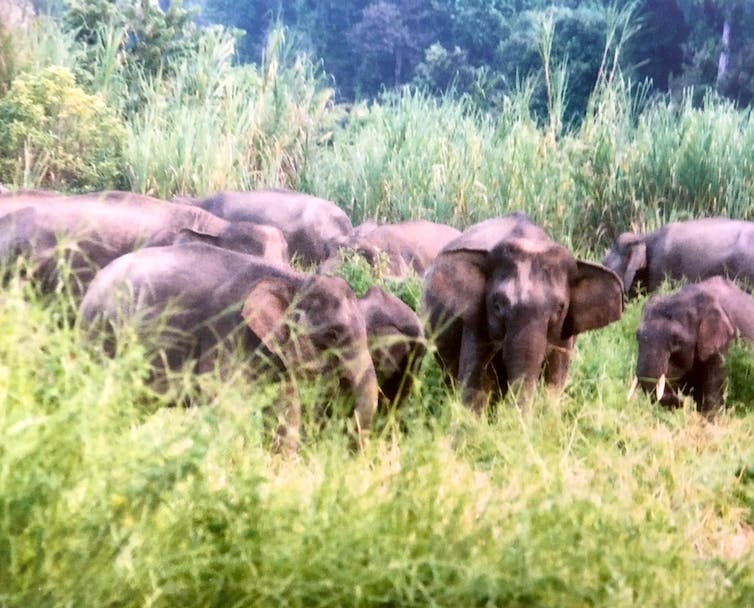 Up close - too close - to a herd of Borneo pygmy elephants.
Darren Saunders
Up close - too close - to a herd of Borneo pygmy elephants.
Darren Saunders
One very enthusiastic guide, upon seeing the unmistakable fresh tracks of elephants crossing the river, had us jumping out of the boat through overhead-high elephant grass and straight into a clearing. The herd of 20 or so elephants quietly grazing there were suddenly infiltrated by some very excited humans. We made a hasty retreat, and it was sadly unsurprising news to hear a young Australian vet was trampled to death by the same herd a couple of years later.
In many ways, travelling in Borneo was reminiscent of childhood holidays in the 1970s and ‘80s. It’s a place of raw enthusiasm and unfenced danger, without safety harnesses or liability waivers. I first came to this realisation while scrambling up the rock faces near the summit of 4095m high Mt Kinabalu in the early morning dark, with lightning cracking in the distance and without safety gear. A visit to the war memorial in Sandakan, where thousands of allied prisoners of war were marched through the jungle to their deaths, put a darker perspective on danger.
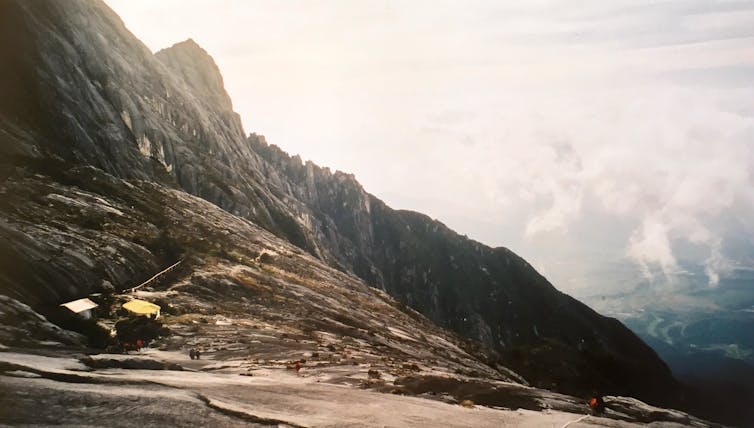 The stark moonscape of the tropical alpine zone approaching the 4095 m summit of Mt Kinabalu, with lowland forest in the distance below.
Darren Saunders
The stark moonscape of the tropical alpine zone approaching the 4095 m summit of Mt Kinabalu, with lowland forest in the distance below.
Darren Saunders
Read more: The Australian history boom has busted
Life in the tropics
Even among all this danger and excitement, the tropics dictate a languid daily rhythm. It’s so hot during the day that even the wildlife keeps a low profile – there’s not much else to do but laze in the shade, reading.
David Attenborough’s autobiography “Life On Air” was almost the perfect accompaniment for a trip to Borneo. Not only was Attenborough a huge influence on my life, reading his reflections on many of the same places I was visiting was a real thrill, and gave some unexpected historical context. It was sobering to read how much the place had changed from his time there in the 1950s, making some of his earliest TV documentaries.
I’ve become increasingly aware of a shift in my motivation for visiting unique natural wonders like Borneo or the Great Barrier Reef. The adventure and thrill of seeing so many unique creatures up close will always stand out, and they still invoke awe and curiosity.
But I travelled there in the past with no inkling that they might disappear. Now, these great natural wonders are under extreme threat from land clearing, climate change and other threats. There is added urgency and an overwhelming sense of sadness that I need to take my kids to see them before many are fundamentally changed, or disappear altogether.
Authors: Darren Saunders, Associate professor, UNSW
Read more http://theconversation.com/that-time-when-science-came-with-me-on-a-tropical-holiday-88955


 Daily Bulletin


