

How the Paradise Papers reveal the tension between rock stars and the tax man
- Written by: Adam Behr, Lecturer in Popular and Contemporary Music, Newcastle University
“It’s one for you, 19 for me” ran George Harrison’s scabrous jibe at the “Taxman” in 1966, a bitter riposte to the 95% supertax that Prime Minister Harold Wilson’s Labour government had imposed on the very wealthy.
Although top rates of tax are now substantially lower across the developed world (under 50% in the UK and Australia), it’s hardly surprising that the latest international tax avoidance scandal – the Paradise Papers – should feature rock stars in its cast.
The leaked papers reveal Michael Hutchence’s estate tied up in offshore tax havens – to the possible exclusion of his surviving family. U2’s Bono has also been found to have used a firm in Malta to pay for a share in a Lithuanian shopping mall.
Read more: Four things the Paradise Papers tell us about global business and political elites
While they’re far from the only such cases, what distinguishes them in the public mind is the disjunction between public image and private affairs. These exposés throw into sharp relief the inconsistencies in romanticising rock. Free-sprited creativity is seen working hand-in-glove with the “suits”.
Sex and drugs and rock and roll, following Ian Dury’s coinage, might seem like a natural fit. Corporate-style tax avoidance and rock and roll less so. Rock has long railed against “The Man” on stage, but the current cases reveal a well-established and more specific hostility between stars and the taxman.
Tax Exile on Main Street
The grubby, druggy aesthetic of the Rolling Stones’ classic Exile on Main Street, recorded on the French Riviera, belied the fact that the eponymous banishment was in fact the band fleeing a tax bill and liabilities as residents in the UK. Bill Wyman recalled:
We owed money to the Inland Revenue. There was no way could make enough money to get ourselves out of trouble, we’d be paying like 93% tax and there was no way we could earn enough to pay back what we owed.
This decision was informed by the band’s business manager, Prince Rupert Loewenstein. His financial stewardship helped to turn them into a global brand, not least through careful choices of touring, rehearsal and recording locations to minimise tax bills.
If these stratagems seem to cut across the “devil may care” rebellion or heartfelt sincerity of rock, they also reveal a paradox at its core as a mass-produced, commercial form of music that inherited an anti-establishment ideology from the folk movements of the 1940s and ’50s.
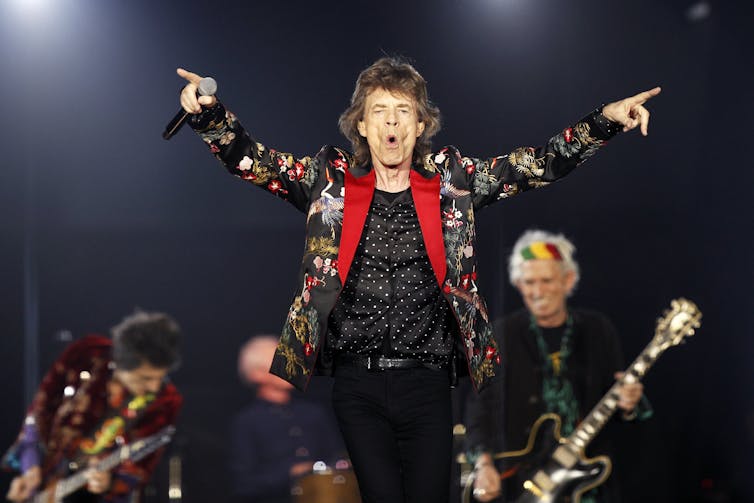 At one point in their career, the Rolling Stones moved to the French Riviera to escape a tax bill back in the UK.
AAP
At one point in their career, the Rolling Stones moved to the French Riviera to escape a tax bill back in the UK.
AAP
With the Beatles’ and Stones’ upending of previous commercial and aesthetic norms aligned with a generational shift, it was, writes Professor Simon Frith, “easy enough for 1960s rock fans … to claim that even if their music was commercial, it nevertheless symbolised a community”.
This tension between “art” and “commerce” is woven throughout popular music. The brightest stars of the musical firmament have battalions of lawyers, managers and accountants to conduct their affairs. The skills needed to negotiate the complexities of multi-million-dollar enterprises are, after all, rather different to those for recording and performing hits.
It’s perhaps to be expected, as appears to have been the case with Hutchence, that some musicians have less-than-granular knowledge of how their often internecine concerns are set up. There’s a long and ignominious history of musicians falling prey to their business associates.
Read more: Three strategies to fight the tax avoidance revealed by the Paradise Papers
Sting’s financial adviser, for instance, lost £4.8 million (A$8.25m) on investments that included restaurants in Australia and plans to adapt Russian military planes into passenger liners. Billy Joel’s former manager, likewise, lost millions on failed investments, and gave out loans of over US$2.5m (A$3.26m) to real estate and horse breeding enterprises. All without their clients’ knowledge.
Bono has been caught in this paradox. Keen to put distance between himself and the mechanics of U2’s business interests when challenged in 2015, he stated that they were “just some smart people we have … trying to be sensible about the way we’re taxed”. More recently, he expressed distress at the possibility that his investments have been “anything less than exemplary”.
The business of authenticity
Given that such stars’ appeal – and therefore partly their commercial success – resides in a sense of something beyond the sharp-edged logistics of the corporate world, it shouldn’t be a shock that accusations of hypocrisy follow a whiff of chicanery around their business dealings.
Pop and rock, though, have been thoroughly tied up in the intricacies of international trade for decades, and the creative industries are increasingly important to governments’ economic strategies.
The issue runs deeper than wealthy artists who make a play on their gritty roots, like the Arctic Monkeys being propelled to fame via trenchant observations of Sheffield street life and then taken to task over a previous tranche of tax revelations, which also included George Michael and Katie Melua. They were all found to have invested in a scheme called Liberty, recently shut down by the UK government. The scheme was set up offshore via a company created in the Cayman Islands, which they then used to avoid taxes on other income.
The Arctic Monkeys were propelled to fame via trenchant observations of Sheffield street life but were later taken to task over their tax affairs.The perception of authenticity at the heart of international stardom is rooted in the commonality that, at the end of the day, taxes exist to support. But sustaining it commercially involves traversing a web of jurisdictions. If these contradictions have been built into rock from the outset, perhaps a sense of betrayal was inevitable. The current travails over superstar taxes are unlikely to be the last.
Ultimately, it will take concerted action – and co-operative international government action at that – to make tax loads at the upper end of the economic ladder more than a matter of conscience.
This won’t solve rock’s art-commerce dichotomy but, to paraphrase the Stones shortly before their own fiscal entanglements, it might help to balance the other equation of people getting what they want against what they need.
Authors: Adam Behr, Lecturer in Popular and Contemporary Music, Newcastle University


 Daily Bulletin


