

What the Nobel Prize tells us about the state of economics
- Written by: Fabrizio Carmignani, Professor, Griffith Business School, Griffith University
While we don’t yet know who will win this year’s Nobel Prize for economics, taking a look at the top contenders gives great insight into where the field of economics is and where it is heading. The big takeaway is a clear resurgence of interest in aggregate economic dynamics such as economic growth and cyclical fluctuations.
Every year since 2002 Clarivate Analytics has provided a list of possible prize winners based on the number of times their research is cited. So far, 45 of the predictions have come true.
One thing to note is that there is not an official Nobel Prize in Economics. There is, instead, a “Prize in Economic Sciences” awarded by the Central Bank of Sweden (Sveriges Riksbank) in memory of Alfred Nobel. Economics was not one of the five original disciplines that Nobel had in mind when he established the prizes in his will.
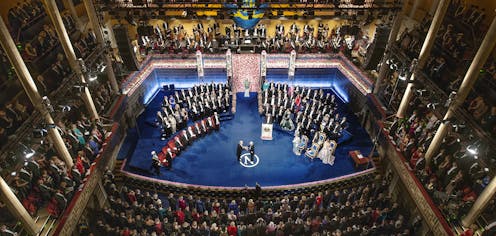
Regardless, the Memorial Prize in Economics is treated the same as the original five. The winner attends the same ceremony, receives a diploma and a gold medal from the Swedish monarch, and banks the same cash prize (9 million Swedish crowns, or A$1.1 million).
Read more: Explainer: what is contract theory and why it deserved a Nobel Prize
Who are the contenders and what do they represent?
The first two contenders, Paul Romer of New York University and Robert Barro of Harvard University, clearly illustrate the resurgence of interest in economic growth. The subject had all but gone under the radar since the 1960s and ’70s, but these two researchers have had the merit to revamp the research on the drivers of economic growth.
Along similar lines, another contender is Robert Hall of Stanford University, who has studied the fundamental determinants of productivity, the key ingredient to model economic growth in the long term.
Elsewhere on the list is evidence of a growing interest in economists who have had significant roles outside of academia. Former US Federal Reserve chairman Ben Bernanke is a name many people will know. Martin Feldstein (former chairman of the White House Council of Economics Advisers) and Oliver Blanchard (former chief economist of the International Monetary Fund) also find themselves on the list.
Read more: Match-making economists earn Nobel prize for economic engineering
Finally, the Clarivate Analytics list also shows some of the emerging fields in economics are rising in prominence.
For instance, among the contenders we find both Richard Thaler of the University of Chicago and Colin Camerer of the California Institute of Technology. They are pioneers in the field of behavioral economics. This is a relatively new, promising approach that tries to explain the behaviour of individuals beyond the traditional economic paradigm based on a perfectly rational person (also known as “Homo economicus”).
The so-called “nudge units” that governments are setting up to affect policy outcomes are based on behavioural economics.
Past winners
As you would expect, browsing through the list of winners is like taking a walk on the Mount Olympus of economics.
While it is virtually impossible to rank winners in order of importance, a recent paper tries to measure their fame and achievement based on the number of Google hits.
The top three turn out to be Milton Friedman, Joseph Stiglitz and Paul Krugman. This is probably not surprising, given that these are the three Nobel laureates who more than anyone else have taken vocal and visible positions in the policy and political arena.
Friedman was a strong supporter of a free market and free choice. He theorised that the best monetary policy can do is to ensure that prices are stable. Hence, authorities should refrain from using monetary policy (changing interest rates) to influence the pace of real economic activity and the level of employment.
Stiglitz was awarded the prize for his work on markets with asymmetric information. That is, markets in which buyers and sellers do not share the same set of information. He has since turned his attention to the globalisation process and its effect on inequality. His view that the current policy approach to globalisation is failing has made him a champion of the anti-globalisation campaign.
Krugman’s initial research interest focused on trade patterns and localisation of industrial activities. More recently, as a columnist for The New York Times, he has sharply criticised the use of austerity policies in the post-Global Financial Crisis years. He has instead proposed the use of government stimulus during periods of contraction or recession.
A phone call in the night
The prize is announced to the winner with a simple phone call from Sweden. This year the call is expected to happen on Monday, October 9, around 11.45am Stockholm time (7.45pm Brisbane time).
Interestingly, this call often comes in the middle of the night. Harvard economist Al Roth, Nobel laureate in 2012 together with Llyod Shapley from UCLA, took the call at 4am and did not register the full extent of the news until he had his first cup of coffee.
Clive Granger, winner in 2003 together with his colleague and co-author Robert Engle, got the call at 3am. At that time, he was a visitor at the University of Canterbury.
The Nobel economics laureate probably best known to the general public is John F. Nash. His life is described in the book A Beautiful Mind, which inspired the movie of the same name. Nash suffered from a severe form of schizophrenia, which forced him out of academia soon after he had completed the work for which he was awarded the prize.
Read more: The legacy of John Nash and his equilibrium theory
As with any other Nobel Prize, the economics prize does recognise the “universal” value of the contribution of the recipient and the profound impact of their work on subsequent generations of researchers and the community at large.
However, if I were to pick one from Clarivate Analytics‘ list, I would go for Robert Barro at Harvard. This is mainly because of the spread of his interests and contributions. In his career Barro has looked at fundamental questions such as what determines economic growth, why governments renege on their policy commitments, why government bonds are not net wealth, and how to design an “optimal” fiscal policy.
But if the good people at the Royal Swedish Academy of Sciences were looking for an alternative Down Under, I would be very happy to take their call, at any time of the day or night. My phone is always on.
Authors: Fabrizio Carmignani, Professor, Griffith Business School, Griffith University
Read more http://theconversation.com/what-the-nobel-prize-tells-us-about-the-state-of-economics-85177


 Daily Bulletin


