

Getting rid of junk health insurance policies is just tinkering at the margins of a much bigger issue
- Written by: Lesley Russell, Adjunct Associate Professor, Menzies Centre for Health Policy, University of Sydney
In media interviews and his speech at the National Press Club this week, the Australian Medical Association (AMA) president, Michael Gannon, has spoken out against “junk” health-insurance policies. He said these are “worth nothing more than the paper they’re written on”, and is pushing the federal government to streamline policies so people know what they are buying.
Organisations like Choice have detailed the type of private hospital policies that are bad value for consumers. Many of these “junk policies” exclude common procedures such as hip and knee replacements, provide little or no choice about which providers can be used, and effectively mean people must access care in public hospitals. So they do nothing to relieve pressures on the public sector.
The AMA and others are pushing for simplified insurance packages, with products classified as gold, silver and bronze, depending on benefits covered and cost. These would provide clarity on what procedures are included or excluded in the cover, and the level of excess you would pay.
At present, there are some 34 insurers offering more than 20,000 policy products. Experts still say there is market failure and private health insurance is only worth it for the rich, sick and for pregnant women.
The proposal for simplified insurance packages will be tinkering at the margins of the real problem. The government policy underpinning the role of private health insurance in our health-care system is defined in terms of competition, choice and personal responsibility by those with higher incomes, rather than health-care needs, outcomes and even costs.
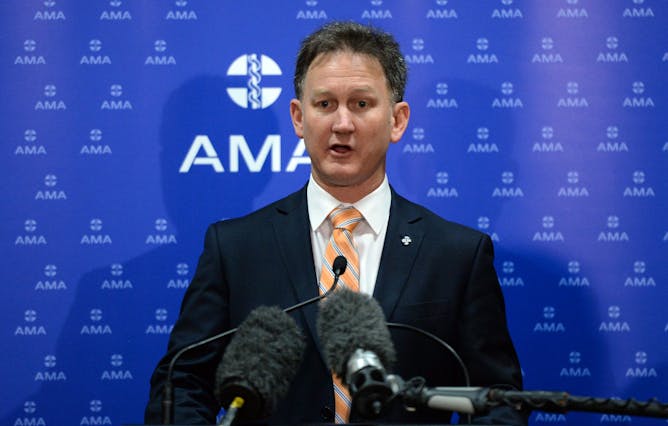 AMA president Michael Gannon wants the government to junk ‘junk policies’.
AAP Image
AMA president Michael Gannon wants the government to junk ‘junk policies’.
AAP Image
Issues with private health insurance
The affordability of private health insurance is an issue for all Australians. This goes not just to cost but to value (as perceived by the purchaser) and utility, especially for Australians who live outside metropolitan areas where they may not have access to treatment in a private hospital. Australians are generally happy with Medicare and often question the need for private health cover; some 25% of people don’t use their insurance when they are hospitalised.
Policies are complex, and exclusions have proliferated. This includes such basics as maternity and mental health services, and gaps in cover such as necessary post-operative care. Combined with the need for individuals to analyse the cost impact of financial carrots and sticks such as the Private Health Insurance Rebate, Lifetime Health Cover and the Medicare Levy Surcharge, it is impossible for many to make informed choices.
Read more: Why do Australians have private health insurance?
Overall, consumer and doctor dissatisfaction with private health insurance is growing. This is expressed in declining numbers of people taking out hospital cover. Australians are increasingly concerned insurance companies are interested only in profits. Faced with relentless price increases and diminishing value for money, many are ditching or downgrading their cover.
Many others are merely looking to evade tax penalties rather than cover their health-care needs. And too often private health-care patients face substantial, unexpected out-of-pocket costs.
In his criticism of junk policies, Gannon is echoing the findings of the Australian Competition and Consumer Commission. It has consistently reported that the complexities and costs of the private health industry drive consumers to lower-priced policies that lack adequate coverage – junk policies, in other words.
What’s the government doing?
 NIB CEO Mark Fitzgibbon has called the AMA campaign ‘paternalistic’.
AAP Image
NIB CEO Mark Fitzgibbon has called the AMA campaign ‘paternalistic’.
AAP Image
The insurance funds, with surging profits, seem indifferent to these concerns. The CEO of health insurer NIB, Mark Fitzgibbon, called the AMA campaign “paternalistic” and an attack on consumer choice. He maintains that “all policies do have a minimum level of cover, it’s a question of where you draw the minimum”.
The Australian government, which is a significant stakeholder in private health care, has been strangely silent on these issues. This year it will pay out A$6.5 billion for the private health insurance rebate, while Medicare pays 75% of most services provided in private hospitals.
Read more: The multi-billion-dollar subsidy for private health insurance isn’t worth it
Rising consumer complaints led the then health minister, Sussan Ley, to establish the Private Health Ministerial Advisory Committee in 2016. This was meant to provide advice on reforms, including developing easy-to-understand categories of insurance, improving transparency, and meeting the specific needs of people living in rural and remote Australia. Despite the pressing need for these reforms, this committee has yet to report.
More transparency about the high variability in specialist doctors’ fees is also needed, notwithstanding the AMA’s objections to this.
Policy analysts and competition experts have consistently pointed out that private health insurance is an ineffective mechanism for transferring funds from healthy young Australians to cover the health-care needs of the sick and elderly. The biggest users of private health care are those aged 60 to 79 and changes to Medicare could provide more efficient and equitable ways to cover their needs.
Addressing this will require substantive reform and the redirection of the funds currently spent on the private health insurance rebate.
Authors: Lesley Russell, Adjunct Associate Professor, Menzies Centre for Health Policy, University of Sydney


 Daily Bulletin


