

Bottleshops affect people's health, so our laws need to reflect that
- Written by: Janani Muhunthan, PhD candidate, George Institute for Global Health
When a new alcohol supermarket opens up in your neighbourhood you might think it’s a great place to get a cheap bottle of wine. But what if one is set to open in a disadvantaged area with a high number of existing outlets, high rates of alcohol-related crime and domestic violence?
Bottleshops aren’t like other shops. There’s growing evidence their location and density influences the health and well-being of the people in surrounding areas, particularly in disadvantaged areas.
Yet, our research reveals when liquor licences and development applications for new bottleshops are considered in court, their public health impact is seldom taken into account.
What if there are lots of other bottleshops nearby?
The 20% of Australians who live in the poorest areas are 1.6 times as likely as the richest 20% to have two or more chronic health conditions like heart disease and diabetes. Yet bottleshops are disproportionately located in areas of socioeconomic disadvantage, potentially adding to the disease burden of an already disadvantaged area.
Local communities with higher densities of alcohol outlets tend to have poorer health, with much higher rates of hospitalisations and premature deaths, particularly due to cirrhosis (long-term liver damage). The link is stronger in poorer communities.
Conversely, research by a colleague shows people who do not have bottleshops within 800 metres of their home say their health is better than the health of people who live closer to a bottleshop.
Competition between nearby outlets – and the extended opening hours, increased visibility of outlets and exposure to alcohol advertising – that often goes with it can increase alcohol consumption.
 Clusters of bottleshops often lead to extended opening hours as outlets compete.
from www.shutterstock.com
Clusters of bottleshops often lead to extended opening hours as outlets compete.
from www.shutterstock.com
The clustering of outlets can also encourage outlets to compete on price and promotions for cheaper and greater quantities of alcohol. Such promotions can lead to anti-social behaviour such as alcohol-related injury and violence. Researchers see this in both rich and poor areas.
Increasing the density of alcohol outlets exacerbates domestic violence in the postcode area, which we see across all areas, but with higher rates in areas of socioeconomic disadvantage.
And there’s a stronger association between outlet density and violence in general in socioeconomically disadvantaged areas compared to other areas.
There are also different effects depending on how the alcohol is sold. For example, a high density of alcohol outlets (which includes large and small bottleshops, clubs and pubs) is strongly related to alcohol-related chronic disease. Meanwhile increases in the number of licenses for bottleshops are associated with increases in rates of domestic violence. We see this across the board, not just in poorer areas.
How about Indigenous communities?
The health consequences of alcohol availability is an issue that cuts across Indigenous and non-Indigenous populations.
Indigenous people are more likely to abstain from drinking than non-Indigenous people (28% versus 22%). Yet Indigenous people disproportionately experience alcohol abuse and alcohol-related harms. Alcohol use is associated with 7% of all deaths and 6% of the total burden of disease experienced by Indigenous Australians compared with 5% of the burden of disease in the general population.
Our research has shown restricting alcohol in Indigenous communities, where community-led, is generally effective in improving health and social outcomes including disease, injury and crime.
How do new bottleshops get approval?
Despite the growing evidence of the detrimental effects of increasing alcohol outlet density, particularly in disadvantaged areas, bottleshops continue to be built in communities already struggling with the harms of drinking.
Our research shows when development applications for new alcohol outlets are rejected, groups with vested interests, such as the alcohol industry, take local governments to court and win – even in cases where there have been hundreds of community submissions opposing the developments.
In 77% of cases we looked at from 2010 to June 2015, the alcohol industry was successful in having local planning decisions overturned in court, and the proposals went ahead.
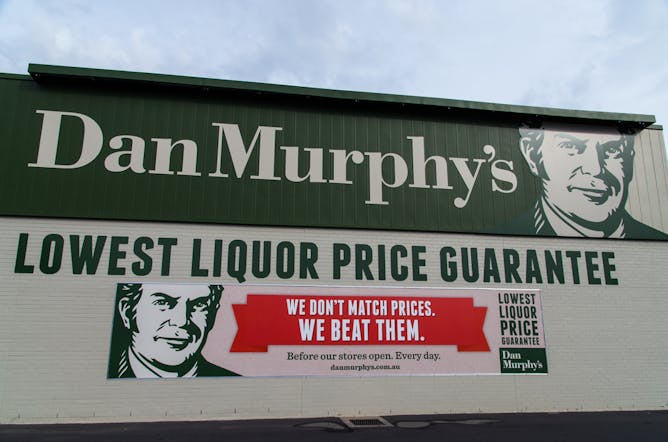 Dan Murphy’s opened up an alcohol supermarket in Nowra, NSW, despite community opposition.
Nils Versemann/www.shutterstock.com
Dan Murphy’s opened up an alcohol supermarket in Nowra, NSW, despite community opposition.
Nils Versemann/www.shutterstock.com
This was the situation for the community of East Nowra in New South Wales. The local government, Shoalhaven City Council, community members, family support services and local police joined together to oppose the development of a 1,400 square metre Dan Murphy’s (owned by Woolworths) liquor store over fears the community’s health and social problems would be made worse by making cheap alcohol more accessible. Yet, the local government’s decision to reject the proposal was overturned in court and the outlet went ahead.
This type of situation is possible because existing policies and legislation that control approvals for liquor licences and bottleshop development applications seldom consider the public health impacts. Rather, they focus on economic imperatives, zoning, planning requirements and amenity (how attractive or pleasant a development is likely to be).
What we’d like to see
To reduce the public health impacts of alcohol outlets in local communities, planning law and policy in all jurisdictions need to consider health and social impacts, as is already the case in the Australian Capital Territory, South Australia and Queensland.
Our results suggest this approach has resulted in fewer cases where the alcohol industry has local government decisions overturned in court.
These provisions would empower the courts to make decisions good for the public health of their communities. They could also help protect the authority and autonomy of local governments to reject industry proposals that do not promote the health and well-being of their constituents.
Authors: Janani Muhunthan, PhD candidate, George Institute for Global Health
Read more http://theconversation.com/bottleshops-affect-peoples-health-so-our-laws-need-to-reflect-that-80324


 Daily Bulletin


