

Building codes not enough to protect homes against water damage in severe storms
- Written by: Matthew Mason, Lecturer in Civil Engineering, The University of Queensland
When Tropical Cyclone Debbie made landfall in North Queensland early in 2017, it led to nearly A$1 billion in insured losses. Fortunately, there were no deaths or serious injuries where people sheltered in buildings.
We conducted a detailed study into what sort of damage took place during Cyclone Debbie. This involved taking direct measurements of winds within communities as the storm came ashore. We then returned after the storm to assess the damage to buildings caused by wind, wind-driven water entry into buildings (water ingress), and storm tide inundation.
We found that buildings designed and constructed using appropriate codes and standards provided safe refuge from Cyclone Debbie’s winds. However, these regulations did not stop significant volumes of water entering these buildings and causing major financial loss and community disruption.
Unless the amount of water entering buildings is reduced, the cost of severe storms will continue to rise.
Measured winds
The Bureau of Meteorology operates a network of fixed weather stations around the country. To supplement these fixed sites, we deployed a network of portable weather stations throughout Proserpine, Bowen, Home Hill and Ayr to measure the wind speeds that hit these areas as Cyclone Debbie made landfall.
 Surface Weather Information Relay and Logging Network (SWIRLnet) weather station deployed in Proserpine. Image taken following storm passage highlighting damage to vegetation.
Author provided
Surface Weather Information Relay and Logging Network (SWIRLnet) weather station deployed in Proserpine. Image taken following storm passage highlighting damage to vegetation.
Author provided
After adjusting these measurements for their local site conditions, we then related them to the design wind speed prescribed in the Australian wind loading standard, AS/NZS1170.2. For new residential and commercial buildings in North Queensland this is 250km per hour.
Our analysis found that wind gusts at Hamilton Island approached design strength (that is, 90-100% of 250km per hour, as shown in the figure below), Airlie Beach and Proserpine experienced winds at 80-85% of design strength, Bowen around 70%, and Ayr/Home Hill and Mackay less than 50%.
We do not believe that any community experienced wind speeds greater than the 250km per hour a new home should be designed to withstand.
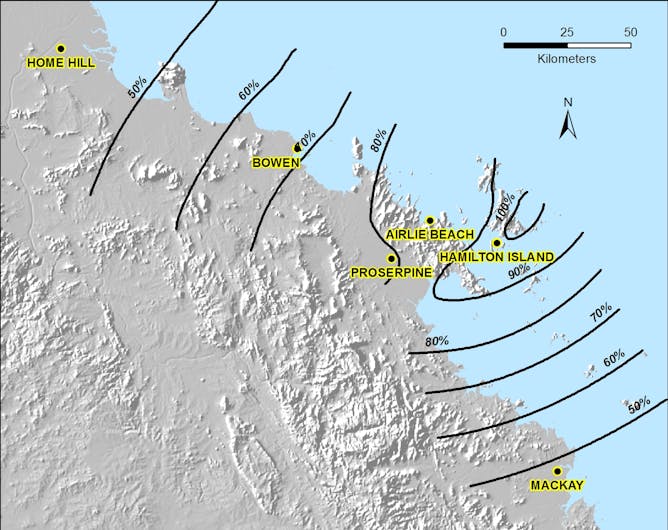 Maximum wind speed contours in the landfall region as a percentage of the design wind speed for coastal North Queensland (250km per hour).
Author provided
Maximum wind speed contours in the landfall region as a percentage of the design wind speed for coastal North Queensland (250km per hour).
Author provided
Wind damage
Communities are made up of a mix of buildings. Newer ones are built to current codes and standards, while older ones are not.
Structural details for wind resistance of housing were introduced to building codes in the mid 1980s in response to damage caused by several severe tropical cyclones in the 1970s.
Echoing similar investigations following these and more recent tropical cyclones, our survey showed that the majority of wind-related failures occurred in older houses. It again highlighted known issues with inadequate tie-down between battens, rafters and trusses, or between the roof structure and wall, as well as deterioration of structural elements.
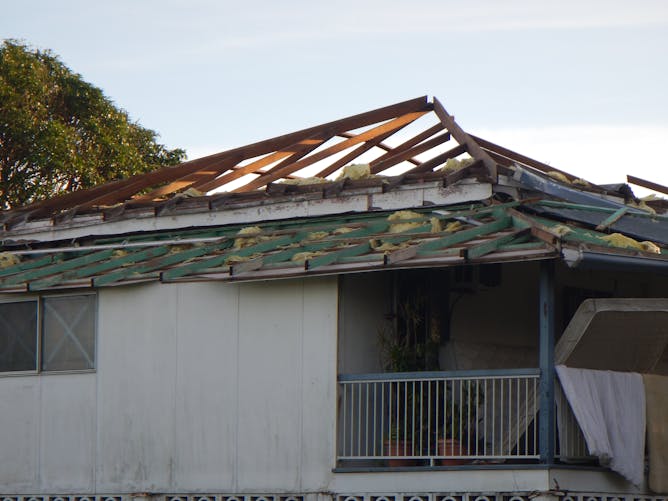 Loss of roof sheeting from a pre-1980s home where wind speeds were less than 80% of design.
Author provided
Loss of roof sheeting from a pre-1980s home where wind speeds were less than 80% of design.
Author provided
Such damage to older buildings remains a problem that will continue to present a risk to life and property unless coordinated structural upgrading or retrofit programs are implemented.
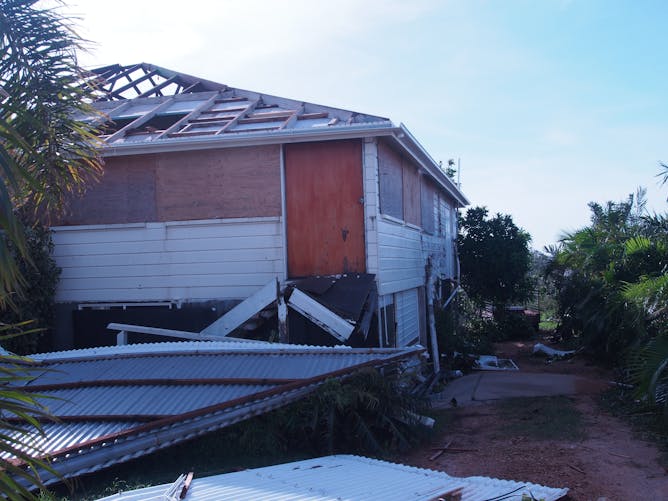 Loss of roofing due to a batten to rafter failure in a pre 1980s home where wind speeds were less than 80% of design.
Author provided
Loss of roofing due to a batten to rafter failure in a pre 1980s home where wind speeds were less than 80% of design.
Author provided
Few contemporary buildings had significant damage where the measured wind speeds were less than 80% of the design wind speed. Where damage was observed, this was primarily due to the use of incorrect or poorly installed details.
 Damage to roofing on modern buildings where wind speeds were close to the design value.
Author provided
Damage to roofing on modern buildings where wind speeds were close to the design value.
Author provided
Overall, however, the low level of structural damage to newly constructed buildings was in line with that expected given measured wind speeds. This shows that where appropriate codes and standards are applied, structural damage can be controlled.
 Damage to veranda roof on a modern buildings were close to the design value.
Author provided
Damage to veranda roof on a modern buildings were close to the design value.
Author provided
The other damage
But cyclones can cause plenty of other damage that can still be a problem for people.
We found that internal linings, ceilings and contents (furniture, clothes, and other items) in many hundreds of contemporary buildings were damaged due to wind-driven water ingress. This occurred irrespective of wind speeds.
Wind-driven water ingress occurs when differential pressure between the inside and outside of a building forces rainwater through windows, doors, louvres, weepholes, vents and even under flashings nominally designed to keep water out.
This ingress occurs in the absence of any structural or building envelope damage and even occurs when doors or windows are closed.
 Damage to home contents due to wind-driven rainwater ingress.
Author provided
Damage to home contents due to wind-driven rainwater ingress.
Author provided
Many people reported mopping up water in front of windows and glass doors during the cyclone. This practice puts people at risk of serious injury if the windows or doors are broken by debris or wind pressure.
But no definitive codes, standards or guidelines currently exist to help prevent water ingress during severe tropical cyclones.
It is anticipated that damage due to wind driven water ingress will make up a significant percentage of the total damage cost of this event.
It has led to significant community disruption during repair and recovery, and is clearly a community resilience issue that must be addressed.
Building more resilient communities
As in previous wind events, from the damage we observed it was clear that wind-driven rainwater ingress was a major cause of loss to modern buildings. Anecdotally, its contribution to the costs of community recovery is increasing.
But, rightly or wrongly, since water ingress is not generally viewed as a life safety issue, codes and standards do not currently control it.
Manufacturer standards, improved design and installation practice and even insurance pricing are possible alternatives. But we believe further research is urgently required to determine the most appropriate method to address this problem.
For the most part, newer buildings - with correctly designed and installed structural details - resist severe winds better than older ones.
The structural details of all buildings, regardless of age, should be checked following major wind events. You service your car to protect your family – why not your home?
Authors: Matthew Mason, Lecturer in Civil Engineering, The University of Queensland


 Daily Bulletin


