

Juno mission unveils Jupiter’s complex interior, weather and magnetism
- Written by: Lucyna Kedziora-Chudczer, Postdoctoral Fellow, Astrophysics Researcher, UNSW
The latest observations of the Juno spacecraft are helping astronomers uncover the true nature of Jupiter in unprecedented detail. Many of the findings were unexpected.
Since July 2016, Juno has been revolving around Jupiter – the largest planet in our Solar System – in a highly elongated, 53-day orbit. This allows a clear view of its poles while the spacecraft ducks in and out of the strong radiation regions that surround the planet.
The first results of Juno observations were released in two studies published in Science last week. They reveal a very new picture of the Jovian interior, its atmosphere and magnetosphere.
Of course it’s not only the observations from Juno that are helping us better understand Jupiter. Simultaneous monitoring from ground based telescopes such as the ones on Mauna Kea in Hawaii, where I was recently, are also helping.
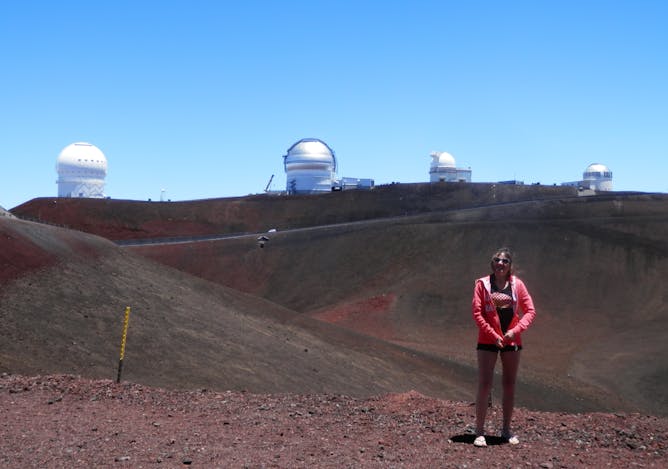 Here I am on Mauna Kea in Hawaii.
Marcel de Vriend
Here I am on Mauna Kea in Hawaii.
Marcel de Vriend
But first to the latest Juno discoveries.
The atmosphere
Juno’s multiple passes over polar regions of the planet revealed stunning images of swirling cyclones, some almost as large as Earth.
There is no banded structure visible in these images, in contrast to Jupiter’s equatorial regions. There is no hexagon or a central vortex in the southern polar region like the one that the Cassini probe observed in Saturn’s north polar atmosphere.
It also appears that a high-altitude thin cloud or a haze, of yet unknown composition, hovers over both poles of Jupiter.
 Juno’s view of Jupiter’s south pole from an altitude of 52,000 kilometers. The oval features are cyclones, up to 1,000 kilometers in diameter.
NASA/JPL-Caltech/SwRI/MSSS/Betsy Asher Hall/Gervasio Robles
Juno’s view of Jupiter’s south pole from an altitude of 52,000 kilometers. The oval features are cyclones, up to 1,000 kilometers in diameter.
NASA/JPL-Caltech/SwRI/MSSS/Betsy Asher Hall/Gervasio Robles
Juno’s radiometry measurements can probe the atmosphere to the unprecedented depth of 350km. This takes it below the frozen ammonia cloud top that we usually see in visible light images of the planet, with atmospheric pressures up to 240 times greater than on Earth’s surface.
Astronomers have already studied the rich and dynamic Jovian weather system since the first space observations of its atmospheric composition and profiles from the Voyager probes. But the previous deepest atmospheric measurements could be considered skin-deep when compared with Juno’s latest observations.
Only in one specific area of the planet was the atmosphere studied up to a depth of 100km. That was in 1995, when the Galileo probe descended into a so-called “hot spot”, a dark region between ammonia clouds that glows strongly in infrared light. Galileo’s probe measurements found this region surprisingly devoid of any water vapour clouds, as would have been expected below ammonia cloud.
Now, for the first time Juno’s radiometry allows a global view of deep atmosphere, showing that the banded pattern extends deeply below the visible tops of the clouds.
The measurements of ammonia content in these deep layers reveals an unexpected and dynamic mixing similar to the Hadley cells in Earth’s atmosphere. This is where masses of hot air rise in equatorial regions and move polewards, before plummeting in the tropics and returning towards the Equator close to Earth’s surface.
One of the goals of the Juno mission was to measure water content in the Jovian atmosphere, which has implications for understanding Solar System formation.
So far Juno has confirmed that the hot spots are indeed very dry regions of descending air with humidity less than 10%.
The magnetosphere
Since the discovery of strong radio emission from Jupiter in the 1950s – implying the existence of a magnetic field around the planet – every new space mission has slowly added to the ever so complex picture of the Jovian magnetosphere.
The Juno mission is designed to make an unprecedented leap forward in the understanding magnetic field generation processes and also to make a detailed map of the planet’s magnetosphere.
One of the most spectacular consequences of interaction between the magnetosphere and atmosphere of a planet is an auroral display, similar to the northern and southern lights on Earth.
Jupiter’s ‘southern lights’ as captured by Juno. (NASA/JPL-Caltech/SWRI)The JADE, JEDI and Waves instruments placed on Juno are used to measure the energies of particles that plummet into the polar regions and smash into atmospheric gases, mainly hydrogen that emits radiation, which we see as aurora.
The ultraviolet and infrared maps of this emission allow us to measure how the top layers of the Jovian atmosphere heat up and cool, as well as to understand the dynamics of the magnetosphere.
But why is the magnetosphere worth our attention? Planetary magnetospheres act like protective shields that deflect space radiation harmful to life.
Only planets that can produce magnetic fields have magnetospheres and, lucky for us, Earth has one too. But besides Earth, only the giant planets in our Solar System have appreciable magnetospheres.
Juno measured magnetic field in regions closer to Jupiter than ever before, and the results were very different than the predictions from the previously used models.
The observed magnetic fields are stronger and also more spatially variable than previously assumed. Since it is understood that a magnetic field is formed in the cores of planets via dynamo process, this suggests that magnetic field formation region is actually much larger than expected.
This, in turn, in combination with Juno’s measurements of gravitational field around the planet, tells us that our previous ideas about the core of the planet may have to be revised.
For example, the textbook images of the rather compact core of metallic hydrogen is not consistent with Juno observations. The metallic hydrogen core could be as large as the half of Jupiter’s radius.
Back on Earth
During Juno’s closest approach to Jupiter – while the probe makes critical observations of Jovian weather, magnetism and gravity – some of the largest telescopes on Earth support the mission with imaging and spectroscopy of the giant planet.
Although the spatial resolution of such observations is no match for imaging from Juno, ground telescopes have a global view of the planet.
During the sixth approach of Juno to the planet on May 19, some of us were using telescopes on Mauna Kea in Hawaii.
I used a high-resolution infrared spectroscope at the Gemini telescope to map the full extend of auroral hydrogen emission around both planetary poles, while my colleagues were taking infrared images of the same regions at the Subaru telescope.
It is exciting to participate in this critical ground base support of the Juno mission, when the international astronomical community joins for a once in a lifetime opportunity to get a very unique view of our giant neighbour.
 Here I am in front of the terminals to the Gemini Telescope, in Hawaii.
Jen Miller
Here I am in front of the terminals to the Gemini Telescope, in Hawaii.
Jen Miller
It is also amazing to have a support from many amateur astronomy groups that joined in observations of visible light from the planet.
The raw images from the Juno’s visible light camera are available on the Juno website for public use. People are invited to process such images and submit their work for viewing.
Future goals for Juno
Juno’s unique orbit allows for making spectacular images of regions not visited in previous missions. The probe also comes much better equipped than some of its predecessors to visit the planet.
The first results from the mission are already suggesting future revisions, or at least adjustments to models of Jupiter’s atmosphere, interior and magnetism.
This unique study of our largest giant planet will hopefully bear implications on the understanding of the formation and composition of similar but much hotter giant planets discovered around other stars.
Authors: Lucyna Kedziora-Chudczer, Postdoctoral Fellow, Astrophysics Researcher, UNSW


 Daily Bulletin


