

Mythbusting Ancient Rome - Caligula's Horse
- Written by: Shushma Malik, Lecturer in Classics and Ancient History, The University of Queensland
When we think of the emperor Caligula, it is John Hurt’s wonderfully maniacal performance in the BBC TV series I, Claudius that usually comes to mind. Hurt dances in a gold bikini, sports a beard soaked with the blood of his progeny, and parades his favourite horse, clad in the toga of a consul, in front of shocked onlookers. He is the very model of a mad Roman emperor.
The story that Caligula made his favourite horse, Incitatus, a consul has long tickled our imaginations. The internet is awash with articles and blogs chewing over whether it is really true. The horse has even made it into the Oxford Dictionary of Phrase and Fable: its definition for the name “Incitatus” reads “the name of Caligula’s horse, made a consul by the emperor”. Perhaps the greatest testament to Incitatus’ immortality, however, is the fact that he has his own Wikipedia page.
While the ancient evidence mentions a plan for making Incitatus consul, the repeated retelling of the story over centuries (in particular, as a snide way to suggest that a politician might be out of his or her depth) means we often forget that Caligula’s horse never actually sat in the senate at all.
The emperor’s favourite ass
The office of consul was the highest magistracy in the Roman Republic. Under the empire, the position still existed, though it was primarily an honorific office, which emperors used to reward loyal senators. On the subject of Caligula’s horse, the ancient sources are unambiguous in their testimony: he was not made a consul.
The biographer Suetonius does, however, report that the emperor lavished gifts upon Incitatus, equipping him with a marble stall, ivory manger, purple blankets, luxurious furniture, and his own slaves. At the climax of this passage, Suetonius writes:
…it is also reported that he designated [Incitatus] to the consulship.
Another ancient source, the historian Cassius Dio, gives a slightly different version:
…and he even promised to designate [Incitatus] consul. And he would most certainly have done this, if he had lived longer.
The story therefore probably owes its origin to an off-hand remark made by Caligula that he would make Incitatus a consul (though he never followed through with it).
Why would Caligula say this? One of the most popular theories is that the emperor was criticising the consuls: they were such “asses” that he might as well include his horse in this elite group.
The name of the horse is particularly relevant here. “Incitatus” means “fast-moving”. The historian David Woods has ingeniously suggested that the name was intended to be an insult directed towards one particular consul, Asinius Celer, whose name means “swift ass”. A joke by Caligula the comedian has been interpreted as historical fact.
A party fit for a horse
Caligula was a far cry from his imperial predecessors Augustus and Tiberius. We think of Augustus as the “first emperor” but he positioned himself as a leading Republican politician, not a monarch. His successor, the dour Tiberius, tried to refuse as many monarchical honours as possible.
Caligula, on the other hand, was a boisterous young man in his mid-twenties. He was keen to experiment with the opportunities his position allowed him, adopting ceremonies and dress that were more in keeping with eastern kings. In short, Caligula wanted to be – and be seen to be – a monarch.
The youth of Rome loved their horse-racing. The attention Caligula lavished on Incitatus went above and beyond that shown to prize steeds by other young aristocrats. He was the emperor, so bigger and better was the name of the game. Caligula did hold parties for his friends in the horse’s grand stables, where Incitatus himself was the “host”. But all the bling was really for Caligula and his mates, so they could live it up in style – it was not for the horse.
Caligula’s regal pretensions did not sit well with Roman aristocrats, who wanted their emperors to respect them and Republican institutions such as the consulship. We can easily imagine Caligula and his drinking buddies lampooning the stuck-up consuls as “asses”, and the emperor declaring that Incitatus would soon be joining their ranks!
The neighs have it
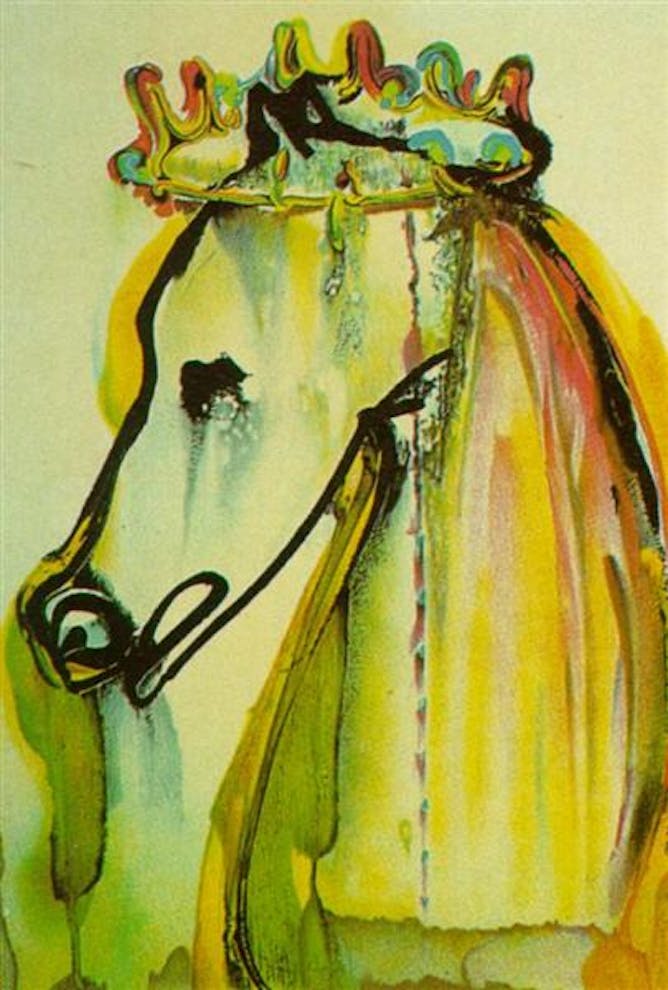 Caligula’s Horse (Dali’s Horses), Salvador Dali, 1971.
www.wikiart.org. Fair Use Licence.
Caligula’s Horse (Dali’s Horses), Salvador Dali, 1971.
www.wikiart.org. Fair Use Licence.
The story of Caligula and Incitatus proved so irresistible as a paradigm of political abuse that it didn’t seem to matter that the horse never donned the consular toga. In particular, commentators through the centuries have had a great deal of fun in comparing contemporary politicians to the emperor’s favourite horse.
One of the cleverer examples of this is a piece from the London Magazine and Monthly Chronologer, printed on 6 February 1742. In a column entitled Common Sense, the subject for discussion is “Caligula’s Prime Minister”. The Prime Minister of Great Britain at the time was Robert Walpole, who, on 28 January 1742, had lost a vote of no confidence in Parliament. The author of this satire immediately lays his cards on the table, stating that Caligula was a good and able emperor who chose the best candidate for the job of “Prime Minister”:
What a happiness … must it have been to have liv’d under the auspicious Reign of the Emperor Caligula, who had so great a Regard to Merit wherever he found it, and took such a fatherly Care in providing for the Happiness of his People, that he made his Horse a Minister of the State.
Incitatus comes up trumps compared to Walpole, as the horse demonstrates all the qualities of a good Prime Minister. The real blow, however, is dealt at the end of the piece:
Whoever considers these Things with an unprejudiced Judgement, will upon an impartial Comparison with another whom I have in my Eye, be obliged to own, that the Horse was not only the honestest, but by far the wisest Minister of the two.
Caligula’s horse also appears in more serious contexts, such as a British response to the American Declaration of Independence of 1776, entitled the “Rights of Great Britain Asserted against the Claims of America”. The author cites the story of Incitatus’ consulship as one of many examples from ancient Rome where the wrong people are given decision-making power:
The extension of the right of electing Magistrates to the people at large, was the principal cause of the fall of freedom in Old Rome. The prejudices and fears of the rabble were the steps by which ambitious men ascended to a power, which they converted into tyranny over their foolish Constituents…the grandsons of voters who placed Marius, Cinna, and Caesar at the head of the State, were employed by Caligula in raising his horse to the Consulship.
Here the story of Incitatus becomes a parable of what happens when a state abandons its founding principles at the behest of sycophants.
But there is a final twist in this horse’s tale. Cassius Dio states that Caligula made a horse – assumed to be Incitatus – a priest of the emperor’s cult. This has usually been overlooked, perhaps because Dio mentions it in a different section and does not explicitly name Incitatus.
As a result, we have been accustomed to interpreting this story as one about the abuse of political, rather than religious, power. Even though Caligula’s horse never actually got to sit in the ivory chair in the Roman senate (his ivory stable had to suffice), we still like to imagine a time when a politician literally was an ass.
Authors: Shushma Malik, Lecturer in Classics and Ancient History, The University of Queensland
Read more http://theconversation.com/mythbusting-ancient-rome-caligulas-horse-75837


 Daily Bulletin


