

Wary of human-animal hybrids? It's probably just your own moral superiority
- Written by: Brock Bastian, ARC Future Fellow, Melbourne School of Psychological Sciences, University of Melbourne
In Greek mythology, the Chimera is a monstrous fire-breathing creature, typically described as having the head of a lion, with a snake as a tail and the head of a goat emerging from its back.
Just as it terrorised the minds of the Greeks, this vision is also the cause of much consternation regarding the successful creation of the first human-pig hybrid embryos at the Salk Institute in California. In fact, such human-animal hybrids are often referred to as “chimeras”.
While this scientific advance offers the prospect of growing human organs inside animals for use in transplants, it can also leave some people with a queasy feeling. It was precisely this queasiness that led to the moratorium on funding for this program of research.
People, it seems, just can’t stomach the idea of growing human kidneys in pigs!
Given the potential advances that this research offers, our objections should probably be based on more than a mild case of nausea. Yet there are a few enduring aspects to the way we perceive human-animal hybrids that makes it difficult to think about them clearly.
It’s just not natural!
Many of us are like six-year-olds who turn their nose up at the idea of mixing their broccoli with their mashed potato. We prefer to keep things pure. Whether it is cross-bred animals or racially mixed children, people who see the world as defined by underlying essences tend to reject this “impurity”.
What is an “underlying essence”? It’s the idea that things have certain necessary properties that are essential to them being what they are. So there is a kind of “pigness” that is exclusive to pigs, and a “humanness” that is exclusive to us.
But in biology, at least, there is no actual essence to anything in this sense. We’re all made of different combinations of the same kinds of stuff, like proteins and amino acids. Even much of the blueprint – our genes and DNA – are shared across species, such that humans and mice share around 90% of their DNA, and we even share around 35% of our genes with the simple roundworm.
But this does not mean that we don’t often rely on this way of thinking to understand what makes a tiger natural in a way that a chair is not. It is also this intuition that makes us squirm at the thought of a tiger-goat but intrigued by the idea of a chair-table.
Mixing human and animal biology is perceived as being unnatural and bit on the nose (much like a laksa risotto I once ordered), creating an irrational fear that human-pigs might escape the lab and take over the world (much like I fear the meteoric rise of Italian-Malay cuisine).
While the possibility of human-pig chimera wandering the planet is far from reality, just like the Greeks, our fear of hybrids fosters the sense that such creatures would be monstrous.
But what about mules?
While hybrids in general can sometimes create a disagreeable mixture of fear and disgust, this is not always the case. Take for instance the boysenberry (a cross between the raspberry, blackberry, dewberry and loganberry) or the clementine (a cross between a mandarin and an orange). We have little trouble consuming such hybrids for our lunch.
Our apparent comfort with some hybrids does not stop at plants. Mules have never been a source of alarm, yet they are the offspring of a male donkey and a female horse. And what about the Liger, Tigon, Zonkey, Geep, or Beefalo?
Still, while hybrids in general can create a sense of foreboding, not all hybrids do, and it may be that mixing biology is most psychologically problematic when it comes to our own human DNA – and perhaps especially when it comes to mixing it with that of other animals.
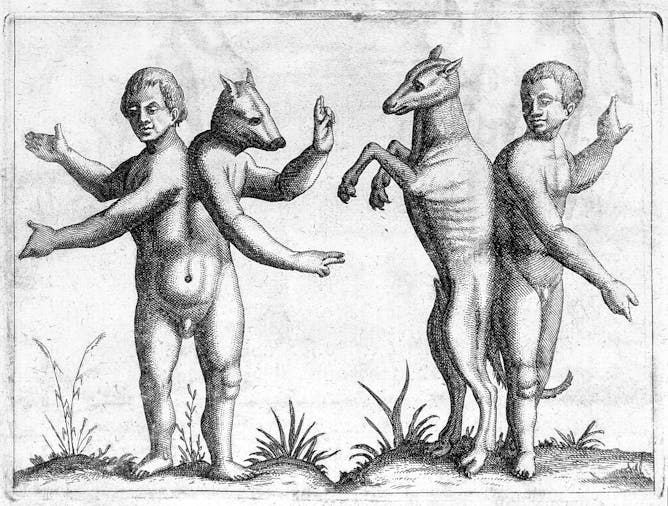 A common theme for depictions of monsters is human-animal hybrids.
Wikimedia
A common theme for depictions of monsters is human-animal hybrids.
Wikimedia
We are not animals
One reason that human-pig hybrids are a source of anxiety is that they can conjure up a fear of our own death. The possibility that a pig could grow your next pancreas is a cogent reminder that humans are also animals, and this very biological reminder can create existential angst.
The notion that humans have souls, but animals do not, was (and still is for some) a popular belief. It gives us a sense of being superior, above or outside the biological order. Harvesting human hearts from goats can shatter this protective belief, leaving us feeling disgusted and dismayed.
Human-animal hybrids turn one’s mind to the inevitable fact that we will all be pushing up the daisies one day. By keeping thoughts of our animal nature at bay, we conveniently forget that we are nothing more than mortal biological organisms waiting to fertilise the fields.
But bacon tastes good!
Another reason that growing a spare liver in the pig on your uncle’s farm while subjecting your own to a bad case of cirrhosis may create unease is that doing so confuses the tastebuds. We eat pigs, not humans. Would you still enjoy bacon if it came from the pig who had nursed your liver for the past six months?
More powerfully, the prospect of pig-humans also confuses the moral compass. Biologically merging pigs with humans reminds us of our shared similarities, something that we mostly try to forget when savouring the smell of frying bacon.
We tend to maintain clear boundaries between those animals we eat and those we do not, as this helps to resolve the sense of discomfort that we might otherwise feel about using animals for food. It was this very confusion of boundaries that led to outrage over the prospect of horse meat in burgers during the 2013 horse meat scandal; horses are perceived as pets or companions, not food.
If confusing pets with animals we eat creates discontent, then confusing those same meat-animals with our own kind is sure to create moral and gustatory hesitation.
Beyond baffling our pallet, it also confounds our understanding of whether it is an animal from whom we are harvesting our next-generation organs, or some kind of sub-human entity. Indeed, harvesting organs from humans conjures visions of a [dystopian future](https://en.wikipedia.org/wiki/The_Island_(2005_film).
In the end, while mythical hybrid beasts may have caused alarm for the Greeks, it would seem that our own objection to growing our next heart in the breast of a pig has more to do with existential angst and a disruption of the moral order.
Whether or not we should use animals for these purposes, or for the satisfaction of human needs more broadly, is a topic for another time. Yet it is safe to say that our personal fear of this scientific advance – the queasiness we feel in the gut – may be mostly to do with how it destabilises our perceived human uniqueness and undermines our own moral superiority than anything to do with broader concerns over hybrids themselves.
Authors: Brock Bastian, ARC Future Fellow, Melbourne School of Psychological Sciences, University of Melbourne


 Daily Bulletin


