What American students can learn from immersing themselves in Africa
- Written by: The Conversation
 American students don't realise how valuable spending time in Africa can be.From www.shutterstock.com
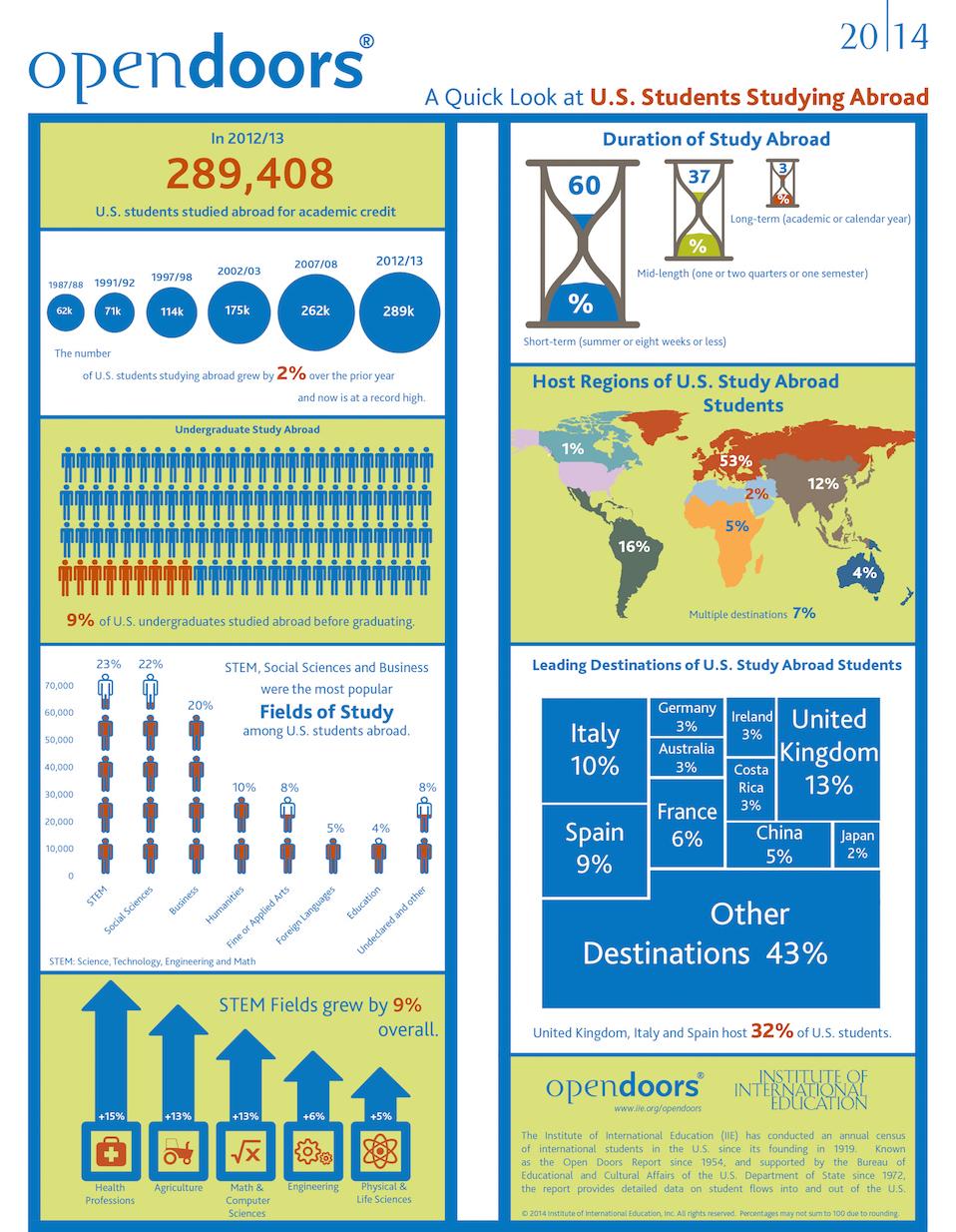
More than one million people travelled from around the world to study at American universities in the 2013 - 2014 academic year. By contrast, just under 300 000 Americans enrolled to study abroad.
In this era of globalisation it’s no surprise that so many young people are keen to study abroad. But as the Institute of International Education’s research reveals, the majority of US students are sticking close to home - not geographically, but culturally.
 While American students are exploring universities elsewhere in the world, there isn’t a lot of diversity in the destinations they choose.Open Doors/Institute of International Education
Africa remains on the margins when it comes to American universities' curricula and initiatives like study-abroad programmes. American university students also display profoundly ill-informed views about Africa.
When historian Curtis Keim asked his college students to choose words that described the continent, “within a few minutes” they came up with “native, hut, tribe, cannibals, jungle, voodoo … poverty, ignorance … spear …”
There are 54 countries in Africa. Collectively, their universities attracted only 5% of those Americans who studied abroad in the 2013 - 2014 academic year. My research suggests that universities are missing out on a valuable opportunity to positively influence individual students and the American academy’s view of Africa.
Cameroon: a case study
The University of Dayton in Ohio designed its Cameroon Immersion Programme 20 years ago. It differs from traditional study abroad programmes in which students are assigned to a university, taught by the professors who accompany them from home and live in hotels.
In Cameroon, students live with host families and are placed at different agencies for service and educational purposes. They teach at elementary schools, work at orphanages and NGOs and do internships at clinics and hospitals. The programme emphasises maximum interaction between American students and Cameroonians.
Both the University of Dayton and Cameroon are useful microcosms. The former is representative of other institutions in America’s mid-West that have study-abroad or immersion programmes. Cameroon, with its population of 20 million people, exemplifies many of Africa’s political, economic, social and religious complexities. It has been nicknamed “Africa in miniature” and this diversity makes it a suitable lens through which to examine students' immersion experiences on the rest of the continent.
Students give several reasons for signing up to the programme: they are idealistic about what Africa could offer them, want to serve communities, enjoy an adventure away from home or simply need to meet the requirements for an academic programme.
 Students are encouraged to get involved in every facet of ordinary life in Cameroon rather than being isolated in hotels and university classroomsDr Julius Amin
The students go to lectures at local universities and get lessons from community leaders. They cook, attend funerals, hang out in bars, date locals and participate in church services. They visit industrial sites and rural communities.
Some students who have been interviewed after completing the programme say that this total immersion has helped them to start unravelling their notions of white superiority. They also reveal that their own lives in America seem very materialistic after they’ve spent some time away from home.
Cameroonian host families were also interviewed. They were overwhelmingly positive about the programme, describing the American participants as “industrious”, “ingenious”, “friendly”, “kind” - and “wealthy”.
Some aspects of the programme surprised the students for more negative reasons. They found that America’s racial practices followed them to Africa and had to confront issues of white privilege and race. For the first time many of the students were the minority in society - but the treatment they received was fundamentally different from how similar groups and immigrants are treated in the US.
One student, Erin Anderson, said she was “treated like a queen … which was a far cry from (the) treatment of minorities who are looked down upon and not respected” in the US. African-American students were stunned by how much Cameroonians admired their Caucasian classmates. “The African people seem to cater to the white man,” wrote an African-American participant, adding that locals “kiss[ed] their ass.”
Success - but in a vacuum
There are many recorded advantages to studying abroad. In the case of the Cameroon Immersion Programme, students returned to the US far more attentive to social issues. They became outspoken critics of racism, poverty and marginalisation. One graduate returned to Cameroon to start an NGO that uses soccer to teach young people life skills.
Others went back to Cameroon to work as teachers or join the Peace Corps Volunteers. In interviews and responses to questionnaires, participants said they had learned new things about themselves during the programme, gained new perspectives and come to understand the commonality of the human experience.
But immersion and study-abroad programmes cannot continue to be successful in a vacuum. Although these programmes have been established at some American universities for more than four decades, the perception of Africa and its people on many college campuses remains ill-informed.
US universities must revise and make their curricula about Africa more inclusive. This will kindle students' interest in - and understanding of - the continent and open the door to holistic study-abroad experiences.
Julius A. Amin does not work for, consult to, own shares in or receive funding from any company or organisation that would benefit from this article, and has no relevant affiliations.
Authors: The Conversation


 Daily Bulletin