

Read The Times Australia

Daily Bulletin

Searching for a ‘technofix’ to climate change has many dangers. Could radical humility save the planet?

  • Written by: Nanda Jarosz, Researcher, Environmental Philosophy, University of Sydney

In 1989, environmentalist Bill McKibben announced to the world that nature was dead. Due to the rapid rate and scale of anthropogenic climate change, he argued, the idea of nature as an entity independent of human activity had become obsolete.

Review: Brave New Wild: Can Technology Really Save the Planet? – Richard King (Monash University Publishing)

A new book by Richard King, Brave New Wild: Can Technology Really Save the Planet?, conducts a postmortem on this idea of “nature”. And it describes a dangerous ideology that has taken root at the heart of the environmental movement.

King considers the moral, political, social and economic implications of a particular way of attempting to solve climate change, known as the “technofix”. This mindset looks for “a technological solution to tackle a social or environmental issue”.

We are, King suggests, entering “a period in which mitigation and adaptation are giving way to re-engineering”. As the consequences of climate change become harder to ignore and the environmental and moral costs of inaction become too high, “radical interventions such as geoengineering and de-extinction are taking root in the imaginations of thought leaders and policymakers across the globe”.

But solutions that come in the guise of technological progress may harbour dangers to the planet that we can’t fully fathom or control.

Brave New Wild examines proposals involving nuclear power, geoengineering, de-extinction approaches to conservation, nanotechnologies capable of manipulating matter at a molecular level, smart technologies and interplanetary colonisation. It outlines potentially terrifying scenarios associated with the technofix mindset.

King describes, for example, the risks that come with developments in nanotechnology. Billions of self-fuelling and self-replicating nanomachines deployed to clean up an oil slick could run out of control and lead to an environmental disaster of planetary scale:

Given that every new nanite created would need to consume some of the Earth’s resources to use as fuel or source material, the resulting army could reduce the biosphere to dust within a matter of days. The grey goo would consume the world.

It has also been suggested that mining the moon “will be feasible by the end of the decade”. King notes that some see this as a positive scenario, because the moon is uninhabited and a “barren, airless wasteland”. But he points out there are many potential hazards to such work: lunar dust pollution, the proliferation of space junk and debris, and risks to workers, including mental health problems, physical disabilities, exploitation and death.
Searching for a ‘technofix’ to climate change has many dangers. Could radical humility save the planet?
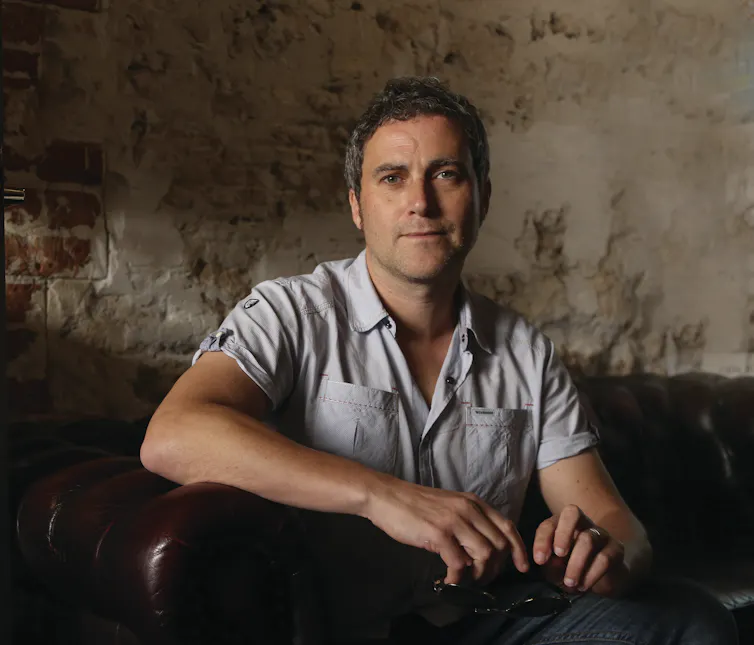
Richard King. Bohdan Warchomij/Monash University Publishing

Anthropocene thinking and moral hazards

King grounds his critique of the “technofix” in an analysis of the concept of the Anthropocene: a period when human activity is altering the conditions of life on a planetary scale and leaving perceptible traces in the geological record.

This development, King argues, “places humanity at the centre of the Earth story, suggesting that whatever challenges the planet faces will need to be solved by Homo sapiens, the species whose destructiveness is inseparable from its genius”.

Paired with the concept of the “death of nature”, Anthropocene thinking is a deadly precursor to the types of technological interventions that, King argues, will fundamentally change humanity’s relationship to the environment.

The problem is not only that technology can escape human control, with catastrophic consequences. Accepting a perspective that subjugates the non-human world to purely human ends has moral and ethical implications.

“The Anthropocene narrative,” King writes, “tends to encourage a view of nature as infinitely malleable – something that can and should be shaped by human hands, to human ends – and this perspective is likely to reproduce the arrogance and lack of principled reflection that placed us in this situation in the first place.”

Removing the separation between human and non-human nature actually makes it easier to exploit the natural environment, including other humans. This mindset – which King terms “ecomodernism” – “repeats the error of industrial capitalism, and even modernity itself, in treating the environment as an abstract entity that can be endlessly manipulated.”

Responsibility towards nature

In response to the ecomodernist mindset, which “effectively abolishes nature as a category distinct from humanity by making everything humans do effectively identical with it”, Brave New Wild suggests an alternative: what King terms “ecohumanism”.

He argues that nature is at once an idea and a phenomenological reality. “Human beings in short, are always part of and always apart from the natural world: nature defines us, and we define nature.”

This view may appear to be the same as that taken by proponents of the technofix. For King, however, our idea of nature actively shapes our experience of reality: “our ability to recognise ourselves as animals marks us out from all the other animals, while the suite of powers (intellectual, technological) from which that self-recognition is inseparable imposes upon us certain responsibilities – to ourselves and to parental nature.”

Searching for a ‘technofix’ to climate change has many dangers. Could radical humility save the planet?
In the act of recognising that nature is created through human thought, we can realise that it should not be used purely for human gain. We must act with a sense of responsibility towards it. King proposes an embodied approach to technological solutions to the problem of anthropogenic climate change. He argues that modern science must move away from a perspective of mastery over nature, towards “an attitude of care”. The first level of interaction with nature should not be mediated through logic or distant observation. It should be phenomenological: at the level of lived experience. It should involve what King calls a “more holistic way of being”. This is based on a consideration of all aspects of what it means to be human and the implications of potential solutions for “conscious, subjective, immediate experience”. One way to achieve this goal is by engaging with the democratic, creative and imaginative aspects of our humanity. King suggests decentralising political and technological control “as far as possible to individual human beings”. He proposes developing community through political policies such as universal basic income and “bringing energy and other utilities into public ownership”. He also points to sources of inspiration in creative and imaginative exercises, such as reading nature writing, or other activities that help to elicit what he calls “human flourishing”. The point, for King, is to revitalise a sense of “conviviality” through a communal understanding of what it means to be human. Radical humility Brave New Wild advocates an ethical sense of human agency. It offers an accessible point of departure for many ideas circulating in environmental philosophy. But while it is true that human beings are part of nature and should treat it respectfully, it is also true that “nature” is not limited to human perception or ideas. Human beings employ reason and sensory perception to make sense of the world, but the universe itself is not rational or reasonable. Despite advances in science and technology, nature exists beyond the powers of human comprehension, in both a material and conceptual sense. As much as scientists can engineer life, they do not know how life in the universe started or how it will end. What King does not explain is how to cultivate ecohumanism among those who view science and technology as providing ready solutions to the messy realities of our ecological existence. To foster the embodied responsibility that his interventions demand, we must first appreciate nature as a force that unsettles our claims to knowledge and mastery. One way of doing this is through the aesthetic appreciation of the sublime. An experience that embraces wonder and destruction, the sublime offers a view of nature on its own terms. It compels us to experience nature as fundamentally incomprehensible. It directly challenges the hubris of a “technofix” approach. In a world of high-tech maps and data-driven solutions, the sublime offers a glimpse of nature as it exists independently of us. The sense of awe might inspire a radical humility. It might move us away from trying to fix the planet, and towards caring for it as a source of infinite possibility.

Authors: Nanda Jarosz, Researcher, Environmental Philosophy, University of Sydney

Read more https://theconversation.com/searching-for-a-technofix-to-climate-change-has-many-dangers-could-radical-humility-save-the-planet-276046

Business News

How Telematics Helps Australian Companies Improve Productivity

Operating a commercial fleet in Australia is a uniquely demanding endeavour. Between the sprawling urban sprawl of cities like Sydney and Melbourne and the immense, unforgiving stretches of the Outb...

Daily Bulletin - avatar Daily Bulletin

Inside the Icon: The BridgeMuseum Officially Opens at the Sydney Harbour Bridge

A bold new way to experience one of Australia’s most recognisable landmarks has arrived, with BridgeClimb Sydney officially opening the all-new BridgeMuseum.  Located inside the Sydney Harbour Brid...

Daily Bulletin - avatar Daily Bulletin

Is Your Brand Showing Up in AI Search? Most Melbourne Brands Aren't.

The New Front Door Nobody Told You About Something changed. Quietly. Without a press release. The way buyers find businesses in Australia has been rewired. Not replaced, rewired. Google isn't dead...

Daily Bulletin - avatar Daily Bulletin

How Australian Businesses Can Measure SEO ROI

SEO can feel vague when you are staring at a dashboard full of numbers that do not clearly connect to revenue. The key is to measure the right signals in the right order, then tie them back to outcome...

Daily Bulletin - avatar Daily Bulletin

How Commercial Roller Shutters Improve Site Security Without Slowing Operations

Security upgrades can be frustrating when they make everyday work harder. A door that takes too long to open, creates bottlenecks at shift change, or fails at the worst time can turn “better protectio...

Daily Bulletin - avatar Daily Bulletin

Why a Document Destruction Service Still Matters for Modern Businesses

Businesses generate large volumes of information every day, from staff records and contracts to invoices, reports and customer files. While attention often focuses on how documents are stored, the way...

Daily Bulletin - avatar Daily Bulletin

Bicycle Rack Safety and Space-Smart Storage

Bike storage problems usually show up as small annoyances first: tangled handlebars, scratched frames, and bikes that topple when you pull one out. Over time, those issues become safety risks, especia...

Daily Bulletin - avatar Daily Bulletin

How to Tell if a Childcare Centre Is a Good Fit for Your Child

Choosing childcare can feel like you’re making a huge decision with limited information. Tours are short, centres are often on their best behaviour, and your child might act differently in a new space...

Daily Bulletin - avatar Daily Bulletin

Car Import Timeline: What Usually Happens at Each Stage

Importing a car into Australia can feel confusing because multiple agencies and checkpoints are involved, and the timeline is shaped as much by paperwork quality as it is by shipping speed. The most u...

Daily Bulletin - avatar Daily Bulletin

The Daily Magazine

Gold Migration Lawyers in Liquidation: How the Closure Affects Your ART Appeal

If your appeal was with Gold Migration Lawyers, a recent change to how the Tribunal decides cases ...

The pressure cooker: life in urban Australia in 2026

Australian cities have always been demanding. Long commutes, rising housing costs, busy schedules a...

What Actually Makes a Good Criminal Lawyer in Melbourne

Most people only think about this question once. That is usually too late. Most people charged wi...

Why Working With A Chatswood Tutor Can Improve Academic Performance

Academic expectations continue increasing for students across primary school, high school, and senio...

Is It Worth Getting Solar Panels in Melbourne?

The real question is not whether solar works in Melbourne. It works. The question is what it is co...

How A Diploma Of Project Management Builds Practical Skills For Modern Work Environments

Developing the ability to plan, execute, and deliver outcomes efficiently is a key requirement in to...

How to Choose the Right Football for Every Level

Choosing a football may seem straightforward, but the right option depends on who will be using it a...

What to Ask a Wedding Photographer Before You Book

Booking a wedding photographer can feel deceptively simple: you like the photos, you like the vibe...

Why Stress Relief For Dogs Is Essential For Emotional Balance And Long-Term Wellbeing

Managing emotional health is just as important as physical care when it comes to pets, which is why ...