

Australia’s forests are finally doing better — but ‘underwater bushfires’ hit oceans hard
- Written by: Albert Van Dijk, Professor, Water and Landscape Dynamics, Fenner School of Environment & Society, Australian National University
Good rainfall across much of Australia in the past year has kept the vegetation green and rivers flowing. For the fifth year in a row, our national environment scorecard for Australia’s landscapes in 2025 rated them as “above average”.
Queensland had an exceptionally wet year. The Channel Country river systems in southwest Queensland flooded spectacularly, sending water surging toward Kati Thanda–Lake Eyre in South Australia. The biggest floods in at least 15 years, this flush of water triggered fish breeding and the arrival of waterbirds from across the continent.
But underneath the ocean waves, it was a different story. Marine heatwaves and the algal bloom in South Australia were a disaster for Australia’s underwater ecosystems and their unique animals and plants.

How we assess environmental health
To create this scorecard we analysed large amounts of data from satellites, weather stations, river gauges and ecological surveys. For the eleventh year running we gathered information on topics like climate change, oceans and weather, and summarised it with a score between zero and ten.
This score gives a relative measure of how favourable conditions were for nature, agriculture and the Australian quality of life, compared to all years since 2000.
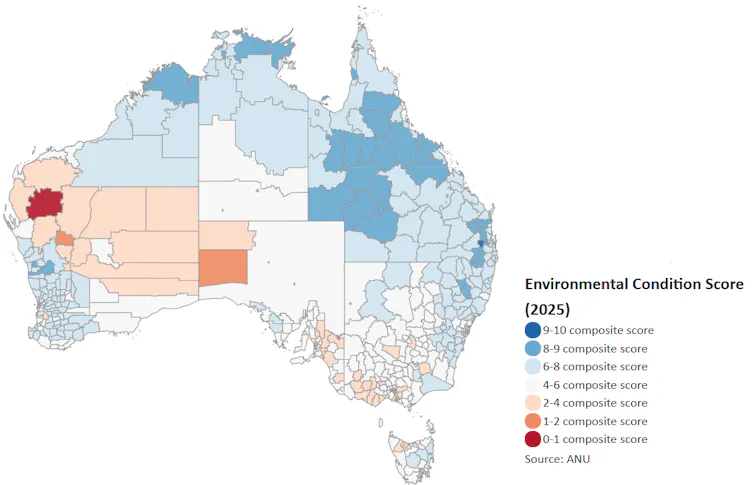
Conditions varied enormously by region this year, so for the first time we have calculated environmental condition scores right down to the suburb and locality level. You can look up your own area at ausenv.tern.org.au.
A good year but uneven on land
The country’s environmental health was split between a wetter, greener north and east, and a dry south and west. Victoria, Tasmania, the Australian Capital Territory and the Northern Territory all recorded notable declines in environmental condition.
But beyond the rainfall, there were real signs of progress. New detailed data on native forest loss and gain — a first in this year’s report — showed forest loss has declined for five consecutive years, with tree cover increasing nationally.
The amount of land cleared for grazing and native forest logging continued to fall. Vegetation canopy area and soil surface protection against erosion was at near record levels. And Australia’s greenhouse gas emissions fell by 1.9%, even as the economy grew 2.6% and the population by 1.5% — a sign growth and environmental damage are slowly being decoupled. Emissions per person have fallen 30% since 2000, though Australians still emit around three times the global average.
These improvements didn’t happen by accident. They reflect real improvements in land management and nature conservation and policy changes on emissions reduction, forest logging and land clearing accumulated over years.
Bushfires under the sea
What our scorecard doesn’t capture is what happened in our oceans in 2025 — and there the story was very different.
The Black Summer fires of 2019–20 were a climate-driven catastrophe. More than a prolonged drought, it was an extreme heat event that turned the forest into a tinderbox and caused fires of unprecedented scale. Marine heatwaves are doing the same thing underwater.
Sea surface temperatures around Australia reached their highest-ever level in 2025, breaking the record set just the year before. Our new analysis of heat stress across 24 monitored reef locations found that nearly 80% exceeded their once-in-a-decade heat threshold — more than in any previous year of the 40-year record. A sixth mass bleaching event struck the Great Barrier Reef in early 2025, following the fifth just months earlier.

The damage extended well beyond the reef. A toxic algal bloom, fuelled by a marine heatwave that pushed water temperatures well above average, spread across nearly a third of South Australia’s coastline and persisted for most of the year, killing more than 80,000 animals of 500 different species and causing respiratory symptoms in coastal residents. Elsewhere, tropical fish appeared far outside their normal ranges.
Marine heatwaves are the underwater equivalent of bushfires: large-scale, climate-driven mass mortality events that used to be rare and are now happening repeatedly. The difference is that most of us don’t see what’s happening below the ocean surface.
The extinction crisis deepens
According to the federal government’s threatened species list, 2,175 species are now listed as threatened – a 54% increase since 2000. Climate change is identified as a threat to nine in ten of the newly listed species. And the legacy of the Black Summer bushfires continues – more than half of all species listed or uplisted since 2019 were affected by those fires.
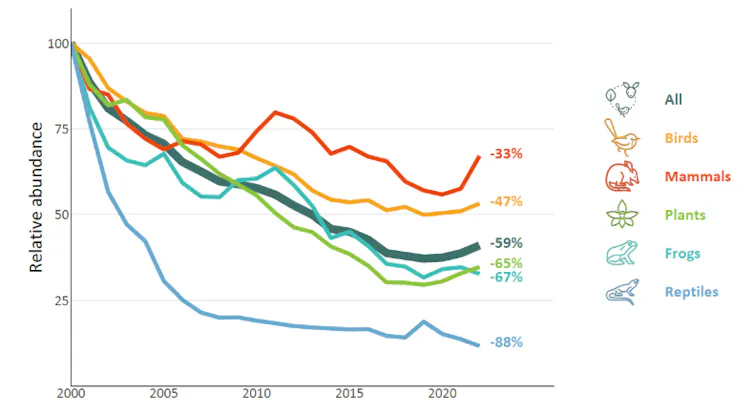
The Threatened Species Index, which tracks population trends of listed species, shows threatened species have declined by an average of 59% since 2000. In 2025 we published Australia’s first Threatened Reptile Index. Based on the monitoring data included in the index, reptile populations have declined by an average of 88% since 2000, and frogs by 67%, the steepest long-term declines of any group we have measured.
Reasons for hope
There are some reasons for hope. The index shows that trends for threatened mammal populations have stabilised in recent years. This may reflect both wetter conditions and the impact of conservation management, such as fenced sanctuaries, predator control and habitat restoration. The data show that sustained conservation effort can make a difference.
In many respects, Australia’s environment is in better shape than it was a decade ago, and progress on emissions and land management is real. But global climate change operates on a different scale entirely. Decades of warming are already locked in, and the damage to our oceans and wildlife will worsen until global warming is brought under control.
Reducing our own emissions matters more than ever. This will also make us more resistant to the kind of energy shocks the world is experiencing right now. We cannot reverse all the damage already done, but we can certainly do much better.
Authors: Albert Van Dijk, Professor, Water and Landscape Dynamics, Fenner School of Environment & Society, Australian National University


 Daily Bulletin


