

Modern rock wallabies seem to survive by sticking together in small areas. Fossils show they need to travel
- Written by: Christopher Laurikainen Gaete, PhD Candidate, Wollongong Isotope Geochronology Laboratory, University of Wollongong
Today, rock wallabies are seen as secretive cliff-dwellers that rarely stray far from the safety of their rocky shelters. But the fossil record tells a very different story.
New research suggests rock wallabies were once travellers, moving across country in search of new habitat. These wandering wallabies, including one that travelled over 60 kilometres, were far more mobile than other kangaroos at the time, even their giant extinct cousin Protemnodon.
These findings reshape our understanding of how rock wallabies interact with their environment and how they may respond to the increasingly fragmented landscapes of modern Australia.
Homebodies by nature?
Modern rock wallabies spend their days sheltering in rocky caves, crevices, and boulder piles, emerging at dusk to feed. They have tiny home ranges, often less than 0.2 square kilometres.
Rock wallabies aren’t fussy eaters, eating leaves and shoots from grasses or shrubs that grow near their rocky refuges. This has led to the assumption that they don’t travel far, sticking together in small groups on isolated habitats. Why travel far when everything you need is right outside your shelter?

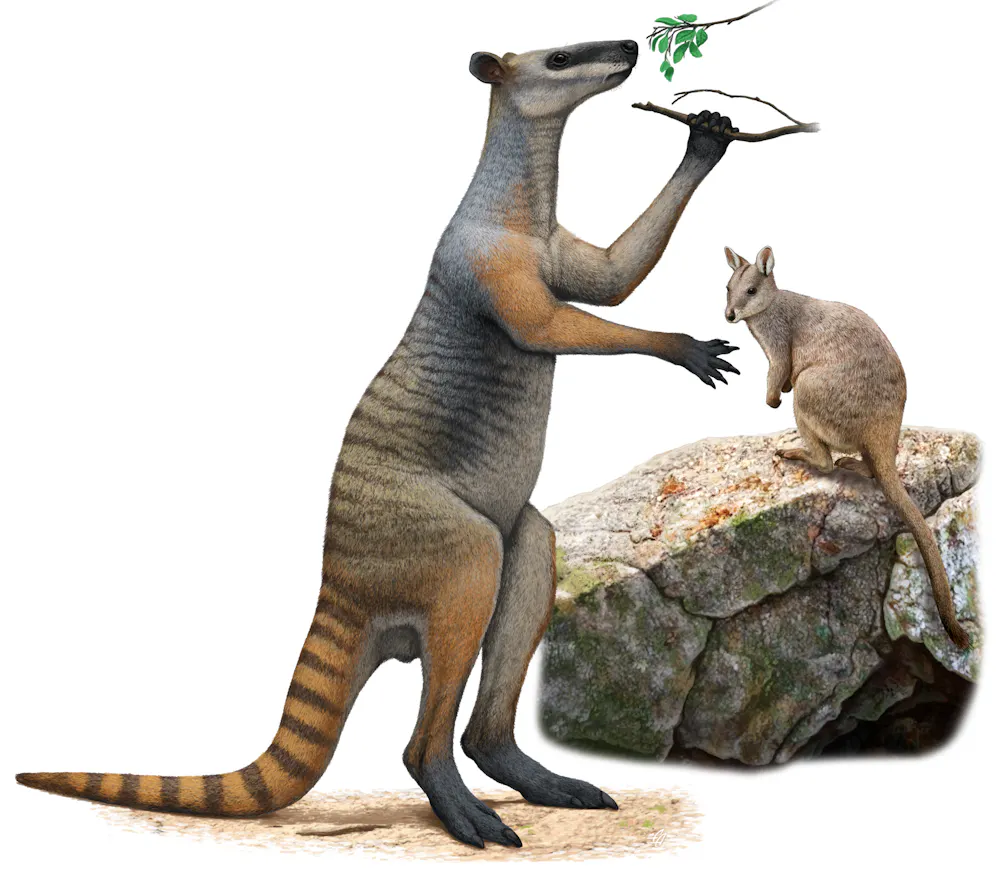
We saw the same pattern in their distant cousin, the giant forest wallaby, Protemnodon, which had small ranges despite their much larger bodies.
Male rock wallabies have been observed occasionally dispersing up to 8km between colonies. While such movements are rare, they may play a crucial role in maintaining gene flow between populations.
Rock wallabies occur in isolated regions across much of mainland Australia, from the Cape York rock wallaby at the northern tip of Australia, to the yellow-footed rock wallaby of the Flinders Ranges, South Australia, and west to the Rothschild’s rock wallaby in the Pilbara, Western Australia.
This broad distribution raises intriguing questions. Were rock wallabies once more mobile than they seem today? And if so, can we see evidence of that movement in the fossil record?
Mount Etna caves
North of Rockhampton, Mount Etna Caves National Park sits right in the heart of rock wallaby country. Rich fossil deposits provide a window into the past 500,000 years, revealing how kangaroos once lived.
From these deposits, we examined fossils from kangaroos of all sizes, ranging from tiny pademelons (Thylogale), through to the megafauna forest wallaby (Protemnodon), as large as an adult human. This let us compare how far different-sized kangaroos travelled. Did small species stay closest to home while the largest roamed?
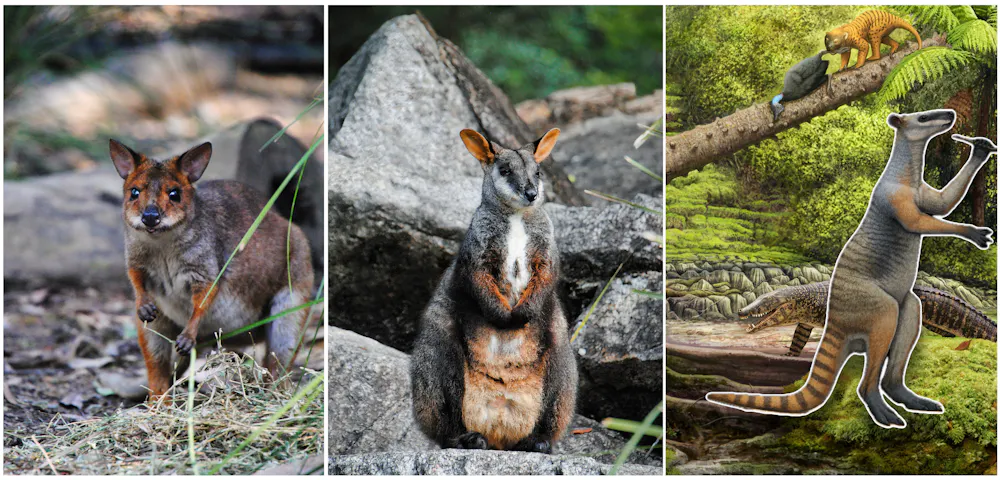 Kangaroo diversity at Mount Etna Caves, including pademelons (left), rock wallabies (middle) and the extinct forest wallaby Protemnodon (right).
Photos: Chris Laurikainen Gaete / Illustration: Queensland Museum & Capricorn Caves / Atuchin / Hocknull / Lawrence
Kangaroo diversity at Mount Etna Caves, including pademelons (left), rock wallabies (middle) and the extinct forest wallaby Protemnodon (right).
Photos: Chris Laurikainen Gaete / Illustration: Queensland Museum & Capricorn Caves / Atuchin / Hocknull / Lawrence
How fossil teeth reveal childhood location
 Fossilised rock wallaby teeth from Mount Etna Caves. Missing enamel in the bottom right tooth shows material taken for analysis.
Chris Laurikainen Gaete
Fossilised rock wallaby teeth from Mount Etna Caves. Missing enamel in the bottom right tooth shows material taken for analysis.
Chris Laurikainen Gaete
To answer these questions, we turned to clues hidden in teeth. When kangaroos eat, unique chemical signatures (strontium isotopes) become locked in their enamel.
Because enamel forms early in life and doesn’t change, the strontium preserved in an animal’s teeth can tell us where it grew up. At Mount Etna Caves, there is no evidence kangaroo remains were brought there by predators to eat. So, we can be confident the patterns we see in their teeth reflect real movements during the animal’s lifetime.
Our results showed that regardless of size, most kangaroos were locals. Rock wallabies showed strong site fidelity, foraging less than 1km from the caves where their fossilised remains were found.
This strong attachment to rocky shelter mirrors modern species observations. Even as the environment changed over hundreds of thousands of years, most rock wallabies maintained small home ranges.
The travellers
While most rock wallabies kept close to the caves, a few individuals found at Mount Etna Caves were born elsewhere. Some originated 8km north near Mount Yaamba, and others around 15km south near Mount Archer.
But our most surprising case was a very adventurous individual that travelled at least 65km, crossing mountains, floodplains, and even the Fitzroy River, which would have been prime crocodile country. This is the first direct evidence of long-range travel in an individual rock wallaby.
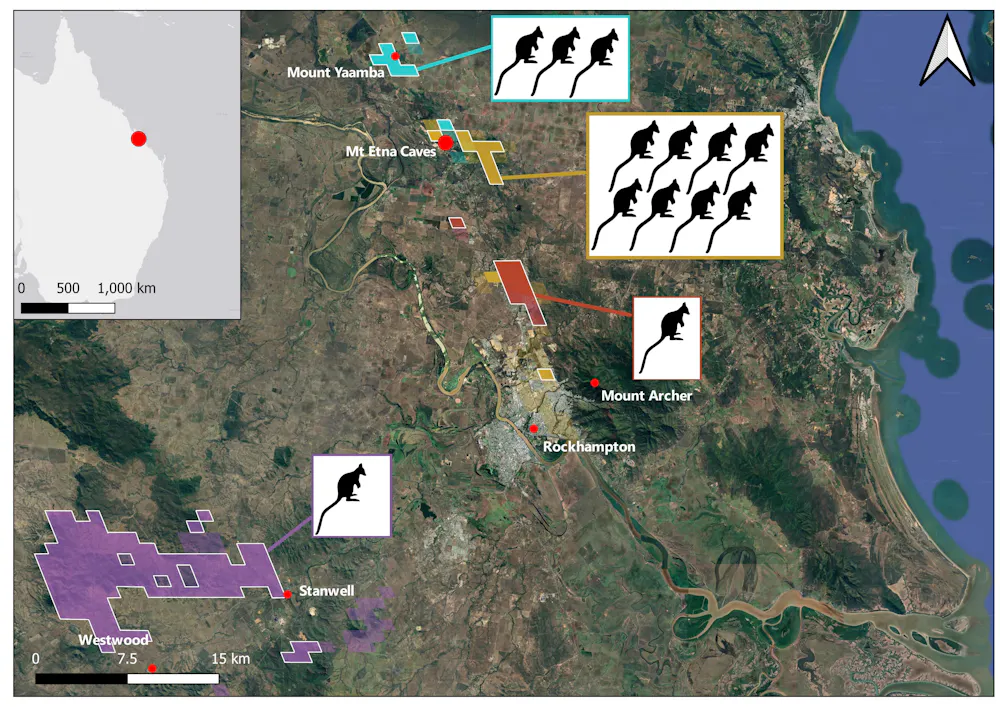 Simplified map showing likely places of origin for fossil rock wallaby individuals. Most lived and died near Mount Etna Caves, with others immigrating longer distances from Mount Yaamba (8km north), Mount Archer (15km south) and somewhere between Stanwell and Westwood (65km southwest of Mount Etna Caves).
Chris Laurikainen Gaete
Simplified map showing likely places of origin for fossil rock wallaby individuals. Most lived and died near Mount Etna Caves, with others immigrating longer distances from Mount Yaamba (8km north), Mount Archer (15km south) and somewhere between Stanwell and Westwood (65km southwest of Mount Etna Caves).
Chris Laurikainen Gaete
While movements over these kinds of distances haven’t been observed in rock wallabies today, genetic evidence from short-eared rock wallabies does show some connection between colonies separated by 67km.
This suggests that, although most rock wallabies stay local, a small number of travellers will leave their birthplace in search of new habitat. These rare long-distance dispersers would play an important role in keeping populations connected across the landscape. Because this kind of dispersal happens beyond the timeframes of human observation, without the fossil record we wouldn’t know this crucial part of rock wallaby natural history.
Modern implications
Importantly, our results also show fossil wallabies were dispersing from areas that are still home to rock wallabies today.
Unadorned rock wallabies still live around Mount Etna and Capricorn Caves, with another colony in the Mount Archer National Park. To the west of the Fitzroy River, Herbert’s rock wallaby occupies rocky outcrops, just outside the town of Westwood.
Isotopic evidence tells us that, in the past, these three groups were not isolated pockets but part of larger interconnected populations.
We don’t know whether rock wallabies are still trying to make these journeys. But with major roads and development now dividing the landscape, humans might inadvertently be creating barriers for these rare but crucial dispersal events.
Fossil and genetic evidence shows rock wallaby populations should not be viewed as isolated colonies, but as parts of a wider network that relies on long-distance dispersal to stay healthy. Recognising this is vital if we want these rock-loving, wandering wallabies to keep thriving in an increasingly urbanised environment.
Authors: Christopher Laurikainen Gaete, PhD Candidate, Wollongong Isotope Geochronology Laboratory, University of Wollongong


 Daily Bulletin


