

The golden age of Japanese cinema: 5 Tatsuya Nakadai films you must see
- Written by: Kristian Ramsden, PhD Candidate in English, Creative Writing and Film, University of Adelaide
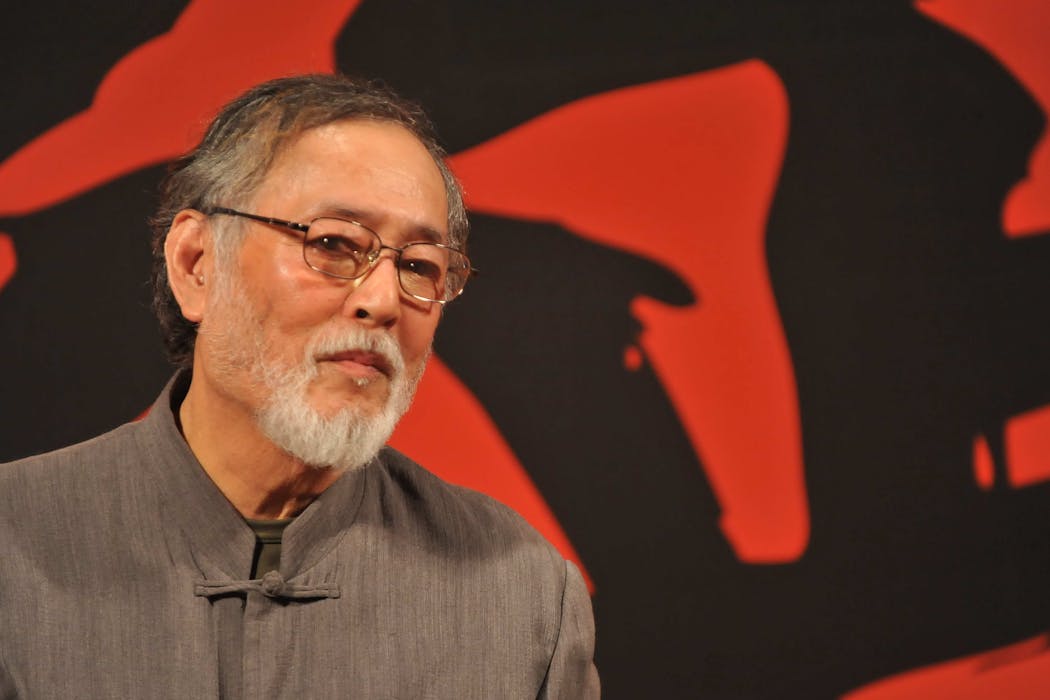
The great Japanese actor Tatsuya Nakadai has died, aged 92. Alongside fellow actor Toshiro Mifune (1920–97), Nakadai was, for many, the face of Japanese cinema across the globe.
Starring in more than 100 films, his filmography features numerous outstanding collaborations with many of the most significant directors of Japanese cinema, such as Akira Kurosawa, Masaki Kobayashi, Kon Ichikawa, Mikio Naruse, Keisuke Kinoshita and Kinuya Tanaka.
With his passing, the world loses one of the supreme titans of world cinema.
In tribute, I have chosen five performances as demonstrations of his remarkable career.
Black River (1957)
Nakadai was discovered working as a shop clerk in Tokyo by the young director Masaki Kobayashi. His first role for the director was a small uncredited bit part in The Thick Walled Room (1956), the debut feature for both. In their subsequent pairing, Black River (1957), Nakadai’s star presence would be established.
A love triangle set on the outskirts of a United States Naval Base, Nakadai plays a young yakuza named “Joe”. The film plays against the actor’s handsome and youthful appeal – while his character’s behaviour is abhorrent, the audience is drawn towards his undeniable charisma.
Dressed up in a Hawaiian shirt and sunglasses, casually smoking a cigarette, the performance oozes a contemporary cool. However, his adoption of “American” garb symbolises a casual indifference to the violence and suffering to those around him.
Kobayashi would be Nakadai’s most frequent collaborator. They would go on to make 11 feature films together, featuring classics such as The Human Condition Trilogy (1959–61), Kwaidan (1964) and Samurai Rebellion (1967).
When a Woman Ascends the Stairs (1960)
After Black River, Nakadai’s star began to rise. In 1960, he appeared in a major role in Mikio Naruse’s When a Woman Ascends the Stairs.
Directing films since the 1930s, Naruse specialised in female-centred melodramas, exploring the shifting roles of women in Japan’s modernising society. Exploring the life of a widowed bar hostess in post-war Ginza, played by Hideko Takamine, Naruse cast Nakadai as her manager.
Nakadai considered this role his most unique. He said,“I’ve played fiercer characters, or more evil” but this character had a “vagueness” and “certain ruthless” about him.
Nakadai strikes a very difficult balance between the paternalistic and the controlling. He spoke of the difficulty of externalising the character’s hidden “hot blooded” temper, deriving from unspoken romantic feelings.
Yojimbo (1961)
After an uncredited appearance in Seven Samurai (1954), the actor appeared in five other films with director Akira Kurosawa.
The first of these films was Yojimbo (1961). Nakadai played the villain, opposite Kurosawa’s regular leading man Toshiro Mifune. At the time, Mifune was the biggest star in Japan. Nakadai was a generation younger, still an up-and-comer.
Nakadai nearly steals the show as Unosuke, the ruthless gangster who brings a gun to a samurai sword fight.
Kurosawa allows his youthful tempestuousness to shine, bringing a sense of fun to his villainous performance. In one particularly striking moment, Nakadai brims with a maniacal smile as an inn burns behind him in the background.
Throughout the rest of the decade, Nakadai and Mifune would play adversaries again in Sanjuro (1962) and Samurai Rebellion (1967). As such, it is a breath of fresh air to see Nakadai play the morally upright police detective who aids Mifune’s character in Kurosawa’s procedural High and Low (1963).
Harakiri (1962)
Harakiri (1962) is Nakadai’s most defining role, and the one in which he truly asserts his status as a leading man. Critic Wal Khairy said the performance “rivals even the best work by Toshiro Mifune”.
As the wandering samurai, Nakadai enters the manor of a feudal lord requesting to die by seppuku. The physicality of Nakadai’s performance is remarkable as the actor oscillates between an intensely controlled stillness and sudden outbursts movements.
The film received the Special Jury Prize at Cannes and Nakadai won the Best Actor Prize from the Association of Tokyo Film Critics. Its reputation has only increased over time, especially amongst younger audiences on Letterboxd where it is the highest rated film on the app.
Ran (1984)
Kurosawa’s last true master work, Ran (1984) is an adaptation of Shakespeare’s King Lear, transposed to medieval Japan. Originally, Kurosawa had planned for Mifune to portray Hidetora, the Lear stand-in.
However, after having played the central role in the director’s previous film Kagemusha (1980), Nakadai was cast. It is perhaps his most impressive role.
Only 53 at the time, Nakadai is transformed into a much older man with the help of his wild gray mane and expressionistic make-up inspired by the masks of classical Noh theatre. In Noh, masks are used to refine expressions down to their essence, forcing actors to convey emotions through precisely calibrated movements of the body.
Throughout the film, Nakadai’s facial expression remains relatively stable. Despite what might be thought of as restrictions, Nakadai manages to express a range of emotions through the rest of his body. At once, he appears a frail old man, hunched over and shifting slowly around, and also a commanding figure of fear, bubbling up with contemptuous anger.
Like Lear, Hidetora is a tragic figure with the character’s pride, arrogance, and vanity leading to his downfall.
The film is highly regarded as one of the great war epics featuring some of the most towering battle sequences ever shot on celluloid. However, underneath all the carnage and chaos, the film is held together by Nakadai’s towering performance as a tiny, little man of history.
Authors: Kristian Ramsden, PhD Candidate in English, Creative Writing and Film, University of Adelaide


 Daily Bulletin


