

The ABC gives true crime the comedy panel show treatment – with expectedly mixed results
- Written by: Xanthe Mallett, Criminologist, CQUniversity Australia
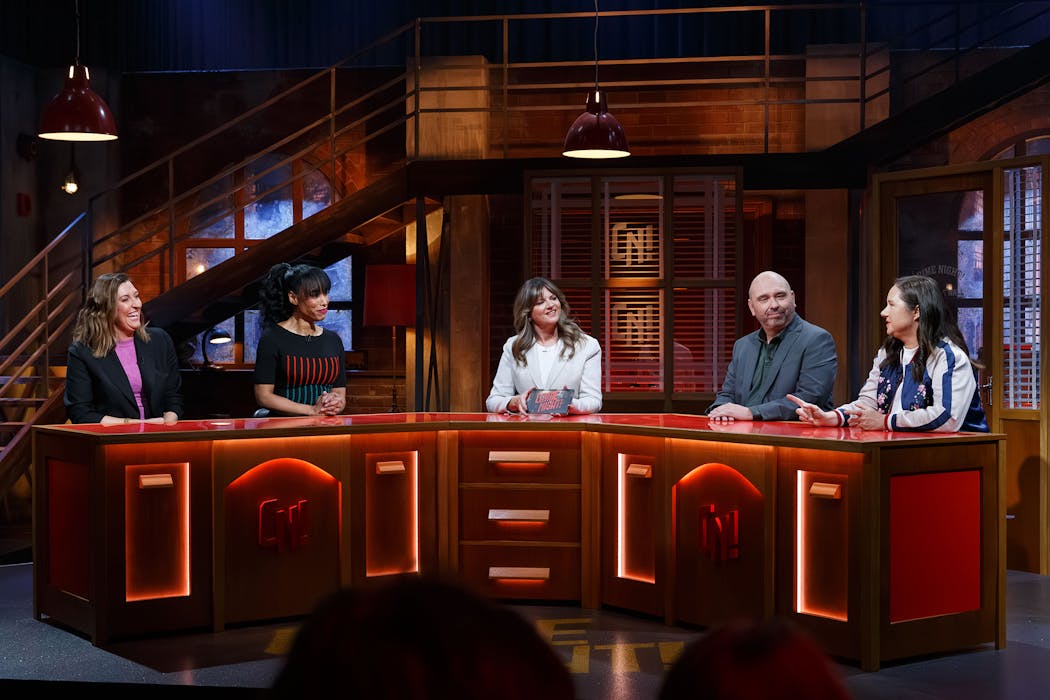
ABC’s new offering is a new take on true crime, where comedian host Julia Zemiro is joined by criminologists Professor Danielle Reynald and Dr David Bartlett and a changing lineup of comedians to unpick key crime issues.
I was intrigued when I saw the trailer for Crime Night, wondering how successful the marriage of crime and comedy could be. Would it work?
I have watched the first two episodes, and as a basic educational tool, this show may be of some interest. But is it educational or entertainment? It doesn’t feel like the creators have made up their mind and so the whole show hasn’t quite come together, at least not yet.
Dissecting eyewitness testimony
The format is this: the host leads the panel through a series of questions, starting with the criminologists who add some facts around the topic of the week. Then clips from true crime shows, or inserts sharing statistics or fun facts. The comedians are asked questions, or chip in to add a lighter moment. The panel discussion is supplemented by “experiments” both inside and outside of the studio, with the comedians or with the audience, hoping to add more light on the topic at hand.
The topic of the first episode is eyewitness testimony.
This is a good first pick: is it incredibly important in criminal investigations, and eyewitnesses get identifications wrong all the time. In Australia, 6% of wrongful convictions involve eyewitness error.
The show touches on some of the reasons this happens. An infamous case from the United States is outlined as an example, where Richard Phillips was misidentified by two witnesses, and subsequently spent almost 46 years in prison for murder.
A key element of this case was “own race bias” – people’s increased cognitive ability to accurately recognise and remember faces of the same geographic ancestry as ourselves. In the case example they used, Phillips was black and the two eyewitnesses were white.
The criminologists do a good job of explaining the case and outline the key elements in an accessible and engaging way.
After the discussion of the Phillips case, the comedians attempt to interject and add some humour to the discussion. Commenting on how the witnesses had not seen the offender clearly, Celia Pacquola quipped “they should have gone to Specsavers”.
While I understand the comedians are there to be funny, it felt flat and pushed. It felt like the comedians were really trying hard to be funny on a topic that naturally elicits few laughs.
Crafting an experiment
As a psychological experiment, when comedians Pacquola and Mel Buttle arrived at the ABC to record the episode, they were covertly filmed in the foyer witnessing an angry woman on the phone.
As part of the show, they had to recreate the face of the woman who was involved in the call from memory.
Surprisingly, the outcomes were remarkably accurate.
There is a huge amount of variation in how accurate people are when attempting to recollect a stranger’s face. Time since observation is key: the sooner a witness is asked to create a composite, the more accurate it is likely to be.
This is complicated by the fact that some people are good at remembering faces and some people are terrible. Where someone is sitting on that scale will heavily affect how well they recognise and remember a stranger committing a crime.
And as an experiment, although a very basic one, it was interesting and added to the production.
Looking at scams
The second episode, focused on scams, is smoother. The two criminologists are the same and the two new comedians, Steph Tisdell and Rhys Nicholson, are more comfortable. The style is less formulated and more discursive; the laughs more natural.
This week’s experiment is conducted on the unwitting audience. On arriving at the studio, the audience were asked to scan a QR code to get a free gift after the show. The purpose was to test the audiences’ trust in the ABC, and to manipulate that trust to encourage them to reveal personal details: 62% of the audience scanned the code, and in this context were “scammed”.
At the end of the show, they use another game to illustrate how easy it is to create deep-faked audio clips that are indistinguishable from the real person. Scary – but a good warning to everyone watching to be very vigilant.
With a focus on scams, the producers appear to be sticking with gentler crimes. It would be very, very hard to make murder, sexual abuse, or domestic and family violence funny. However, I wonder how many types of crime they can cover in this softer space, where the mix of crime and comedy won’t become offensive.
At the end of episode one, I was left wondering what the point was. But at the end of episode two, I thought this show could be used to educate people about current issues that will affect them.
In a world of media where everyone is searching for the new formula, this show might grow into something that could actually do some good.
I’m at least going to give episode three a go. If you are interested in contemporary issues in criminal justice, you might find something of value here.
Crime Night premieres tonight on ABC and ABC iView.
Authors: Xanthe Mallett, Criminologist, CQUniversity Australia


 Daily Bulletin


