

Ancient ‘salt mountains’ in southern Australia once created refuges for early life
- Written by: Rachelle Kernen, Research Fellow, Geology, University of Adelaide
Salt is an essential nutrient for the human body. But hundreds of millions of years before the first humans, salt minerals once shaped entire landscapes. They even determined where early life on Earth could thrive.
Deep in Earth’s past, over millions of years, ancient seas evaporated, leaving behind thick layers of salt. These were eventually buried and turned into rock. These enormous layers of buried rock salt move slowly over time, deforming other layers of rock around them and creating “salt mountains” at Earth’s surface.
Our new research, published in the Geological Society of America Bulletin, investigates one of these ancient salt mountains – called salt diapirs – which formed beneath a shallow sea in the Precambrian period, about 640 million years ago.
Our study reveals this diapir in southern Australia was actively rising while reef ecosystems were developing in the waters above it. The Precambrian was a critical period for increasing complexity of life on Earth, and our research suggests these salt mountains played an important role.
A geological lava lamp
Salt diapirs are like slow-motion geological lava lamps. In a lava lamp, the warm, soft blobs at the bottom slowly rise through the liquid, bending and stretching as they move.

Underground, rock salt behaves a bit like those blobs – it moves upward over millions of years, forming complex shapes. Thick layers of buried rock salt rise because they’re less dense and more flexible than the overlying rocks.
When the salt rises upward, it forms a structure geologists call a diapir. It’s a kind of dome of salt surrounded by distorted rock layers. These structures can be many kilometres tall and wide.
In present day environments, salt diapirs are found both on land and beneath the ocean floor. They often host vibrant communities of living things – from unique soils to deep-sea organisms that survive without sunlight.
Signs of early life
Geologists studying ancient environments have found preserved evidence of salt diapir structures in the rock record. These are well known from the spectacular Flinders Ranges in South Australia, which formed at a time of major changes in climate and life on Earth during the Neoproterozoic era 1 billion to 541 million years ago.
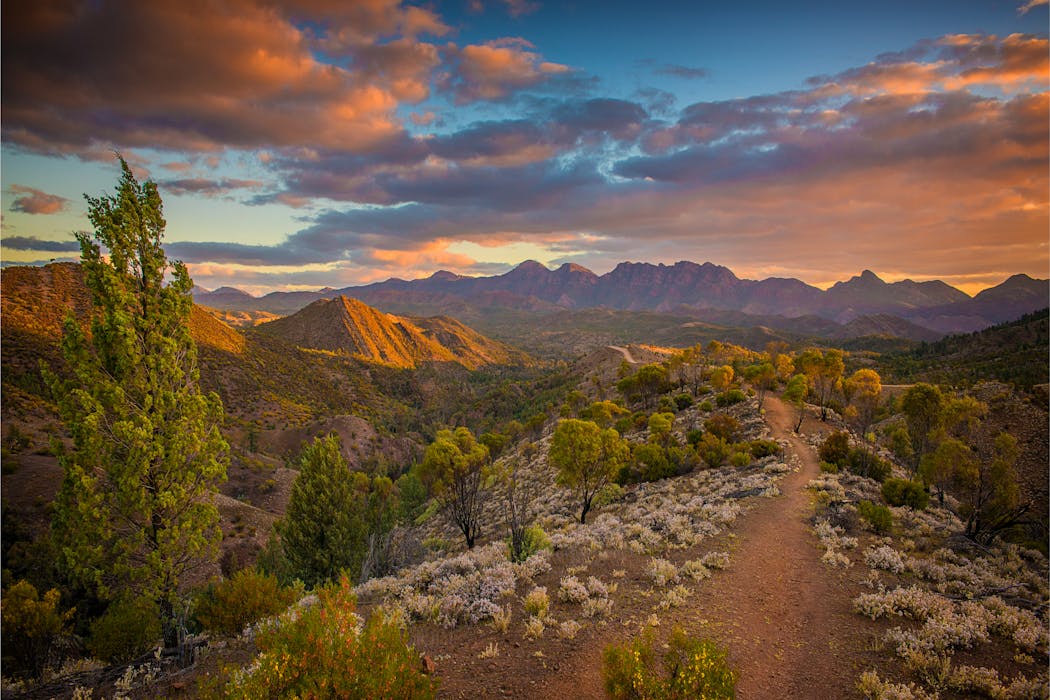
Our location for this study was the Enorama diapir, in the Ikara-Flinders Ranges National Park, Adnyamathanha Yarta Country.

We found evidence that the formation of this underwater salt mountain provided the right conditions for early life to thrive in the environments right above it. We propose that diapir movement formed the right topography for these ecosystems to develop.
In Earth’s history – especially before complex animals evolved – life often faced long stretches of global hardship: ice ages, extreme heat and major changes in ocean chemistry.
During these times, specialised environments like those around salt diapirs may have acted as refuges, providing shelter when the wider world was inhospitable. When conditions improved, the survivors from these refuges could spread out again, helping repopulate the oceans.
In this way, salt diapirs may have quietly played a role in life’s persistence through mass extinctions and other crises.
 This diagram shows how a Precambrian stromatolite reef grew on the shallow seafloor above a salt diapir. The salt pushed upward, creating a habitat where microbial mats could thrive and build rocky mounds.
Rachelle Kernen
This diagram shows how a Precambrian stromatolite reef grew on the shallow seafloor above a salt diapir. The salt pushed upward, creating a habitat where microbial mats could thrive and build rocky mounds.
Rachelle Kernen
Reefs, but not like the ones we know today
In the Precambrian, the sea hosted carbonate reefs, ecosystems that were much less complex than coral reefs are today.
These reefs were formed from stromatolites, colonies of cyanobacteria microorganisms, which precipitated carbonate minerals in-between grains of sand and mud, slowly building rock layers.
Stromatolites have been on Earth for more than 3 billion years, making them one of the planet’s oldest life forms. Over geologic time, carbonate reefs have evolved from simple stromatolites to increasingly complex ecosystems and their connected environments.
While we studied just one salt diapir, there is widespread evidence for salt diapirs in the Precambrian globally. Our research concludes salt diapirs may have played a critical role in the development of stromatolite reefs during this time.
 A: Drone view of the landscape, shaped by ancient processes. B: Up close with a camera, outcrops reveal layers and patterns that hint at changing environments. C: Under the microscope, hidden textures show the building blocks of our planet.
Rachelle Kernen
A: Drone view of the landscape, shaped by ancient processes. B: Up close with a camera, outcrops reveal layers and patterns that hint at changing environments. C: Under the microscope, hidden textures show the building blocks of our planet.
Rachelle Kernen
Diapirs are still relevant today
Understanding how salt diapirs grew and shaped ecosystems in the past helps scientists make sense of rock properties deep beneath the surface today. These are directly relevant for modern water, mineral and energy resources.
Buried salt diapirs influence how fluids move through rocks, affecting the flow of water and other materials such as petroleum, copper, carbon dioxide and hydrogen.
Geologists studying ancient salt-related environments are helping design hydrogen storage projects. An alternative to natural gas for energy, hydrogen can be injected deep underground during times of abundant hydrogen production. Then, it can be retrieved when needed.
Lessons from the past, including how life adapted to salty settings, are contributing directly into strategies for a more sustainable future.
The next time you see a grain of table salt, imagine it buried deep beneath the seabed as part of a thick salt layer, slowly rising. As it rises, it reshapes the sea floor and creates environments that support the development of an ecosystem.
Beneath the ocean waves, sunlight filters over stromatolite reefs, tiny creatures shelter in their crevices, and life thrives.
Authors: Rachelle Kernen, Research Fellow, Geology, University of Adelaide


 Daily Bulletin


