

Read The Times Australia

Daily Bulletin

‘We just have to be defiant’: irrepressible environmentalist Bob Brown reflects on a life of activism

  • Written by: Kate Crowley, Adjunct Associate Professor, Public and Environmental Policy, University of Tasmania
‘We just have to be defiant’: irrepressible environmentalist Bob Brown reflects on a life of activism

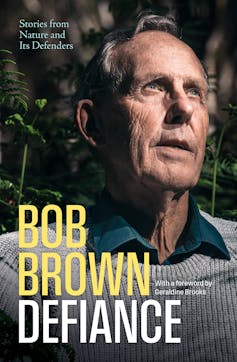
Hobart’s Theatre Royal was packed to the rafters on a chilly October evening when the irrepressible nature warrior Bob Brown launched his latest book Defiance.

Given the state of the planet “we just have to be defiant”, Brown told the audience, as the image of activist Lisa Searle was projected onto the screen behind him.

Searle sat atop one of the world’s tallest flowering plants, a eucalyptus tree named Sentinel by its defenders, in Tasmania’s Styx Valley, perched there to prevent its destruction.

Review: Defiance: Stories from Nature and Its Defenders – Bob Brown (Black Inc.)

Writing is itself an act of defiance for Brown. Defiance is the latest and last in a long line of books. A collection of “musings about the human-induced plight of the planet”, it contains stories, calls to action, and odes to “our brilliant little planet”. It is written with thanks to “everyone who has ever lifted a finger to ward off its destruction”.

Some of these writings have appeared previously. Some are historical recollections. Many paint pictures of unique Australian environments and places, both protected and despoiled. But all of them decry “the escalating global overconsumption of Earth’s living resources”.

Communal action

Defiance calls for open resistance, taking the plunderers head on by “defying the laws that serve those who are exploiting the planet and its people”. But environmental activism is not just an act of defiance for Brown. It is also an antidote to depression.

He suffered from the “black dog” in the decade before he moved to Tasmania, where he fell in with local activists and, motivated by their ardour, soon found himself director of the nascent Tasmanian Wilderness Society. As history attests, Brown then plunged headlong into the ultimately successful campaign in the early 1980s to save southern Australia’s last great wild river, the Franklin.

Brown’s defiance began in the 1970s. As a young medical doctor visiting the United States, he protested in Chicago in support of students in Greece, who were opposing a military coup d’etat there. Two years later, he was camped out alone and fasting for a week atop kunanyi/Mount Wellington in Hobart in protest at the visit of the nuclear-armed aircraft carrier USS Enterprise. It takes courage to be an environmentalist of Brown’s ilk. Over his activist years, which continue even today, he has been attacked physically and verbally, dragged from under bulldozers, arrested, jailed and shot at. But he has an uncanny way of shaking this off and seeing the upside. When Brown found himself in Tasmania’s Risdon Prison for participating in the blockade against the flooding of the Franklin River, he played ping pong and volleyball and “enjoyed the features of jail which match the wilderness – no phones, no traffic, no slick advertising, and the early-to-bed, early-to-rise routine”. Only defiant communal action, Brown argues, can keep the destruction of nature in check. If, as he writes, “materialism’s dream is of a virtual reality to replace the wild Earth”, we cannot stand by and do nothing. In Defiance, he evokes the great tradition of non-violent action, where “ordinary people take affairs into our own hands to overcome the power of corporate influence on governments”. Brown intended Defiance to be a direct-action handbook, only to be overwhelmed by the stories of defiance and the good fights that needed telling. And there are many examples of communal action in his book. Defiance is dedicated to Amrita Devi, the original tree-hugging activist, whose bravery has inspired forest defenders around the world. In 1730, Devi and her three daughters, along with 359 fellow Bishnoi people, were beheaded for obstructing the clearing of the Khejarli forest in Rajasthan, northern India. Brown also celebrates “nature’s defenders” in Australia, including luminaries Melva and Olegas Truchanas, who tried to save Tasmania’s Lake Pedder, and Lionel Murphy, the High Court Justice who played a crucial role in saving the Franklin River. He writes of Anmatyerr woman and globally renowned Indigenous artist Emily Kam Kngwarray, who believed the power of her work would protect her Country, and whose legacy includes the magnificent Earth’s Creation. Ordinary stories about local acts of defiance are equally acknowledged.
In Defiance, Bob Brown remains full of optimism. Ethan James/AAP

Dance, love, read a book

There is an element of being up against the impossible in such defiance. Today, the scales have tipped even further against activists, with laws in Australia curtailing civil disobedience.

Following its stories of collective action, Defiance turns to what activists are up against: the brutes in suits, “as rich in dollars as they are poor in spirit”.

Brown has no hesitation in denouncing their unrelenting pursuit of growth, because Earth’s living resources cannot sustain it. He delivers blistering broadsides against capitalism, corporations, plutocrats and “greenophobia”, which he calls “the fear or hatred of environmentalists”.

Brown has been staring down corporate power as an activist, green politician, state leader, Australian senator and environmental advocate for half a century. In Defiance, the conservative media, the egoists, the billionaires who rule the world, and the politicians who are too compromised or too feeble to resist corporate power are called out as complicit.

But Brown also makes it clear that having fun is not incongruent with saving the planet. Indeed, he warns that “angst at the imminence of Earth’s destruction isn’t helpful”. Anxiety shouldn’t trip you up on the path to action, he warns. There is always time on hand to turn things around. You can still “dance, love, be loved”, or read a book by the river.

This is not to treat environmental destruction lightly, but to sustain the human efforts to address it. After decades of activism, Brown remains full of optimism in Defiance.

Defiant people make things happen, author Geraldine Brooks observes in her foreword to the the book. Indeed, the arc of the moral universe only bends towards justice if brave people make it so.

There is no creeping conservatism about the octogenarian Brown; if anything, he is more infectiously defiant than ever. His book concludes with a series of odes to wild places that reveal his close, indeed transpersonal, connection with nature. He wants everyone to share how it feels to see a wedge-tailed eagle rise on thermals, or the sun break through the clouds and light up a patch of forest in a distant valley.

“We need natural beauty,” he writes, because “our minds and bodies are made for wildness”.

Authors: Kate Crowley, Adjunct Associate Professor, Public and Environmental Policy, University of Tasmania

Read more https://theconversation.com/we-just-have-to-be-defiant-irrepressible-environmentalist-bob-brown-reflects-on-a-life-of-activism-265480

Business News

Inside the Icon: The BridgeMuseum Officially Opens at the Sydney Harbour Bridge

A bold new way to experience one of Australia’s most recognisable landmarks has arrived, with BridgeClimb Sydney officially opening the all-new BridgeMuseum.  Located inside the Sydney Harbour Brid...

Daily Bulletin - avatar Daily Bulletin

Is Your Brand Showing Up in AI Search? Most Melbourne Brands Aren't.

The New Front Door Nobody Told You About Something changed. Quietly. Without a press release. The way buyers find businesses in Australia has been rewired. Not replaced, rewired. Google isn't dead...

Daily Bulletin - avatar Daily Bulletin

How Australian Businesses Can Measure SEO ROI

SEO can feel vague when you are staring at a dashboard full of numbers that do not clearly connect to revenue. The key is to measure the right signals in the right order, then tie them back to outcome...

Daily Bulletin - avatar Daily Bulletin

How Commercial Roller Shutters Improve Site Security Without Slowing Operations

Security upgrades can be frustrating when they make everyday work harder. A door that takes too long to open, creates bottlenecks at shift change, or fails at the worst time can turn “better protectio...

Daily Bulletin - avatar Daily Bulletin

Why a Document Destruction Service Still Matters for Modern Businesses

Businesses generate large volumes of information every day, from staff records and contracts to invoices, reports and customer files. While attention often focuses on how documents are stored, the way...

Daily Bulletin - avatar Daily Bulletin

Bicycle Rack Safety and Space-Smart Storage

Bike storage problems usually show up as small annoyances first: tangled handlebars, scratched frames, and bikes that topple when you pull one out. Over time, those issues become safety risks, especia...

Daily Bulletin - avatar Daily Bulletin

How to Tell if a Childcare Centre Is a Good Fit for Your Child

Choosing childcare can feel like you’re making a huge decision with limited information. Tours are short, centres are often on their best behaviour, and your child might act differently in a new space...

Daily Bulletin - avatar Daily Bulletin

Car Import Timeline: What Usually Happens at Each Stage

Importing a car into Australia can feel confusing because multiple agencies and checkpoints are involved, and the timeline is shaped as much by paperwork quality as it is by shipping speed. The most u...

Daily Bulletin - avatar Daily Bulletin

Portable Toilet Hygiene Standards Explained: Clean vs Sanitised vs Disinfected

In portable toilet servicing, the words clean, sanitised, and disinfected often get used as if they mean the same thing. They don’t. And that difference matters because a unit can look tidy and still ...

Daily Bulletin - avatar Daily Bulletin

The Daily Magazine

Gold Migration Lawyers in Liquidation: How the Closure Affects Your ART Appeal

If your appeal was with Gold Migration Lawyers, a recent change to how the Tribunal decides cases ...

The pressure cooker: life in urban Australia in 2026

Australian cities have always been demanding. Long commutes, rising housing costs, busy schedules a...

What Actually Makes a Good Criminal Lawyer in Melbourne

Most people only think about this question once. That is usually too late. Most people charged wi...

Why Working With A Chatswood Tutor Can Improve Academic Performance

Academic expectations continue increasing for students across primary school, high school, and senio...

Is It Worth Getting Solar Panels in Melbourne?

The real question is not whether solar works in Melbourne. It works. The question is what it is co...

How A Diploma Of Project Management Builds Practical Skills For Modern Work Environments

Developing the ability to plan, execute, and deliver outcomes efficiently is a key requirement in to...

How to Choose the Right Football for Every Level

Choosing a football may seem straightforward, but the right option depends on who will be using it a...

What to Ask a Wedding Photographer Before You Book

Booking a wedding photographer can feel deceptively simple: you like the photos, you like the vibe...

Why Stress Relief For Dogs Is Essential For Emotional Balance And Long-Term Wellbeing

Managing emotional health is just as important as physical care when it comes to pets, which is why ...