

New data shows the US dollar still dominates foreign exchange markets – despite Trump’s economic chaos
- Written by: John Hawkins, Head, Canberra School of Government, University of Canberra
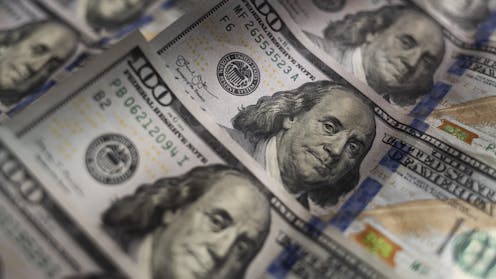
Reports of the death of the US dollar appear to be greatly exaggerated (like that of author Mark Twain).
Global trading in the foreign exchange market has risen to almost US$10 trillion (A$15 trillion) per day. This figure comes from a survey released overnight by the Bank for International Settlements covering transactions in April.
By comparison, global trade in goods and services was around US$33 trillion in 2024. This is about US$0.1 trillion per day.
So, only around 1% of global foreign exchange trading relates to international trade.
Most foreign exchange trading is therefore not importers buying foreign currency to purchase goods from their suppliers, nor exporters converting revenue into their home currency.
The trading is purely financial transactions: insuring against adverse currency movements or speculating (or put less kindly, gambling).
April was a crazy month
The average daily foreign exchange turnover of US$9.6 trillion in April was fuelled by the fallout from President Donald Trump’s “liberation day” tariffs. That made it a very volatile month for exchange rates. This may have led to an unusual amount of hedging and speculating in currency markets, with turnover 28% higher than in April 2022.
The survey showed the US dollar remains the dominant currency. It is on one side of 89% of currency transactions.
Well behind are the euro, involved in 29% of trades; the yen, involved in 17%; and the British pound involved in 10% of foreign exchange transactions.
Trading in the Chinese renminbi is growing fast and now accounts for 8.5% of transactions.
Little Aussie battler
Surprisingly for a small economy, the Australian dollar is the seventh most traded currency in the world, just behind the Swiss franc. This may be due to speculators viewing it as a “commodity currency”, or a proxy for less accessible Asian currencies. It is one side of 6% of trades.
It is much more heavily traded than the currencies of much larger economies such as India, Russia, Indonesia, Brazil and South Korea. As the Reserve Bank Deputy Governor Andrew Hauser recently put it, the Australian dollar “has long punched above its weight in global markets”.
The Bank for International Settlements also compiles information about where the transactions occurred. This shows three-quarters of currency trading is concentrated in just four places: London, New York, Singapore and Hong Kong.
Will US dollar dominance be challenged?
Notwithstanding much discussion about challenges to the US dollar’s position, the trading data show little change. The US dollar was involved in 90% of foreign exchange transactions in the first survey in 1989 and 89% in 2025.
However, where the decline is evident is in the holdings of currency reserves by central banks. US dollar assets now make up 58% of reserves, according to the International Monetary Fund. This has dropped from 65% in 2016.
The US dollar and euro are each used for invoicing about 40% of global trade, according to a European Central Bank study. While use of the renminbi has grown, it is still only used for around 2%.
This special status of the US dollar has been termed an “exorbitant privilege”, originally by the then-French finance minister (and later president), Valéry Giscard d’Estaing. It allows the US to borrow at lower interest rates.
The status of the US dollar has been increasingly resented by the emerging economies known as the BRICS nations. Originally Brazil, Russia, India, China and South Africa (most of the largest economies outside the G7), the BRICS have now been joined by some other non-Western countries. They have expressed a desire to trade more using their own currencies.
Read more: Brics+ countries are determined to trade in their own currencies – but can it work?
But history tells us that dominant currencies change only slowly. The British pound still maintained a strong role in the 1950s despite the UK’s share of the global economy having been overtaken by Germany and the United States early in the 20th century.
This is partly a “network effect”. In the same way that Uber, Facebook and Spotify have dominated their respective markets, once a currency is dominant the rest of the world finds it more convenient to use it.
Because markets involving the US dollar are much deeper and more liquid, an Australian exporter selling to Thailand is likely to sell their Thai baht for US dollars and then convert them into Australian dollars rather than try to directly go from baht to Australian dollars.
Is all this currency trading a good or bad thing?
Views differ about whether all this trading is a stabilising or destabilising force. If speculators succeed by buying low and selling high, this trading should be a stabilising force. But at times “momentum trading”, where speculators expect price rises to be followed by further price rises, may amplify fluctuations.
Some have suggested throwing some “sand in the wheels” of global trading with a so-called “Tobin tax”. This idea of a small tax on foreign exchange transactions was first suggested by Nobel Prize-winning Keynesian economist James Tobin. But he later seemed embarrassed when it was picked up by anti-globalisation campaigners.
To avoid just driving transactions elsewhere, it would need to be adopted simultaneously by all the major financial centres. So, especially with Trump, the plutocrats’ friend, in the White House, it is very unlikely to happen.
Authors: John Hawkins, Head, Canberra School of Government, University of Canberra


 Daily Bulletin


