

These little bettongs were wiped out in South Australia a century ago. Now they’re thriving alongside foxes and feral cats
- Written by: Chloe Frick, PhD Candidate in Ecology, University of Adelaide
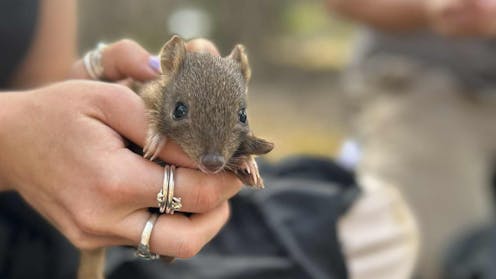
Around 200 years ago, bettongs were the most common macropod in Australia. These small wallaby-like creatures were once found seemingly everywhere and in great numbers.
After colonisation, bettongs became harder to find. The five living species were decimated as land was cleared for farms, and feral cats and foxes spread across the continent. Weighing in at 1-2 kilos, these small rat-kangaroos were easy prey for introduced nocturnal ambush hunters.
Ecologists think of these species as ecosystem engineers, as they can turn over six tonnes of earth a year, spreading seeds and fungi across the landscape. As foxes and cats picked them off, their absence rippled through ecosystems.
To support and protect the species, conservationists have had success in translocating the critically endangered brush-tailed bettong (Bettongia penicillata ogilbyii) to fenced, feral predator-free reserves. But could these creatures – known as woylie to Noongar people and yalgi/yalgiri to Narungga – ever be released back into areas where they once roamed alongside cats and foxes? Our new research suggests it might be possible.

Trial and error
Between 2021 and 2023, we released almost 200 brush-tailed bettongs into Dhilba Guuranda-Innes National Park on South Australia’s Yorke Peninsula. These bettongs had been absent from South Australia for at least 120 years.
Like most national parks, feral cat and fox numbers are suppressed using lethal control. But foxes and cats still persist.
We were hopeful these bettongs stood a good chance in this national park because small tammar wallabies have thrived after their reintroduction and the park has dense native vegetation.
With greater pest control and careful planning, monitoring, and research, we hoped other species could be successfully reintroduced. The brush-tailed bettong was the first of hopefully many species to be reintroduced through the marna banggara project.
Some wild populations of bettongs have proven they can live alongside cats and foxes in Western Australia. But no new population had been established where these feral predators are.
Our goal was to try to establish a new population able to survive alongside low fox and cat numbers. To that end, we wanted to know which traits helped our bettongs survive. Would larger animals do better? Or would smaller, stealthier animals survive and breed? Did we need a mix of both? What about previous experience with predators?
We sourced brush-tailed bettongs from three different locations:
Wedge Island, South Australia. In the early 1980s, 11 bettongs were released on this small island. Their numbers grew to an estimated few thousand. These are known to be smaller, less wary and not used to threats such as cats, foxes, and cars.
Tone-Perup Nature reserve, Western Australia. These animals come from both a remnant wild and a fenced safe haven population. Overall, they’re bigger and faster. Wild population bettongs were familiar with native and introduced predators.
Dryandra Woodland National Park, Western Australia. These animals are similarly drawn from both wild and safe haven populations. They are larger, and both groups had predator exposure.

Into the wild
We didn’t just set our bettongs free and hope for the best. We fitted each animal with small radio tags and monitored them remotely with the help of several towers in the national park. We conducted regular trapping surveys to check how healthy the population was and whether they were reproducing.
By December 2023, the brush-tailed bettong population had doubled to around 400 animals. Members from all source populations were still alive, breeding was occurring and baby bettongs were being born. Since then, surveys have shown the bettongs are thriving overall.
 Many of the reintroduced brush-tailed bettongs made nests and began breeding. Their numbers soon doubled.
Chloe Frick, CC BY-NC-ND
Many of the reintroduced brush-tailed bettongs made nests and began breeding. Their numbers soon doubled.
Chloe Frick, CC BY-NC-ND
Which animals did best? We had expected the Tone-Perup bettongs to survive and thrive based on their size and predator familiarity. Sure enough, they were surviving at higher rates. But to our surprise, the smaller Wedge Island animals were surviving well, despite their lack of familiarity with foxes and cats.
Both Tone-Perup and Wedge bettongs increased their survival likelihood over time. That’s because it’s a case of the quick and the dead. Slower, less wary and less capable individuals got eaten, outcompeted, or died of other causes, while better adapted animals kept going.
These findings are good news. They suggest some brush-tailed bettongs can adapt to life in the wild alongside foxes and cats – if they get past the crucial first few months.
The same can’t be said for our Dryandra population, who had lower survival rates than the other two groups. This was surprising, given Dryandra animals also had greater size and predator exposure.
Why did this happen? It’s most likely because we released these animals later. They may have struggled to find a niche not taken by the bettongs we had released earlier and were either outcompeted or moved further away.
How could these bettongs survive?
It can be hard to watch endangered animals get eaten. But it’s unlikely Australia will ever be rid of feral cats and foxes. This is why bold new techniques are worth trialling, to see if species can be returned to the wild.
Brush-tailed bettongs were last sighted on the Yorke Peninsula over 120 years ago. What changed to make it possible for them to return?
Most likely, it’s due to a combination of predator control and the dense, complex remnant native vegetation offering safer nesting and foraging. Bettongs can move faster through dense shrub than foxes and cats, and it’s harder for predators to spot them in these thickets.
What’s next?
It is still early days, but our research is encouraging. We think the key is active management. Monitor animals intensively in the early months when the animals are most at risk. If too many are being eaten, ramp up feral predator control efforts.
For the first time in over 100 years, yalgiri are digging, spreading seeds and fungi and shaping the soils of the Yorke Peninsula. Their return is good news, not just for the species but for the health of the whole landscape. These small, crafty creatures are finding ways to live alongside feral cats and foxes.
Authors: Chloe Frick, PhD Candidate in Ecology, University of Adelaide


 Daily Bulletin


