

How safe is your face? The pros and cons of having facial recognition everywhere
- Written by: Joanne Orlando, Researcher, Digital Wellbeing, Western Sydney University
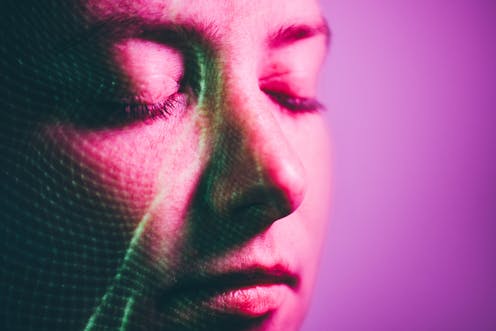
Walk into a shop, board a plane, log into your bank, or scroll through your social media feed, and chances are you might be asked to scan your face. Facial recognition and other kinds of face-based biometric technology are becoming an increasingly common form of identification.
The technology is promoted as quick, convenient and secure – but at the same time it has raised alarm over privacy violations. For instance, major retailers such as Kmart have been found to have broken the law by using the technology without customer consent.
So are we seeing a dangerous technological overreach or the future of security? And what does it mean for families, especially when even children are expected to prove their identity with nothing more than their face?
The two sides of facial recognition
Facial recognition tech is marketed as the height of seamless convenience.
Nowhere is this clearer than in the travel industry, where airlines such as Qantas tout facial recognition as the key to a smoother journey. Forget fumbling for passports and boarding passes – just scan your face and you’re away.
In contrast, when big retailers such as Kmart and Bunnings were found to be scanning customers’ faces without permission, regulators stepped in and the backlash was swift. Here, the same technology is not seen as a convenience but as a serious breach of trust.
Things get even murkier when it comes to children. Due to new government legislation, social media platforms may well introduce face-based age verification technology, framing it as a way to keep kids safe online.
At the same time, schools are trialling facial recognition for everything from classroom entry to paying in the cafeteria.
Yet concerns about data misuse remain. In one incident, Microsoft was accused of mishandling children’s biometric data.
For children, facial recognition is quietly becoming the default, despite very real risks.
A face is forever
Facial recognition technology works by mapping someone’s unique features and comparing them against a database of stored faces. Unlike passive CCTV cameras, it doesn’t just record, it actively identifies and categorises people.
This may feel similar to earlier identity technologies. Think of the check-in QR code systems that quickly sprung up at shops, cafes and airports during the COVID pandemic.
Facial recognition may be on a similar path of rapid adoption. However, there is a crucial difference: where a QR code can be removed or an account deleted, your face cannot.
Why these developments matter
Permanence is a big issue for facial recognition. Once your – or your child’s – facial scan is stored, it can stay in a database forever.
If the database is hacked, that identity is compromised. In a world where banks and tech platforms may increasingly rely on facial recognition for access, the stakes are very high.
What’s more, the technology is not foolproof. Mis-identifying people is a real problem.
Age-estimating systems are also often inaccurate. One 17-year-old might easily be classified as a child, while another passes as an adult. This may restrict their access to information or place them in the wrong digital space.
A lifetime of consequences
These risks aren’t just hypothetical. They already affect lives. Imagine being wrongly placed on a watchlist because of a facial recognition error, leading to delays and interrogations every time you travel.
Or consider how stolen facial data could be used for identity theft, with perpetrators gaining access to accounts and services.
In the future, your face could even influence insurance or loan approvals, with algorithms drawing conclusions about your health or reliability based on photo or video.
Facial recognition does have some clear benefits, such as helping law enforcement identify suspects quickly in crowded spaces and providing convenient access to secure areas.
But for children, the risks of misuse and error stretch across a lifetime.
So, good or bad?
As it stands, facial recognition would seem to carry more risks than rewards. In a world rife with scams and hacks, we can replace a stolen passport or drivers’ licence, but we can’t change our face.
The question we need to answer is where we draw the line between reckless implementation and mandatory use. Are we prepared to accept the consequences of the rapid adoption of this technology?
Security and convenience are important, but they are not the only values at stake. Until robust, enforceable rules around safety, privacy and fairness are firmly established, we should proceed with caution.
So next time you’re asked to scan your face, don’t just accept it blindly. Ask: why is this necessary? And do the benefits truly outweigh the risks – for me, and for everyone else involved?
Authors: Joanne Orlando, Researcher, Digital Wellbeing, Western Sydney University


 Daily Bulletin


