

Goodbye petrostates, hello ‘electrostates’: how the clean energy shift is reshaping the world order
- Written by: Niusha Shafiabady, Associate Professor in Computational Intelligence, Australian Catholic University
For more than a century, global geopolitics has revolved around oil and gas. Countries with big fossil fuel reserves, such as Saudi Arabia and Russia, have amassed significant wealth and foreign influence, helping shape the world order.
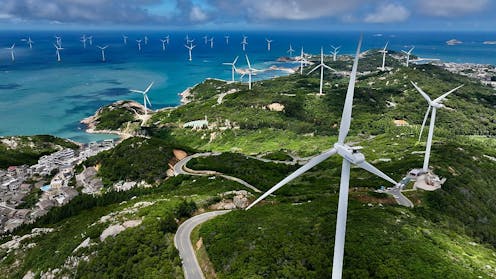
But the global shift toward renewable energy is challenging these power structures. As the world transitions away from oil and gas, renewable energy resources promise to become the new basis for geopolitical influence.
Nations with a bounty of sun and wind, and the capacity to export that energy, have much to gain. So too do nations endowed with critical minerals, and the means to produce the technology required in a low-carbon world.
Say goodbye to the “petrostates” of old, and welcome the rise of the “electrostate”. China is heading the charge – and Australia, if it plays its cards right, could be at its heels.
A shift is underway
Petrostates are nations rich in oil, gas and coal, and which are heavily dependent on revenue from extracting and exporting these commodities.
Australia is a major exporter of gas and coal. But it lacks the core features of a petrostate – centralised state control of production, the ability to order export cuts, and heavy fiscal reliance on oil and gas rents. Instead, publicly owned resources are developed by private firms under regulation, which gives the government regulatory influence rather than coercive “petro-power.”
World economies have traditionally needed fossil fuels to operate. So, petrostates have used their control of these resources to gain leverage in diplomatic talks, influence global energy prices and create alliances with other nations.
For example, the security partnership between Saudi Arabia and the United States is underpinned by the US’ need for Saudi oil. And moves by Russia to cut gas supply to Europe in 2022 was widely seen as a retaliation for sanctions imposed on Russia following its invasion of Ukraine.
But these fortunes are changing. The Middle East, Russia and the United States gained power in the age of oil. Now, in the age of renewables, a new cohort of electrostates is emerging.
What is an electrostate?
The term “electrostate” describes a nation that dominates the energy transition. Instead of oil wells or gas fields, its influence comes from commanding positions in supply chains that underpin electrification. These include:
critical minerals (such as lithium, cobalt, nickel, rare earths)
battery production and recycling
semiconductors and digital infrastructure
clean energy technologies (such as solar, wind and electric vehicles).
China leads the way in clean energy innovation and development.
It processes about 60% of the world’s lithium and cobalt. It also refines more than 90% of rare earth elements used in electric vehicles, wind turbines and “smart” electricity grids.
Chinese firms CATL and BYD produce more than half of the global supply of lithium-ion batteries – and this capacity is expanding rapidly. What’s more, BYD recently overtook Tesla as the world’s largest EV manufacturer, supported by a vast domestic market.
China produces about 80% of the world’s solar panels, and dominates wind turbine supply chains. And through its Belt and Road Initiative, China has secured access to overseas mines, ports and energy projects.
None of this happened by chance. It’s the result of a deliberate, state-backed strategy executed over two decades.
Beijing combined industrial policy, subsidies and long-term investment with a willingness to absorb early losses for strategic gain. The result? China is now the indispensable player in the global energy transition.
This matters for the world
The rise of electrostates reshuffles the global energy map.
Just as the European Union once worried about maintaining supplies of Russian gas, now it worries about over-dependence on Chinese batteries, critical minerals and fuel cells.
The US, EU, Japan, India and others are racing to reduce reliance on China. Initiatives such as the US Inflation Reduction Act, the EU Critical Raw Materials Act and the Quad’s supply chain cooperation are all responses to China’s dominance.
China has already used its control of the renewables supply chain to exert global influence. For example, earlier this year it restricted exports of seven rare earth elements needed to produce technologies such as electric vehicles. The move was considered a retaliation to tariffs imposed by US President Donald Trump.
Australia’s opportunity
Australia, too, has big electrostate potential. The continent holds some of the world’s largest reserves of lithium, nickel and rare earths. We already supply more than half of global lithium.
But much work is needed to seize this opportunity.
First, rather than just exporting raw minerals, Australia must invest in domestic refining, battery manufacturing and recycling. This would keep more jobs and income in Australia and reduce our reliance on overseas suppliers.
Strategic partnerships are crucial. Australia needs to broaden and deepen cooperation with nations in Asia, Europe, the Middle East and Africa. This would enable us to supply different parts of the world and build domestic manufacturing and processing capacity.
Governments and the private sector must also invest in innovation. That means supporting research in next-generation batteries, hydrogen and electricity grids to maintain technological leadership.
Throughout the expansion, companies extracting critical minerals and producing clean energy should meet high environmental and social standards. This will maintain public trust and international credibility.
All this requires smart policy and international collaboration. Decisions taken in Canberra over the next decade will determine whether Australia depends on electrostates – or becomes one.
Authors: Niusha Shafiabady, Associate Professor in Computational Intelligence, Australian Catholic University


 Daily Bulletin


