

Why have athletes stopped ‘taking a knee’?
- Written by: Ciprian N. Radavoi, Associate Professor in Law, University of Southern Queensland
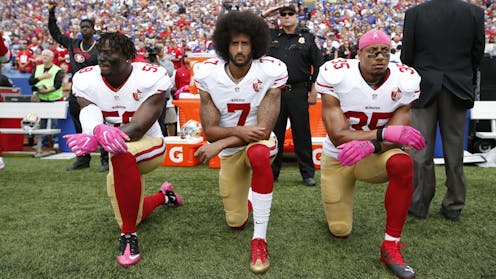
It’s almost a decade since San Francisco 49ers quarterback Colin Kaepernick started a worldwide trend and sparked fierce debate when he knelt during the US national anthem.
In 2016, Kaepernick refused to follow the pre-game protocol related to the national anthem and knelt instead, saying:
I am not going to stand up to show pride in a flag for a country that oppresses black people and people of colour.
Soon, many athletes and teams began “taking a knee” at sports events to express their solidarity with victims of racial injustice.
Now, they appear to have stopped, which prompted us to research the decline.
Initial widespread support
Following the intense public debate over the appropriateness of Kaepernick’s act, the ritual quickly spread worldwide, with athletes in major soccer leagues, cricket, rugby, Formula 1, top-tier tennis and the US’s Major League Baseball and National Basketball Association taking a knee.
Athletes didn’t always kneel during national anthems, with the majority kneeling at certain points pre-game.
Despite the occasional “defection” of a small number of players who would stand while their teammates knelt – such as Israel Folau in rugby league, Wilfried Zaha in soccer and Quinton de Kock in cricket – the ritual was widely embraced by teams and athletes and helped raise awareness of the issue.
Even major sports organisations notorious for prohibiting any type of political activism generally accepted the kneeling ritual. For example, soccer’s International Football Federation (FIFA) showcased kneeling as a “stand against discrimination” and as human rights advocacy.
The International Olympic Committee (IOC) initially stood firm by its Rule 50, which states “no kind of demonstration or political, religious, or racial propaganda is permitted in any Olympic sites, venues or other areas”.
But just three weeks before the 2021 Olympic and Paralympic Games in Tokyo, the IOC relaxed its interpretation, and athletes were permitted to express their views in ways that included taking a knee.
A surprising turn of events
Despite permission and even encouragement from sports governing bodies, our research shows the practice is disappearing from major sports competitions.
Take soccer, for example. At the FIFA World Cup 2022, England and Wales were the only national teams that knelt at their games in Qatar.
At the FIFA Women’s World Cup 2023 in Australia and New Zealand, no teams or players knelt.
The same happened at the 2024 Olympic soccer tournament in Paris.
That only a handful of teams knelt in Tokyo at the 2021 Olympics, two at the FIFA Mens’ World Cup in Qatar in 2022, none at the FIFA Womens’ World Cup in Australia and New Zealand in 2023, and again none at the Paris 2024 Olympics indicates a growing reluctance throughout the sports world.
This surely cannot mean athletes have become indifferent to racial injustice or other forms of oppression in the interval between the late 2010s and the mid-2020s.
The explanation must be sought elsewhere. A hint was provided when Crystal Palace soccer player Zaha, the first player of colour in the UK who refused to kneel, explained:
I feel like taking the knee is degrading, because growing up my parents just let me know that I should be proud to be Black no matter what and I feel like we should just stand tall.
The explanation may therefore be, at least in part, the players’ uncomfortable feelings related to the kneeling posture.
In sociology, this bothersome state of mind is called “cognitive dissonance”: the mental conflict a person experiences in the presence of contrasting beliefs.
A history of kneeling
The body posture of kneeling is not deemed, in any culture, as expressing solidarity.
Ancient Greek and the Roman societies, on whose values Western civilisation was built, rejected kneeling as improper, even when praying to gods.
Then, with the spread of Christianity in the Western world, kneeling became widely used, but only as an act of worship, confessing guilt, or praying for mercy.
When performed outside the church, kneeling meant submission to nobility or royalty.
The significance of kneeling as humility is not limited to the Western world.
In African tribal culture, the young kneel in front of elders, and everyone kneels before the king.
In China in 1949, Chairman Mao famously proclaimed at the first plenary of the Chinese People’s Political Consultative Conference:
From now on our nation […] will no longer be a nation subject to insult and humiliation. We have stood up.
With this in mind, kneeling may be deemed unfit at sporting events, which often feature a powerful cocktail of emotions, values and social expectations.
The inconsistency between the excitement of competition and the expectation to kneel — a gesture associated with submission and humility — likely creates a bothersome state of mind for athletes.
This potentially motivates some players to reject one of the two – in this case, the kneeling – to restore cognitive harmony.
What could replace the kneeling ritual?
After refusing, by unanimous players’ vote, to take a knee before their October 2020 game against the All Blacks, the Australian rugby union team chose instead to wear a First Nations jersey.
The same year, several teams in German soccer’s top league chose to show their support for Black Lives Matter by wearing distinctive armbands.
So it appears wearing a distinctive jersey or at least an armband is more easily accepted by modern-day athletes. This may be challenging given the governing bodies of many sports, such as FIFA, ban athletes from wearing political symbols on their clothing.
Depending on whether sports code accept this type of activism in the future, wearing suportive clothing could replace taking a knee as symbolic communication of solidarity with oppressed minorities.
Authors: Ciprian N. Radavoi, Associate Professor in Law, University of Southern Queensland
Read more https://theconversation.com/why-have-athletes-stopped-taking-a-knee-259047


 Daily Bulletin


