

What is a ‘bunker buster’? An expert explains what the US dropped on Iran
- Written by: James Dwyer, Lecturer, School of Social Sciences, University of Tasmania
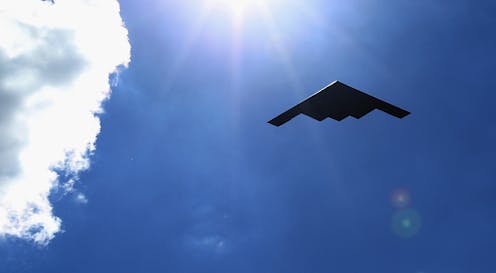
Late on Saturday night, local time, the United States carried out strikes against Iranian nuclear enrichment sites at Fordow, Natanz and Isfahan, marking its open participation in the conflict between Iran and Israel.
The US says it fired 30 submarine-launched missiles at the sites in Natanz and Isfahan, as well as dropping more than a dozen “bunker buster” bombs at Fordow and Natanz.
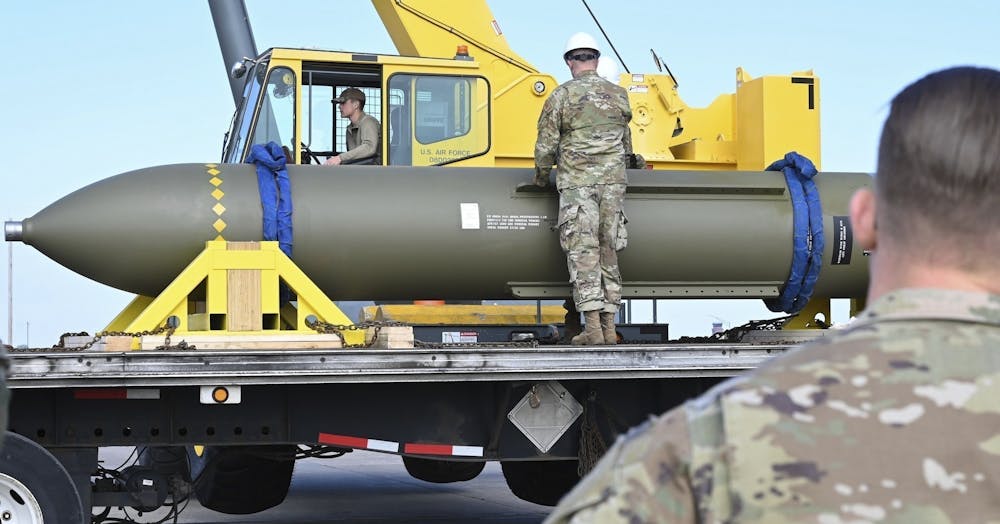
The kind of bomb in question is the extremely destructive GBU-57 Massive Ordnance Penetrator, or MOP, which weighs around 13.5 tonnes.
The attacks raise a lot of questions. What are these enormous bombs? Why did the US feel it had to get involved in the conflict? And, going forward, what does it mean for Iran’s nuclear ambitions?
What are ‘bunker busters’, and why are they used?
Bunker busters are weapons designed to destroy heavily protected facilities such as bunkers deep underground, beyond the reach of normal bombs.
Bunker busters are designed to bury themselves into the ground before detonating. This allows more of the explosive force to penetrate into the ground, rather than travelling through the air or across the surface.
Iran’s nuclear enrichment sites at Fordow, Natanz and Isfahan are built deep underground. Estimates suggest that Fordow for example could be 80m beneath the surface, and capped with layers of reinforced concrete and soil.
What is the MOP?
The bunker buster used in this particular operation is the largest in the US arsenal. Leaving aside nuclear weapons, the MOP is the largest known bunker buster in the world.
Weighing some 13.5 tonnes, the MOP is believed to be able to penetrate up to 60 metres below ground in the right conditions. It is not known how many the US possesses, but the numbers are thought to be small (perhaps 20 or so in total).
We also don’t know exactly how many were used in Iran, though some reports say it was 14. However, it is likely to be a significant portion of the US MOP arsenal.
Why does only the US possess this capability?
The US is not the only state with bunker-busting weaponry. However, the size of MOP means it requires very specialised bombers to carry and drop it.
Only the B2 stealth bomber is currently able to deploy the MOP. Each B2 can carry at most two MOPs at a time. Around seven of America’s 19 operational B2s were used in the Iran operation.

There has been some consideration whether large transport aircraft such as the C-130 Hercules could be modified to carry and drop the MOP from its rear cargo doors. While this would allow other countries (including Israel) to deploy the MOP, it is for now purely hypothetical.
Why has the US (apparently) used them in Iran
The Trump administration claims Iran may be only a few weeks from possessing a nuclear weapon, and that it needed to act now to destroy Iranian nuclear enrichment sites. This claim is notably at odds with published assessments from the US intelligence community.
However, Israel lacks bunker-busting weaponry sufficient to damage the deeply buried and fortified enrichment sites at Fordow, Natanz and Isfahan.
 An F-15E Strike Eagle releases a GBU-28 ‘bunker buster’ laser-guided bomb, a smaller equivalewnt of the 13,600 kg GBU-57 ‘Massive Ordnance Penetrator’ believed to have been used in Iran.
Michael Ammons / US Air Force
An F-15E Strike Eagle releases a GBU-28 ‘bunker buster’ laser-guided bomb, a smaller equivalewnt of the 13,600 kg GBU-57 ‘Massive Ordnance Penetrator’ believed to have been used in Iran.
Michael Ammons / US Air Force
Only the MOP could do the job (short of using nuclear weapons). Even then, multiple MOPs would have been required to ensure sufficient damage to the underground facilities.
The US has claimed that these sites have been utterly destroyed. We cannot conclusively say whether this is true.
Iran may also have other, undeclared nuclear sites elsewhere in the country.
Iran’s reaction
The US has reportedly reached out to Iran via diplomatic channels to emphasise that this attack was a one-off, not part of a larger project of regime change. It is hard to say what will happen in the next few weeks.
Iran may retaliate with large strikes against Israel or against US forces in the region. It could also interrupt shipping in the Strait of Hormuz, which would affect a large portion of global oil shipments, with profound economic implications.
Alternatively, Iran could capitulate and take steps to demonstrate it is ending its nuclear program. However, capitulation would not necessarily mean the end of Iran’s nuclear ambitions.
The value of nuclear weapons
Perhaps a greater concern is that the attack will reinforce Iran’s desire to go nuclear. Without nuclear weapons, Iran was unable to threaten the US enough to deter today’s attack.
Iran may take lessons from the fate of other states. Ukraine (in)famously surrendered its stockpile of former Soviet nuclear weapons in the early 1990s. Russia has since felt emboldened to annex Crimea in 2014 and launch an ongoing invasion in 2022. Other potential nuclear states, such as Iraq and Gadaffi’s regime in Libya, also suffered from military intervention.
 A 2019 photo released by the Atomic Energy Organization of Iran shows centrifuge machines at the Natanz uranium enrichment facility.
Atomic Energy Organization of Iran via AP
A 2019 photo released by the Atomic Energy Organization of Iran shows centrifuge machines at the Natanz uranium enrichment facility.
Atomic Energy Organization of Iran via AP
By contrast, North Korea successfully tested its first nuclear weapon in 2006. Since then there has been no serious consideration of military intervention in North Korea.
Iran may yet have the ability to produce useful amounts of weapons-grade uranium. It may now aim to buy itself time to assemble a relatively small nuclear device, similar in scale to the bombs used in Hiroshima and Nagasaki.
Depending on what facilities and resources have survived the US strikes, the attack has likely reinforced that the only way the Iranian regime can guarantee its survival is to possess nuclear weapons.
Authors: James Dwyer, Lecturer, School of Social Sciences, University of Tasmania


 Daily Bulletin


